

Medically Reviewed by Dr. Shradha Chakhaiyar, MBBS, DGO, MRCOG (London) | IVF & Fertility Specialist, Shradha IVF & Maternity, Patna
Quick answer
The most common ovulation mistake is having sex only on the day of ovulation. Sperm survive three to five days; the egg survives just 12 to 24 hours. That means the days before ovulation matter more than the day itself. The other frequent errors are ignoring cervical mucus, using ordinary lubricants that damage sperm, testing with first-morning urine, timing from a Day 14 rule that does not fit your cycle, and waiting too long before investigating an underlying cause.
Most couples who come to us worried about infertility are not facing a medical problem. They are mistiming.
Ovulation is not a single day. It is a fertile window of about six days, and small errors inside that window can cost you a cycle. The good news is that every mistake on this list is fixable, and several are fixable this month.
Mistake 1: Timing Sex Only on Ovulation Day
This is the single most common error, and it comes from an understandable assumption — that the day the egg is released must be the day that matters most.
It is the opposite. Consider the biology:
- Sperm survive three to five days in fertile cervical mucus
- The egg survives only 12 to 24 hours after release
So sperm already waiting when the egg arrives have a far better chance than sperm arriving afterwards. By the time you are certain ovulation has happened, the window is closing.
The fix
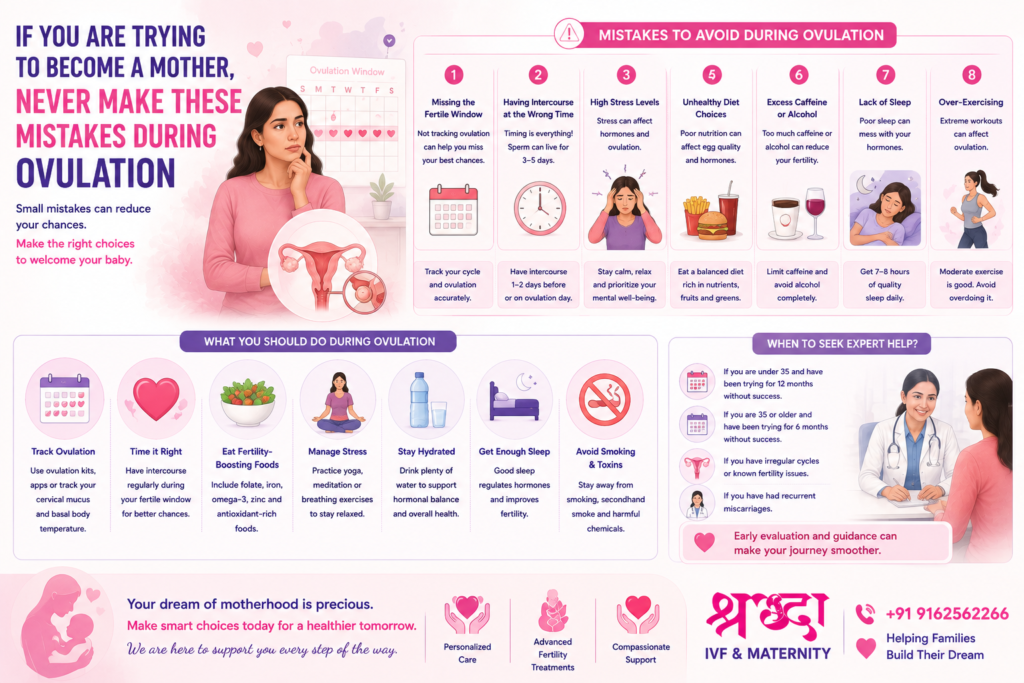
Have intercourse every two to three days across your fertile window, which runs from about five days before ovulation to the day of ovulation itself. On a 28-day cycle, that is roughly Days 9 to 14.
Do not try to hit one perfect day. Regular intercourse across the window performs as well as daily attempts and causes far less stress.
Mistake 2: Using the Day 14 Rule When Your Cycle Isn’t 28 Days
Almost every article repeats that ovulation happens on Day 14. That is only true for a 28-day cycle.
Here is the detail that makes prediction possible: the luteal phase — from ovulation to your next period — is fairly fixed at around 14 days for most women, whatever the total cycle length. What varies is the first half.
So count backwards, not forwards. Subtract 14 from your usual cycle length.
| Your cycle length | Likely ovulation day | Fertile window |
|---|---|---|
| 24 days | Day 10 | Days 5–10 |
| 26 days | Day 12 | Days 7–12 |
| 28 days | Day 14 | Days 9–14 |
| 30 days | Day 16 | Days 11–16 |
| 32 days | Day 18 | Days 13–18 |
| 35 days | Day 21 | Days 16–21 |
A woman with a 24-day cycle has finished her fertile window before a woman with a 35-day cycle has begun hers. Following generic Day 14 advice would cause both to miss it. Our guide on the best time in your cycle to conceive covers this in full.
Mistake 3: Ignoring Cervical Mucus
Your body signals the fertile window before any test can. In the days leading up to ovulation, rising oestrogen changes cervical mucus — it becomes clear, slippery and stretchy, much like raw egg white.
That change means the window is open. It often appears earlier than a positive ovulation kit, which makes it a useful cue for when to start testing.
The fix
Check daily and note what you see. Dry or sticky means low fertility. Creamy means approaching. Clear and stretchy means you are in your most fertile days — act now. Our guide to fertile ovulation discharge explains what to look for at each stage.
Mistake 4: Using the Wrong Lubricant
This one surprises most couples, and it is rarely mentioned in Indian fertility advice.
Most conventional lubricants — including many of the best-known brands — impair sperm. Their pH and osmolality damage sperm motility, and some contain glycerin or parabens that reduce sperm survival. A lubricant used to make conception easier can quietly make it harder.
The fix
- If cervical mucus is adequate, no lubricant is needed at all
- If you do need one, use a fertility-friendly lubricant specifically formulated to be sperm-safe — these are pH-balanced and isotonic
- Avoid saliva, which also impairs sperm motility
Mistake 5: Testing With First-Morning Urine
Ovulation kits look like pregnancy tests, so most people assume the same rules apply. They do not.
For a pregnancy test, first-morning urine is best because hCG is most concentrated. For an ovulation kit, first-morning urine is the worst choice. The LH surge enters the bloodstream in the early hours and takes several hours to reach detectable levels in urine — so a first-morning sample can show negative when the surge has genuinely started.
The fix
Test between 10 am and 8 pm, at roughly the same time each day, and limit fluids for a few hours beforehand. And remember that on an ovulation kit, a faint second line is a negative — the test line must be as dark as or darker than the control line. Our full guide covers how to use an ovulation kit and read the result.
Mistake 6: Letting Stress and Over-Exercise Disrupt Your Cycle
Sustained stress raises cortisol levels, which interfere with the hormonal signals that trigger ovulation. It can delay ovulation, shorten the luteal phase, or occasionally suppress ovulation altogether.
Intense exercise has a similar effect at the end. Moderate activity supports fertility; very heavy training combined with low body fat can disrupt cycles.
The fix
- Moderate movement — walking, yoga, swimming — rather than high-intensity training every day
- Breathing practice, meditation or pranayama, which measurably lower cortisol
- Adequate sleep, which is when most reproductive hormone regulation happens
One honest caveat: “just relax, and it will happen” is unhelpful and often untrue. Stress management supports fertility. It does not treat a blocked tube, a low sperm count, or PCOS.
Mistake 7: Waiting Too Long to Look for an Underlying Cause
Perfect timing cannot overcome a physical barrier. If several correctly timed cycles pass without result, the question is no longer when — it is why.
Conditions frequently found at this stage:
- PCOS — irregular or absent ovulation
- Thyroid disorders — disrupt the ovulation signal
- Blocked fallopian tubes — often symptomless
- Low ovarian reserve — assessed by AMH and antral follicle count
- Endometriosis or adenomyosis
- Male factor — involved in roughly 40% of cases. Semen analysis is the simplest test in fertility and the most commonly delayed.
When to get tested?
| Your situation | When to seek assessment |
|---|---|
| Under 35, regular cycles | After 12 months of trying |
| Over 35 | After 6 months |
| Over 40 | Straight away |
| Irregular or absent periods | Straight away |
| Two or more miscarriages | Straight away |
| Known PCOS, endometriosis, or previous pelvic surgery or infection | Straight away |
What Normal Report Actually Looks Like
Before you conclude something is wrong, it helps to know the realistic numbers. For a healthy couple under 35 with well-timed intercourse:
- About 20 to 25% chance of conceiving in any single cycle
- About 60% conceive within six months
- About 85% conceive within twelve months
Three or four unsuccessful cycles is entirely expected, not a warning sign. If ovulation is confirmed and you are still not conceiving, this guide explains what else can be involved.
— Dr. Shradha Chakhaiyar, MBBS, DGO, MRCOG (London), Shradha IVF & Maternity, Patna
How We Can Help at Shradha IVF, Patna
If you have corrected the timing and several cycles have still passed, a proper assessment answers the question rather than extending the guesswork. At Shradha IVF & Maternity, we offer follicular monitoring to confirm whether an egg is being released, hormonal profiling, including AMH and thyroid levels, tubal assessment, and semen analysis for your partner.
Most couples who come to us do not need IVF. They need to know what is happening.
Call (+91) 916 256 2266 · Book an appointment
Frequently Asked Questions
How many days before ovulation should we start trying?
About five days before. Sperm survive three to five days in fertile cervical mucus, so intercourse in the days leading up to ovulation gives the best chance. Every two to three days across the window works better than trying to hit one exact day.
Can you get pregnant the day after ovulation?
It is possible but unlikely. The egg survives only 12 to 24 hours after release, so the window closes quickly. Two days after ovulation the chance is effectively zero. This is why timing before ovulation matters far more than after.
Does lying down after sex help conception?
There is no strong evidence that it changes the outcome. Sperm reach the cervix within minutes. Lying down for a short while does no harm, but it is not something to worry about or feel you have failed at.
Can stress stop ovulation completely?
Severe or prolonged stress can delay ovulation or, less commonly, suppress it for a cycle. Everyday stress usually does not. If your cycles have become irregular during a stressful period, it is worth mentioning to your doctor rather than assuming it will settle.
Is it bad to have sex every day when trying to conceive?
No, but it is not necessary. Daily intercourse performs about the same as every two to three days, and the latter is easier to sustain. If your partner has a low sperm count, your doctor may specifically advise a gap of two to three days.
Why am I not getting pregnant even though I ovulate?
Ovulation is only one requirement. Sperm must reach the egg within 12 to 24 hours, the tubes must be open, fertilisation must occur, and the embryo must implant in a receptive lining. Even when everything is normal, only about a fifth to a quarter of ovulatory cycles result in pregnancy.