

Medically Reviewed by Dr. Shradha Chakhaiyar, MBBS, DGO, MRCOG (London) — Fertility Specialist & Reproductive Surgeon, Shradha IVF & Maternity, Patna
20+ Years of Experience · www.shradhaivf.com
For women trying to conceive or undergoing IVF, most fertility specialists recommend a TSH level below 2.5 mIU/L — lower than the general “normal” upper limit of about 4.5. Thyroid disorders, especially hypothyroidism (high TSH), can disrupt ovulation, implantation, and raise miscarriage risk. They’re common, often silent, easily tested, and highly treatable — usually with levothyroxine, adjusted by your doctor.
📋 What This Guide Covers
- What the thyroid does for fertility
- How thyroid problems affect conception
- Hypothyroidism vs hyperthyroidism
- The TSH level you need to conceive
- Subclinical hypothyroidism — the grey zone
- Thyroid antibodies (Hashimoto’s) & fertility
- Thyroid and PCOS
- Thyroid during IVF and pregnancy
- Which tests you actually need
- How it’s treated
- A note from Dr. Shradha
- FAQs
What the Thyroid Actually Does for Your Fertility?
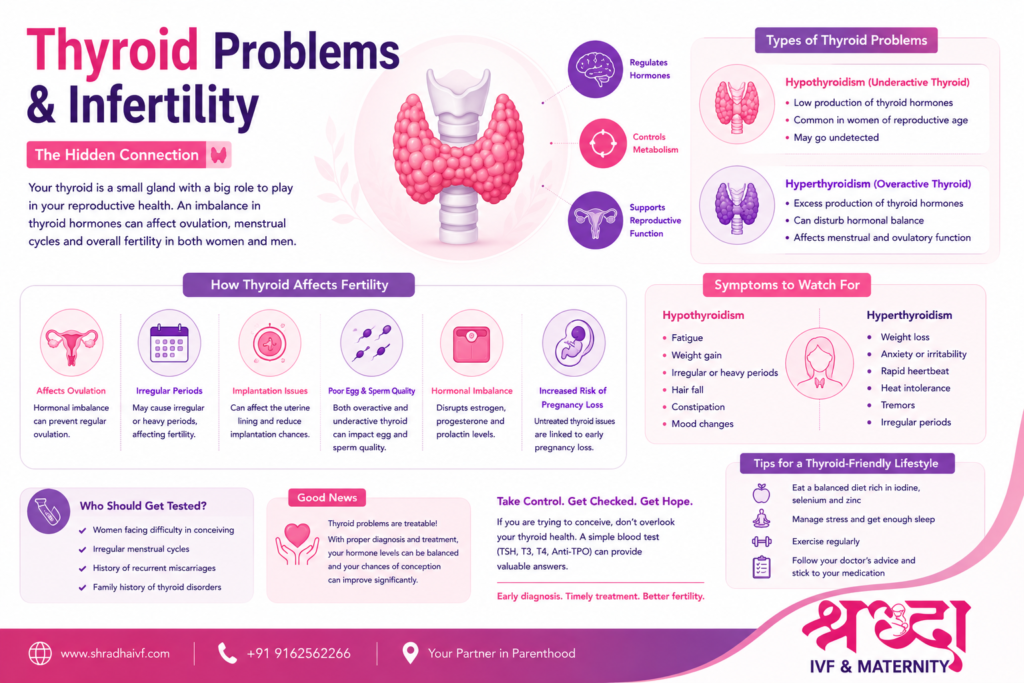
The thyroid is a small butterfly-shaped gland in the front of your neck that produces hormones (T3 and T4) controlling your metabolism — the rate at which your body uses energy. But its influence reaches far beyond metabolism. Thyroid hormones directly affect the reproductive system: they help regulate the menstrual cycle, support healthy ovulation, influence the quality of the uterine lining where an embryo implants, and even affect egg quality. When thyroid levels are right, these processes run smoothly.
When thyroid function is disrupted, the ripple effects on your reproductive system can be significant. The thyroid does not cause infertility in isolation — rather, it affects the entire hormonal environment that makes conception and a healthy pregnancy possible. This is why thyroid and infertility are so closely connected, and why a thyroid function test is now a standard part of any thorough fertility evaluation in India and worldwide.
That’s why thyroid function is a standard part of any proper fertility evaluation, and why a simple thyroid blood test belongs in every couple’s first workup.
How Thyroid Problems Affect Conception?
When the thyroid is underactive or overactive, it can interfere with fertility in several ways:
- Disrupting ovulation — thyroid imbalance can prevent regular release of eggs or stop ovulation altogether.
- Causing irregular or abnormal periods — cycles may become irregular, heavy, or absent, making conception harder and timing unpredictable.
- Affecting the uterine lining — reducing its receptivity, so even a healthy embryo may struggle to implant.
- Impairing egg quality — particularly with thyroid autoimmunity (more on that below).
- Raising miscarriage risk — untreated hypothyroidism and thyroid antibodies are both linked to higher rates of early pregnancy loss.
This is exactly why thyroid dysfunction is such a frequent culprit behind unexplained infertility and recurrent miscarriage — it’s often the quiet factor no one checks for.
Hypothyroidism vs Hyperthyroidism: What is the Difference?
There are two directions the thyroid can go wrong, and they’re near-opposites:
| Hypothyroidism (underactive) | Hyperthyroidism (overactive) | |
|---|---|---|
| TSH level | High | Low |
| How common in fertility | More common | Less common |
| Typical symptoms | Fatigue, weight gain, cold intolerance, heavy/irregular periods, dry skin, low mood | Weight loss, palpitations, anxiety, heat intolerance, light/irregular periods |
| Effect on fertility | Disrupts ovulation, thins response, raises miscarriage risk | Menstrual irregularity, can affect conception & pregnancy |
| Usual treatment | Levothyroxine (thyroid hormone replacement) | Anti-thyroid medication; stabilise before conceiving |
Hypothyroidism (an underactive thyroid, shown by a high TSH) is the one most often linked to infertility, and the one we’ll focus on most, though hyperthyroidism also needs proper control before trying to conceive.
Can Thyroid Affect Fertility?
- Irregular or absent periods — about 80% of women with hypothyroidism experience some degree of menstrual disruption
- Anovulation — failure to release an egg, because the LH surge that triggers ovulation is impaired
- Short luteal phase — even if ovulation occurs, inadequate progesterone in the second half of the cycle prevents a fertilised egg from implanting successfully
- Increased miscarriage risk — especially when thyroid antibodies (anti-TPO) are also present
- Poor ovarian reserve — higher TSH levels are associated with lower egg count and reduced follicle development
What are the Symptoms of Thyroid-Related Infertility?
Thyroid disorders can sometimes be silent — especially subclinical hypothyroidism. But many women do experience symptoms that, when combined with fertility difficulties, point clearly to the thyroid as a contributing factor.
🐢 Hypothyroidism — Signs to Watch
- Irregular, heavy, or absent periods
- Unexplained weight gain
- Extreme fatigue, even after sleep
- Cold sensitivity
- Hair thinning or significant hair loss
- Dry skin and constipation
- Low mood, depression, or brain fog
- Recurrent miscarriages
- Difficulty losing weight despite effort
⚡ Hyperthyroidism — Signs to Watch
- Irregular or very light periods
- Unexplained weight loss
- Racing heartbeat or palpitations
- Heat intolerance and excessive sweating
- Hand tremors
- Anxiety, irritability, restlessness
- Difficulty sleeping
- Bulging eyes (in Graves’ disease)
- Frequent bowel movements
If you are experiencing any of these alongside difficulty conceiving, ask your doctor for a full thyroid panel. It is a simple blood test that can provide answers many couples have been searching for — sometimes for years.
How Is Thyroid-Related Infertility Diagnosed?
Diagnosis involves a targeted blood test panel. At Shradha IVF, we routinely check the following as part of our initial fertility evaluation:
- TSH (Thyroid-Stimulating Hormone): The primary screening test. A high TSH indicates underactivity; a low TSH suggests overactivity.
- Free T3 and Free T4: Measure the actual circulating thyroid hormones, distinguishing overt from subclinical dysfunction.
- Anti-TPO antibodies: Detect Hashimoto’s thyroiditis or autoimmune thyroid disease. Positive results are clinically relevant for fertility even when TSH is normal.
- Anti-Tg antibodies (anti-thyroglobulin): Tested alongside Anti-TPO for a complete autoimmune picture, particularly useful in cases of recurrent miscarriage.
- Prolactin: Elevated prolactin is a common consequence of hypothyroidism and is itself a cause of ovulation failure. We check this as part of the same hormonal panel.
- Thyroid ultrasound: Recommended if nodules, goitre, or structural changes are suspected based on physical examination or antibody results
What is the Right TSH Level You Need to Conceive?
Here’s the number everyone’s really looking for — and where a lot of confusion (and missed diagnoses) happens. When you get a routine thyroid test, the lab report usually flags anything up to around 4.5–5.0 mIU/L as “normal.” And for the general population, it is. But for a woman trying to conceive, undergoing IVF, or in early pregnancy, most fertility specialists aim lower — for a TSH below 2.5 mIU/L.
| Stage | Recommended TSH Range | Clinical Significance |
|---|---|---|
| Trying to conceive (natural) | 1.0 – 2.5 mIU/L | Optimal for ovulation, implantation, and early embryo health |
| Before IVF or IUI | < 2.5 mIU/L | Best embryo quality and implantation outcomes |
| First trimester (weeks 1–12) | 0.1 – 2.5 mIU/L | Critical period — fetal brain development depends on maternal thyroid |
| Second trimester (weeks 13–26) | 0.2 – 3.0 mIU/L | Slightly relaxed range as the placenta begins producing thyroid hormones |
| Third trimester | 0.3 – 3.5 mIU/L | Continue monitoring; adjust dose if needed |
| TSH 2.5 – 4.0 (with + antibodies) | Consider treatment | Individualised decision — higher miscarriage risk with anti-TPO positivity |
| TSH above 4.0 mIU/L | Treat before conception | Associated with miscarriage, implantation failure, and reduced IVF success |
This is the crucial point: your TSH can be labelled “normal” by a general lab range and still be higher than ideal for conception. A result of, say, 3.8 might never be flagged by a general physician, yet a fertility specialist would often want it brought down before an IVF cycle. This single gap — a “normal” result that isn’t optimal for fertility — is one of the most common missed factors I see.
Subclinical Hypothyroidism — the Grey Zone
You may hear the term “subclinical hypothyroidism.” It means your TSH is mildly raised, but your actual thyroid hormone (Free T4) is still normal — a subtle, “silent” state with often no symptoms at all. On its own, it might be ignored in general practice. But in the fertility context — especially with a history of infertility, recurrent miscarriage, or thyroid antibodies — many specialists will treat it to bring TSH comfortably below 2.5, because the potential benefit is meaningful and the treatment is simple and safe.
What are Thyroid Antibodies (Hashimoto’s) and How Does it Affect Fertility?
This is the part most pages skip — and it matters. It is an autoimmune condition in which the body’s immune system mistakenly attacks the thyroid gland, gradually damaging its ability to produce hormones.
Some women have thyroid antibodies (such as TPO antibodies), a sign that the immune system is attacking the thyroid — the hallmark of Hashimoto’s thyroiditis, the most common cause of hypothyroidism.
What makes Hashimoto’s particularly relevant to fertility is not just the low thyroid hormone production — it is the autoimmune activity itself. The same immune dysregulation that causes Hashimoto’s can also:
- Interfere with embryo implantation by creating a hostile uterine environment
- Significantly raises miscarriage risk — rates of pregnancy loss approach 50% in untreated women with Hashimoto’s and Graves’ disease
- Increase the risk of preterm birth and low birth weight even when TSH is within the normal range
- Be associated with other autoimmune fertility conditions, such as antiphospholipid syndrome
Hashimoto’s is diagnosed by testing for anti-TPO (thyroid peroxidase) antibodies and anti-thyroglobulin (anti-Tg) antibodies in the blood. This is why a complete thyroid panel at Shradha IVF includes antibody testing — not just TSH. Treatment with levothyroxine can stabilise thyroid hormone levels, and there is evidence that bringing TSH to the lower end of the optimal range (below 2.0 mIU/L) specifically benefits women with Hashimoto’s who are trying to conceive.
Here’s the key insight: thyroid antibodies can affect fertility and raise miscarriage risk even when your TSH is completely normal. They’ve been linked to reduced egg quality, lower fertilisation, and implantation difficulty.
This is why a good fertility workup checks not just TSH, but also Free T4 and thyroid antibodies. If antibodies are present, your specialist may monitor you more closely during pregnancy and, in some cases, consider low-dose thyroid treatment even with a normal TSH. It’s a subtle factor, but for a woman with unexplained infertility or repeated miscarriage, it can be the missing piece.
The Thyroid and PCOS Connection — When Two Conditions Overlap
🔗 Why This Matters for So Many Indian Women
Polycystic Ovary Syndrome (PCOS) and thyroid disorders — particularly hypothyroidism — are the two most common hormonal conditions affecting women of reproductive age in India. And they frequently occur together. Research suggests that up to 22–27% of women with PCOS also have hypothyroidism, compared to about 8% in the general female population.
- Both conditions disrupt ovulation and menstrual regularity, making it hard to identify which is the primary cause of infertility
- Hypothyroidism can worsen insulin resistance — the core metabolic issue in PCOS — creating a compounding hormonal problem
- Elevated TSH is associated with higher AMH levels in some women, which can mimic the appearance of PCOS on ultrasound (multiple follicles) even when PCOS is not truly present
- Treating hypothyroidism in women who have both conditions often improves their PCOS symptoms, including cycle regularity and ovulation frequency
If you have been diagnosed with PCOS, your fertility evaluation must include a full thyroid panel. Treating hypothyroidism first — before starting PCOS-specific fertility treatments like Clomiphene or letrozole — can significantly improve outcomes and may even make additional treatment unnecessary.
Thyroid Disorders and IVF: What You Need to Know
If you are planning IVF and have a thyroid disorder, the core message is this: with optimal thyroid management, IVF success rates are comparable to those without thyroid issues. Two things happen:
- During ovarian stimulation, the high oestrogen levels that IVF medications produce increase your body’s demand for thyroid hormone. This means a TSH that was fine before your cycle can drift mid-treatment upward — so thyroid levels are monitored, and levothyroxine may need adjusting.
- In early pregnancy: your growing baby relies entirely on your thyroid hormone in the first trimester, when its own brain and nervous system are developing. The demand rises sharply, and women already on thyroid medication usually need a dose increase, often as soon as pregnancy is confirmed. This is why untreated hypothyroidism in pregnancy is taken so seriously.
The evidence is striking. Research shows that treating subclinical hypothyroidism with levothyroxine before an IVF/ICSI cycle improved embryo quality, implantation rates, and live birth rates — from 25% in the untreated group to 53% in the treated group. This is one of the clearest examples in fertility medicine of how a simple, low-cost intervention can double outcomes.
Elevated TSH affects IVF in several specific ways:
- Reduces the quality of eggs retrieved during stimulation
- Impairs embryo development in the laboratory
- Reduces endometrial receptivity — making implantation less likely even with a good-quality embryo
- Increases the risk of biochemical pregnancy (a pregnancy that shows on a test but does not develop further)
If you’re going through IVF, thyroid management becomes even more important — and this is where the page’s title really comes to life.
How to Monitor Your Thyroid During Pregnancy?
Getting pregnant is not the end of the thyroid conversation — it is where careful monitoring becomes even more important. During pregnancy, your body’s demand for thyroid hormone increases by approximately 30–50%, beginning as early as the 4th or 5th week of gestation. This is because the developing baby depends entirely on the mother’s thyroid hormones for brain development during the first trimester, before its own thyroid gland is functional.
Women who were already on levothyroxine before pregnancy will almost certainly need a dose increase. Women with previously normal thyroid function can also develop gestational hypothyroidism. Here is how monitoring should be structured:
As soon as pregnancy is confirmed (Week 4–6): Check TSH immediately. If you are on levothyroxine, your dose typically needs to increase by 25–30% right away. Do not wait for a scheduled appointment — contact your doctor as soon as you see a positive test.
First trimester (Weeks 6–12) — every 4 weeks: TSH should be maintained between 0.1–2.5 mIU/L. This is the most critical window for fetal brain development. Uncontrolled hypothyroidism during this period is associated with cognitive development issues in the child.
Second trimester (Weeks 13–26) — every 4–6 weeks: The placenta begins producing some thyroid hormones, and TSH levels may stabilise. Continue monitoring and adjust dose as needed. Target TSH: 0.2–3.0 mIU/L.
Third trimester and post-delivery: Continue monitoring until delivery. After birth, many women can return to their pre-pregnancy dose. However, postpartum thyroiditis — a thyroid flare in the months after delivery — is common in women with Hashimoto’s and should be watched for.
Treatment: Can Treating Thyroid Problems Restore Fertility?
In most cases, yes — and often dramatically so. Thyroid-related infertility is one of the most responsive conditions to treatment in all of reproductive medicine.
For hypothyroidism, the standard treatment is levothyroxine — a synthetic T4 hormone taken as a once-daily tablet, typically first thing in the morning on an empty stomach. It is safe, inexpensive (₹50–₹150 per month), and highly effective. TSH levels typically normalise within 4–8 weeks, and many women see their menstrual cycles regularise within 2–3 months. Studies report that 76.6% of women treated for hypothyroidism successfully conceived after therapy.
For hyperthyroidism, anti-thyroid medications bring levels under control, usually within 3–6 months. Once thyroid function is stable, fertility treatment can begin safely, and outcomes are generally excellent.
For subclinical hypothyroidism with anti-TPO antibodies, even low-dose levothyroxine — enough to bring TSH to the lower end of the normal range — has been shown to reduce miscarriage rates and improve IVF live birth rates.
Diet and Lifestyle Tips That Support Thyroid Health and Fertility
Medication is the primary treatment for thyroid disorders — but what you eat and how you live can meaningfully support your thyroid health and amplify the benefits of treatment. This is especially relevant for women in India, where dietary iodine sufficiency has historically varied significantly by region.
✅ Foods That Support Thyroid Health
- Iodine-rich foods: iodised salt, eggs, dairy (milk, yoghurt), seafood (especially fish and shrimp)
- Selenium sources: Brazil nuts (just 2–3 per day), sunflower seeds, brown rice, mushrooms — selenium supports T4 to T3 conversion
- Zinc-rich foods: pumpkin seeds, lentils, chickpeas, meat — zinc supports TSH production
- Anti-inflammatory foods: turmeric, ginger, berries, leafy greens — beneficial for Hashimoto’s
- Vitamin D: sun exposure, fatty fish, fortified milk — low vitamin D is common in hypothyroidism and linked to poor IVF outcomes
⚠️ Foods to Limit (for Hypothyroidism)
- Raw cruciferous vegetables in excess: cabbage, cauliflower, broccoli — cooking reduces their goitrogenic effect; moderate cooked intake is fine
- Excess soy: tofu, soy milk — can interfere with thyroid hormone absorption; avoid within 4 hours of taking levothyroxine
- Highly processed foods: trans fats and excess sugar worsen inflammation, especially in Hashimoto’s
- Gluten (for Hashimoto’s patients): some women with Hashimoto’s benefit from a gluten-reduced diet — discuss with your doctor
- Calcium and iron supplements: must be taken at least 4 hours apart from levothyroxine as they block absorption
Lifestyle Habits That Make a Difference
- Manage stress: Chronic stress raises cortisol, which suppresses thyroid hormone conversion and worsens both hypothyroidism and PCOS. Yoga, meditation, and regular sleep (7–8 hours) have measurable positive effects on thyroid function.
- Maintain a healthy weight: Excess weight worsens thyroid hormone resistance. Even a 5–10% reduction in body weight in overweight women can improve TSH levels and ovulation frequency.
- Exercise moderately: Regular moderate exercise supports metabolism and reduces inflammation. Avoid extreme exercise, which can suppress thyroid function further in already underactive cases.
- Avoid smoking: Smoking is independently associated with thyroid autoimmunity and worsens the effects of Hashimoto’s on fertility.
Can Thyroid Problems Affect Men’s Fertility Too?
Yes — and this is something most couples are not aware of. Thyroid disorders affect male fertility in several clinically significant ways:
- Hypothyroidism in men reduces testosterone levels, lowers sperm count, impairs sperm motility, and can lead to erectile dysfunction
- Hyperthyroidism raises SHBG and disrupts testosterone balance, also degrading sperm quality
- Elevated TSH increases sperm DNA fragmentation, which reduces the chance of fertilisation and healthy embryo development, even when basic semen parameters appear normal on a standard analysis
This is why at Shradha IVF, we screen both partners for thyroid function as part of our initial fertility evaluation. A male thyroid problem is often overlooked, but correcting it can meaningfully improve IVF or natural conception outcomes — particularly in cases where semen analysis looks borderline.
A Note from Dr. Shradha, Patna
Is Your Thyroid Affecting Your Fertility?
At Shradha IVF & Maternity in Patna, thyroid testing is a standard part of every fertility evaluation — because we know that getting the hormonal foundation right makes everything else work better. Our team works closely with endocrinologists to ensure your thyroid is fully optimised before any treatment begins.
Frequently Asked Questions on Thyroid and Infertility
Yes. Both hypothyroidism and hyperthyroidism can disrupt ovulation, menstrual cycles, and hormone balance — all of which affect fertility. Thyroid disorders are among the most common and treatable hormonal causes of infertility in women. Once thyroid levels are controlled, fertility often improves significantly or completely, even without additional fertility treatment.
For natural conception, a TSH between 1.0 and 2.5 mIU/L is considered optimal. For IVF patients, TSH below 2.5 mIU/L before embryo transfer is the recommended target. During the first trimester, TSH should be between 0.1–2.5 mIU/L. Your doctor will guide you based on your full thyroid profile and antibody status.
Yes — absolutely. Many women with hypothyroidism conceive naturally or with assisted reproduction once their thyroid levels are properly managed with levothyroxine. Studies show that 76.6% of women treated for hypothyroidism were able to conceive after therapy. Hypothyroidism is one of the most hopeful fertility diagnoses precisely because it responds so well to treatment.
Yes. Uncontrolled hypothyroidism and the presence of anti-TPO thyroid antibodies are both associated with an increased risk of miscarriage. Treating thyroid disorders before and during pregnancy significantly reduces these risks — which is why thyroid testing is a standard part of any miscarriage investigation at Shradha IVF.
Yes. Elevated TSH reduces egg quality, embryo development, and endometrial receptivity. Research shows that treating subclinical hypothyroidism before IVF improved live birth rates from 25% to 53% in affected women — one of the most significant treatment benefits in fertility medicine. This is why we always check and optimise thyroid function before starting any IVF cycle.
Hypothyroidism is treated with levothyroxine, a daily tablet that replaces thyroid hormone, with the dose adjusted by your doctor to reach the target TSH. Hyperthyroidism is managed with anti-thyroid medication and stabilised before conception. Both are inexpensive and effective — thyroid is among the most treatable fertility factors.
Hypothyroidism is treated with levothyroxine, a daily tablet that replaces thyroid hormone, with the dose adjusted by your doctor to reach the target TSH. Hyperthyroidism is managed with anti-thyroid medication and stabilised before conception. Both are inexpensive and effective — thyroid is among the most treatable fertility factors.