

Medically Reviewed by Dr. Shradha Chakhaiyar, MBBS, MRCOG (London) — Fertility Specialist & Reproductive Surgeon, Shradha IVF & Maternity, Patna
20+ Years of Experience · www.shradhaivf.com
Adenomyosis is a condition where the tissue that normally lines the uterus grows into the muscular wall of the uterus, causing it to become enlarged, inflamed, and often painful. It commonly causes heavy, painful periods and a bulky uterus, though about a third of women have no symptoms at all. It can make conception harder by reducing the lining’s receptivity to an embryo — but many women with adenomyosis do conceive, naturally or through IVF. There is no permanent cure short of hysterectomy, but for women wanting a baby there are effective fertility-preserving options: hormonal treatment, GnRH-agonist preparation before embryo transfer, uterus-sparing surgery (adenomyomectomy), and IVF.
📋 What This Guide Covers
- What is adenomyosis?
- What are the symptoms of adenomyosis?
- What’s the difference between adenomyosis and endometriosis?
- Does adenomyosis cause a bulky uterus?
- Bulky uterus with adenomyosis vs with fibroids — how do they differ?
- What causes adenomyosis?
- How is adenomyosis diagnosed?
- Can you get pregnant with adenomyosis?
- Could adenomyosis be why your IVF failed?
- How is adenomyosis treated if you want a baby?
- Do you really need a hysterectomy?
- How is IVF adapted for adenomyosis?
- Is pregnancy with adenomyosis safe?
- A note from Dr. Shradha, Patna
- FAQs
What Is Adenomyosis?
Your uterus has two main parts that matter here: the endometrium — the soft inner lining that thickens each month and sheds as your period — and the myometrium, the thick muscular wall that surrounds it. Normally these stay in their own territory.
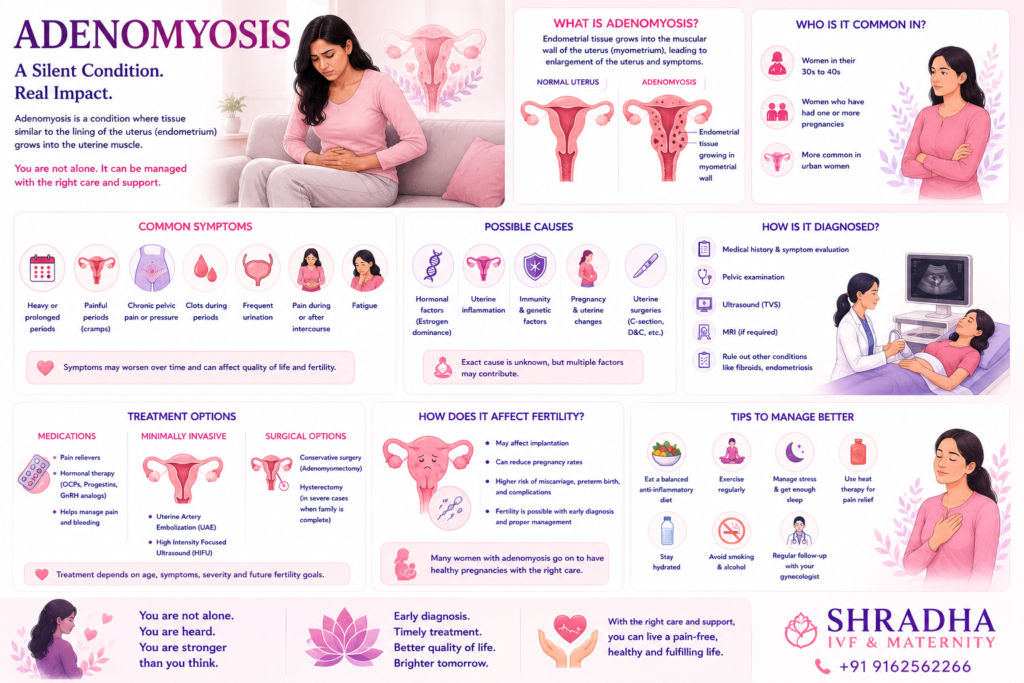
In adenomyosis, endometrial tissue grows into the muscular wall. And here is the crucial part: that displaced tissue still behaves like lining tissue. Every month, it responds to your hormones — it thickens, breaks down, and bleeds — but it is now trapped inside the muscle, with nowhere to go. The result is inflammation, swelling, and a uterus that becomes enlarged, boggy, and tender. This is why adenomyosis so often shows up on a scan as a bulky uterus, and why the pain can be so much worse than ordinary period pain.
It is often called a “silent” condition, because it is badly underdiagnosed. Roughly one in three women with adenomyosis has no symptoms whatsoever — and many others are simply told their painful periods are normal. A great number of women only discover they have it during a fertility investigation, sometimes after years of symptoms nobody took seriously.
What Are the Symptoms of Adenomyosis?
When symptoms do occur, they tend to be these — and they often worsen gradually, which is why women dismiss them for so long:
- Heavy menstrual bleeding — prolonged periods, flooding, or passing clots, sometimes leading to anaemia and exhaustion
- Severe period pain (dysmenorrhoea) — often described as cramping that has become noticeably worse over the years
- Chronic pelvic pain — a persistent ache or heaviness, not confined to your period
- A feeling of pressure or fullness in the lower abdomen, sometimes with visible bloating
- Pain during intercourse (dyspareunia)
- Difficulty conceiving, or recurrent miscarriage — sometimes the only sign
I want to say something plainly here, because it matters. Period pain that stops you from working, or bleeding heavy enough to leave you anaemic, is not “just how periods are.” Generations of women in Bihar have been told to endure it. If this describes you, it deserves investigation — not endurance.
What’s the Difference Between Adenomyosis and Endometriosis?
These two are constantly confused, even though the distinction is simple. Both involve endometrial-type tissue growing where it shouldn’t. The difference is where:
| Adenomyosis | Endometriosis | |
|---|---|---|
| Where the tissue grows | Inside the muscular wall of the uterus | Outside the uterus — on ovaries, tubes, pelvic lining |
| Typical effect on the uterus | Uterus becomes enlarged, “bulky,” boggy | Uterus usually normal in size |
| Hallmark symptoms | Heavy bleeding + worsening period pain | Pelvic pain, painful periods, sometimes adhesions |
| Main fertility mechanism | Poor implantation — the lining is less receptive | Anatomical distortion, adhesions, egg quality |
| Definitive treatment | Hysterectomy (only if family complete) | Surgical excision of deposits |
One important practical note: the two frequently occur together, and adenomyosis often co-exists with fibroids too. If you have been diagnosed with one, it’s worth asking whether you’ve been properly checked for the others — because the combination changes the treatment plan.
Does Adenomyosis Cause a Bulky Uterus?
Yes — and for a great many women, this is exactly how the two words first collide. Your ultrasound report says “bulky uterus” and, somewhere further down, “adenomyosis” or “adenomyotic changes” or “heterogeneous myometrium”. You are left wondering whether you have one problem or two.
You almost certainly have one. “Bulky uterus” is a description of size — it means the uterus measured larger than the typical range on ultrasound. Adenomyosis is a diagnosis — a specific condition that explains why it’s enlarged. Along with fibroids, adenomyosis is one of the two leading causes of a bulky uterus in women of reproductive age.
The mechanism is straightforward once you understand the disease. Endometrial tissue trapped in the muscular wall keeps responding to your monthly hormones — thickening, breaking down, and bleeding with nowhere to drain. That drives chronic inflammation and swelling throughout the muscle wall, thickening it. The uterus becomes uniformly enlarged, globular in shape, and characteristically soft or “boggy” to examine. That diffuse, whole-organ swelling is precisely what the radiologist is describing when they write “bulky.”
So if your report carries both terms, read it like this: the second word is the explanation for the first. (For a fuller explanation of the finding itself, see our guide on what a bulky uterus means.)
Bulky Uterus with Adenomyosis vs Bulky Uterus with Fibroids — How Do They Differ?
This is the question I’m asked most often once a woman has read her report properly — and it genuinely matters, because although both conditions produce a “bulky uterus,” they behave differently, they affect fertility differently, and they are treated differently. Getting the distinction right changes your treatment plan.
The simplest way to hold it in your head: a fibroid is a lump; adenomyosis is a spread. A fibroid is a discrete, well-defined growth with visible edges — you can point to it on a scan. Adenomyosis is diffuse disease infiltrating through the muscle wall, with no clean border. That single difference explains almost everything else.
| Bulky uterus with adenomyosis | Bulky uterus with fibroids | |
|---|---|---|
| What’s actually there | Lining tissue infiltrating diffusely through the muscle wall — no clear border | One or more discrete, well-defined growths with visible edges |
| Shape of the uterus | Uniformly enlarged, globular, symmetrical | Often irregular, lumpy, or asymmetrical in contour |
| How it feels on examination | Soft, “boggy,” and typically tender | Firm, often not tender |
| Dominant symptom | Pain — severe, progressively worsening period pain, plus heavy bleeding | Bleeding & pressure — heavy periods, bladder/bowel pressure; often painless |
| How it affects fertility | Impairs implantation — the lining becomes less receptive; inflammation throughout the uterus | Depends on location — a submucosal fibroid distorting the cavity matters; a subserosal one often doesn’t |
| On ultrasound | Thickened, irregular muscle wall; small cysts in the muscle; distorted junctional zone | A distinct, measurable mass with defined margins |
| Fertility-sparing surgery | Adenomyomectomy — possible, but harder (no clean plane to cut along); best for focal disease | Myomectomy — generally cleaner and more straightforward; the fibroid “shells out” |
| Typical IVF strategy | Calm the uterus first (e.g. GnRH-agonist preparation), then a frozen transfer | Remove the fibroid if it distorts the cavity; otherwise often proceed |
Why this distinction changes what we do
Here’s the practical consequence, and it’s the reason I won’t let a scan report go unexamined. With fibroids, the key question is location: is it in the way? A fibroid sitting harmlessly on the outer wall of the uterus may need nothing done at all before an embryo transfer, even if it’s making the uterus measure bulky.
With adenomyosis, there is no “out of the way.” The disease is in the wall the embryo has to implant against, and the inflammation affects the whole uterine environment. So the strategy is different: rather than removing something, we work to quieten the uterus and improve the lining’s receptivity before we transfer an embryo into it.
Two reports that both say “bulky uterus” can therefore lead to two completely different plans. This is exactly why I’d rather look at your imaging myself than have you conclude a single word. (Our guides on bulky uterus with fibroids and fibroids and infertility cover the fibroid side in detail.)
What Causes Adenomyosis?
Honestly, the cause is not fully understood — and any page claiming certainty is overstating it. What we do know is that certain factors are consistently associated with it:
- Previous uterine surgery — including caesarean section, D&C, or fibroid removal, which may allow lining tissue to breach the muscle wall
- Childbirth — it is more common in women who have had children
- Age — most commonly diagnosed in the 30s and 40s, though it certainly occurs in younger women
- Oestrogen — the condition is hormone-driven, which is why symptoms typically settle after menopause
- Chronic inflammation of the uterine wall
How Is Adenomyosis Diagnosed?
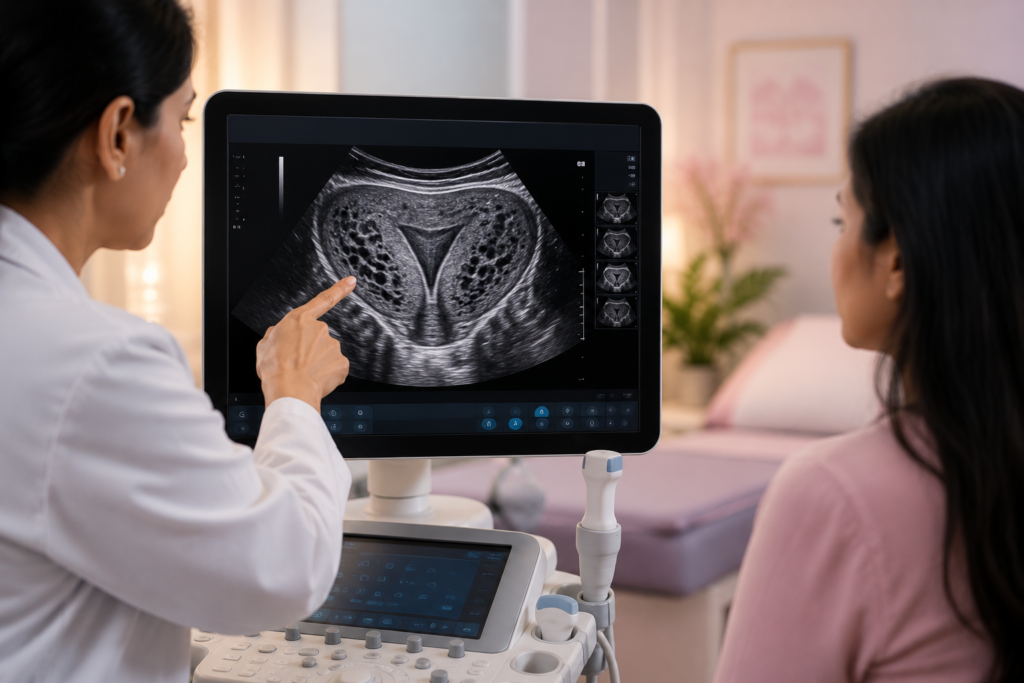
- Transvaginal ultrasound — the usual first step. A skilled sonographer can spot the classic signs: an enlarged, globular uterus, a thickened and irregular muscle wall, small cysts within the muscle, and a distorted “junctional zone” between lining and muscle.
- MRI — more precise, and particularly useful for distinguishing adenomyosis from fibroids, mapping how extensive it is, and planning surgery.
- Clinical examination — an adenomyotic uterus often feels characteristically enlarged and tender.
Historically, adenomyosis could only be confirmed definitively by examining the uterus after it was removed — which is precisely why it was underdiagnosed for so long, and why so many women were told for years that nothing was wrong. Modern imaging has changed that. It can now be diagnosed reliably while your uterus stays exactly where it belongs.
Can You Get Pregnant with Adenomyosis?
Yes. Many women with adenomyosis conceive — naturally, or with fertility treatment. Please hold onto that before reading the rest of this section, because the mechanisms below sound more frightening than the outcomes justify.
Adenomyosis can make conception harder, and it does so mainly by affecting implantation rather than by preventing fertilisation. Research suggests several overlapping reasons:
- Reduced endometrial receptivity — the lining becomes less “welcoming” at a molecular level, with altered expression of the adhesion molecules an embryo needs in order to attach
- Chronic inflammation inside the uterus, creating a hostile environment for an early embryo
- Disrupted uterine contractions — the abnormal muscle can interfere with the coordinated movements that help sperm travel and help an embryo settle
- Structural distortion of the uterus and its junctional zone
- Oxidative stress and hormonal imbalance in the local environment
Studies do report that, untreated, adenomyosis is associated with lower pregnancy rates and higher miscarriage rates. But — and this is the part the internet keeps burying — the same body of research also shows that treating adenomyosis improves those outcomes. Peer-reviewed reviews indicate that both medical and surgical treatment can raise pregnancy and live-birth rates. A diagnosis is not a verdict. It is information you can act on.
Could Adenomyosis Be Why Your IVF Failed?
If you have had an embryo transfer fail — especially more than once, or with an embryo that looked perfectly good — this section is for you.
Around 22–24% of women with infertility are found to have adenomyosis, and it is especially concentrated among women with recurrent implantation failure and recurrent miscarriage. Yet many of those women have never been told they have it. It hides behind “unexplained” infertility and behind a scan report that said “bulky uterus.”
This is exactly the scenario I want women in Bihar to stop falling into: cycle after cycle, good embryos, no pregnancy, and nobody looking properly at the uterus the embryos are being placed into. If that is your story, ask your doctor directly whether adenomyosis has been ruled out. (Our guides on why a perfect-looking embryo fails and what to change after a failed first IVF cycle go deeper into this.)
How Is Adenomyosis Treated If You Want a Baby?
This is the section the rest of the internet doesn’t write. Treatment depends entirely on one question: are you trying to conceive? If you are, the options look like this:
| Option | What it involves | Fertility-compatible? |
|---|---|---|
| Pain & bleeding control | Anti-inflammatory medication and other measures to manage symptoms while you try | ✅ Yes |
| GnRH-agonist preparation | A course of medication before embryo transfer to quieten the adenomyosis, reduce inflammation, and improve the lining’s receptivity | ✅ Yes — used for fertility |
| Adenomyomectomy | Uterus-sparing surgery removing the adenomyotic tissue while preserving the uterus — for focal or localised disease | ✅ Yes — designed for this |
| IVF (often with freeze-all/FET) | Create embryos, freeze them, then transfer into a properly prepared uterus in a later cycle | ✅ Yes |
| Egg freezing | If you’re not ready to conceive now, preserving eggs while your ovarian reserve is stronger | ✅ Yes |
| Hormonal IUD / continuous hormones | Effective for symptoms, but prevents pregnancy while in use | ⚠️ Only between attempts |
| Endometrial ablation | Destroys the uterine lining to stop bleeding | ❌ No — ends fertility |
| Hysterectomy | Removal of the uterus — the only permanent cure | ❌ No — only if family complete |
The GnRH-agonist point most Indian articles miss entirely
This is worth spelling out, because it is genuinely actionable. Research indicates that a course of GnRH-agonist treatment before embryo transfer — which temporarily suppresses the hormonal activity driving the adenomyosis — may improve pregnancy rates and reduce miscarriage rates in women with adenomyosis. The evidence also suggests that a GnRH-agonist long protocol performs better here than antagonist cycles. In plain terms: we can calm the uterus down before we ask it to accept an embryo. That single strategic choice can change the outcome of a cycle — and almost none of the Indian pages you’ll find even mention it.
Do You Really Need a Hysterectomy?
Let me be completely straight with you, in both directions.
The honest truth: hysterectomy is the only permanent cure for adenomyosis. Because the disease lives inside the muscle of the uterus itself, removing the uterus is the only way to guarantee it never comes back. That is a real fact, and I won’t pretend otherwise.
But here is what those articles fail to say: a permanent cure is not what you’re looking for. You are looking for a baby. Those are entirely different goals, and they call for entirely different treatment.
Hysterectomy is the right answer for a woman in her forties who has completed her family and is exhausted by years of pain and bleeding. For her, it can be genuinely life-changing, and I have recommended it many times. It is emphatically not the answer for a 32-year-old who wants a child. For her, we manage the condition rather than eliminate it — we quieten it, we prepare the uterus, we get her pregnant, and we deal with the symptoms afterwards.
“There is no cure” does not mean “there is no baby.” If you take one sentence away from this entire article, please let it be that one.
How Is IVF Adapted for Adenomyosis?
IVF is frequently the most effective route to pregnancy with moderate or severe adenomyosis — but it works best when the protocol is adapted, not simply run as standard. In practice that means:
- Getting the eggs first. We often collect eggs and create embryos before doing anything that would suppress the ovaries — securing the embryos while conditions are good.
- Freeze-all, then transfer later. Rather than a fresh transfer, embryos are frozen and the transfer happens in a subsequent, carefully prepared cycle. This separates “making good embryos” from “preparing a receptive uterus” — two jobs that adenomyosis makes hard to do at the same time. (More in our guide on frozen vs fresh transfer.)
- Preparing the uterus before transfer — typically with GnRH-agonist suppression to reduce inflammation and improve receptivity, alongside careful attention to the uterine lining.
- Transferring a strong single embryo into a properly prepared uterus, rather than rushing.
The philosophy is simple, and it’s the same one that runs through all our uterine work: an excellent embryo cannot rescue an unprepared uterus. Fix the home first.
Is Pregnancy with Adenomyosis Safe?
Most women with adenomyosis have healthy pregnancies and healthy babies — that is the headline, and it is true. It is also honest to say that adenomyosis is associated with a somewhat higher risk of certain complications, including miscarriage, preterm birth, and pre-eclampsia. This is not a reason to despair; it is a reason to be monitored properly. A pregnancy with adenomyosis is one we watch a little more closely, and that closer watching is precisely what keeps it safe.
A Note from Dr. Shradha, Patna
At Shradha IVF & Maternity, adenomyosis is assessed and managed with fertility as the priority, under the personal care of Dr. Shradha Chakhaiyar, MRCOG (London). You can also estimate your odds with our IVF success rate calculator. The first consultation is free.
FAQs Related to Adenomyosis
Adenomyosis is a condition where tissue that normally lines the uterus grows into its muscular wall. This displaced tissue still bleeds each month but has nowhere to drain, causing inflammation, an enlarged "bulky" uterus, heavy bleeding, and pain. About a third of women with it have no symptoms.
Yes. Many women with adenomyosis conceive naturally or with IVF. It can make conception harder by reducing the uterine lining's receptivity to an embryo, but it does not prevent pregnancy. Treating the adenomyosis before trying — medically or surgically — has been shown to improve pregnancy and live-birth rates.
Yes. Hysterectomy is the only permanent cure, but it's only appropriate for women who have completed their families. For women wanting a baby, options include hormonal and anti-inflammatory treatment, GnRH-agonist preparation before embryo transfer, uterus-sparing surgery (adenomyomectomy), and adapted IVF protocols.
It can, mainly by reducing the uterine lining's receptivity and increasing inflammation, which affects implantation. However, adapted protocols help considerably — research suggests GnRH-agonist preparation before embryo transfer may improve pregnancy rates and lower miscarriage risk. Many women with adenomyosis succeed with IVF.
No. "Bulky uterus" describes size on an ultrasound; adenomyosis is one of the two most common causes of that finding (fibroids being the other). A bulky uterus can also result from hormonal changes or recent childbirth. Adenomyosis needs specific imaging features to diagnose.
Usually, yes. Adenomyosis is driven by oestrogen, so when oestrogen levels fall after menopause, the condition typically becomes inactive and symptoms resolve. This is little comfort if you're trying to conceive now — which is why active management during your reproductive years matters.
Yes — they co-exist frequently, and a scan report may mention both. In that case the uterus is bulky for two reasons at once. Each is managed on its own terms: assessing whether a fibroid distorts the uterine cavity, while separately treating the inflammation adenomyosis causes.
Diagnosed with Adenomyosis? You Don’t Have to Choose Between Your Uterus and a Baby.
Dr. Shradha will assess how extensive your adenomyosis is and build a plan aimed at one thing: getting you pregnant while keeping your uterus. Advanced imaging, fertility-sparing surgery, and adapted IVF protocols — all here in Patna. The first consultation is free.