

Reviewed by Dr. Shradha Chakhaiyar MBBS, DGO, MRCOG (London) | IVF & Fertility Specialist | Shradha IVF & Maternity, Patna, Bihar
Quick answer
An ovulation kit detects the surge of luteinising hormone (LH) that happens 24 to 36 hours before an egg is released. Start testing around Day 11 of a 28-day cycle, once a day, at roughly the same time — ideally late morning or afternoon, not first thing in the morning. The result is positive only when the test line is as dark as or darker than the control line. Unlike a pregnancy test, two faint lines do not count. Once you get a positive, try on that day and the following two days.
You have been trying to conceive. You have read enough to know that timing matters — that there is a window in your cycle, just a few days, when the chances of conception are at their highest. An ovulation kit is not just a piece of plastic with lines on it. Used correctly, it is one of the most powerful tools you have.
At Shradha IVF & Maternity in Patna, we see couples every day who were testing incorrectly — at the wrong time of day, on the wrong cycle day, or misreading the lines — and who turned their journey around simply by understanding how the kit actually works.
This article covers everything: how an ovulation kit works, the correct steps to use it, how to read the results, when to start testing based on your cycle length, and what to do if the results are confusing or persistently negative.
What Is an Ovulation Kit?
An ovulation kit — also called an ovulation predictor kit or OPK — is a simple urine test you use at home to find the two or three days in your cycle when conception is most likely.
It looks almost identical to a pregnancy test, and that resemblance causes most of the confusion. The two measure completely different hormones and are read in completely different ways. A pregnancy test looks for hCG, which is only present once an embryo has implanted. An ovulation kit looks for LH, which is present in small amounts throughout your cycle and rises sharply just before an egg is released.
That single difference is why any second line means positive on a pregnancy test, but not on an ovulation kit.
The names all mean the same thing
- Ovulation kit — the term used most commonly in India
- OPK — ovulation predictor kit, the abbreviation you will see online
- Ovulation test kit or ovulation strip
- LH test or LH surge test — named after the hormone it measures
Kits come as paper strips you dip into a urine sample, midstream sticks you hold in the urine flow, or digital readers that display a symbol instead of lines. The strips are cheapest and most common in India; the digital versions cost more but remove the judgement involved in comparing line darkness.
How Does an Ovulation Kit Work?
Every month, once an egg has matured inside its follicle, the pituitary gland releases a sharp burst of luteinising hormone. This LH surge is the trigger that makes the ovary release the egg, and it happens roughly 24 to 36 hours before ovulation.
LH passes from your blood into your urine within a few hours, which is what the kit detects. A positive result therefore tells you the surge has started — and that ovulation is likely within the next day or two.
What an ovulation kit does not tell you?
It predicts ovulation. It does not confirm it. A kit can register a surge in a cycle where the follicle never actually releases the egg — a situation called luteinised unruptured follicle syndrome. Only an ultrasound can confirm that an egg was genuinely released.
This distinction matters if you have been getting positive results for several months without conceiving. A positive kit is not proof that everything is working.
“The LH surge is a reliable, measurable signal. When my patients use ovulation kits correctly, they stop guessing and start planning. That shift alone dramatically improves their conception success rate.”
— Dr. Shradha Chakhaiyar, IVF Specialist, Patna
What are the Different Types of Ovulation Kits Available in India?
Not all ovulation kits are the same. Here is a clear breakdown of the types you will find at Indian pharmacies and online.
1. Strip-based urine kits (most common in India)
These are thin cardboard or plastic strips that you dip in a urine sample or hold in the urine stream. Results appear within 5 minutes as coloured lines. Popular brands available across India include:
- i-Know (Piramal) — India’s first dedicated OPK brand, available at Apollo, Medplus, 1mg, Netmeds and Amazon. Contains 5 strips per pack.
- Ova News (Prega News) — Contains 6 strips. Reads result in 5 minutes. Two pink lines = positive.
- Apollo LH Ovulation 5 Day Test Kit — Available at Apollo Pharmacy. Cost-effective and reliable.
- Generic LH strips — Available online in packs of 10–20. Less branded but functional for frequent testing.
2. Digital ovulation monitors
These use a digital reader to display clear symbols — a smiley face or the words “Peak” or “High” — eliminating confusion about line interpretation. ClearBlue is the most widely available digital OPK in India. The monitor costs considerably more than strips, and test sticks are sold separately.
3. Saliva-based kits
These analyse the salt content of saliva, which increases before ovulation. Less messy than urine kits but also less accurate, and harder to read. Generally less recommended for clinical purposes.
How to Use an Ovulation Kit: Step-by-Step Guide
Follow these steps carefully. Most errors occur with timing, hydration, and result reading — all easily avoided.
- Calculate when to start testing. Count the length of your average menstrual cycle (from Day 1 of your period to the day before your next period). Subtract 17 from that number. The result is the cycle day you should begin testing. For a 28-day cycle: 28 − 17 = Day 11. For a 30-day cycle: 30 − 17 = Day 13.
- Choose the right time of day. Do not test with your first urine of the morning. The LH surge is released into the bloodstream in the early hours but takes several hours to reach detectable concentrations in urine — so a first-morning sample can miss a surge that has genuinely started. The best time to test is between 10 AM and 8 PM, with early afternoon as the ideal window.
- Avoid excessive fluids for at least 4 hours before testing. Drinking too much water dilutes your urine, which can cause a false negative by lowering the concentration of LH.
- Collect or use urine directly. For strip kits: collect urine in a clean, dry container and dip just the absorbent tip of the strip into it for 5–15 seconds. For stick-based kits, hold the absorbent tip in your urine stream for 5–7 seconds. Keep the tip pointing downward.
- Lay the strip flat and wait 5 minutes. Do not read results before 5 minutes or after 10 minutes. The reading window is between 5 and 10 minutes.
- Read the result — see the next section for exactly how to interpret the lines.
- Record your result each day. Use a diary or a fertility app. Continue testing daily until you detect the LH surge (positive result) or until your expected fertile window has passed.
- After a positive result, act straight away. Have intercourse on the day of the positive result and the following two days. This gives sperm the best chance of meeting the egg at the moment of ovulation.
Important Test at the same time each day. Consistency improves your ability to detect the LH surge reliably, especially if your cycle is irregular. |
How to Read Ovulation Kit Results
This is the section that causes the most confusion. The key difference between an ovulation test and a pregnancy test is how you read the lines.
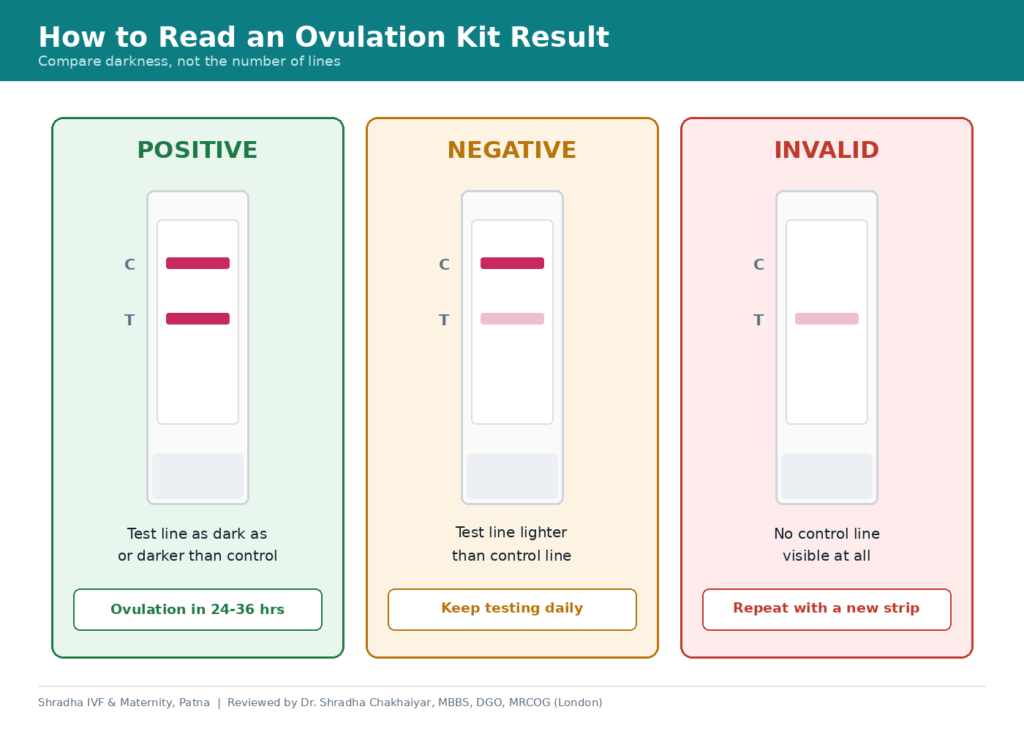
Every strip has two areas: the control line (C), which confirms the test worked, and the test line (T), which shows how much LH is in your urine. You are comparing darkness, not counting lines.
Positive result — LH surge detected
A positive ovulation test occurs when the test line (T) is as dark as or darker than the control line (C). This is not like a pregnancy test, where any second line means positive. On an ovulation test, a faint test line is a negative result.
What to do: begin timing intercourse immediately. Have sex on the day of the positive result and the following two days — this window gives you the best statistical chance of conception.
Negative result — LH surge not yet detected
The test line is absent or lighter than the control line. This means your LH surge has not yet occurred. Continue testing at the same time each day. A test line that gets darker each day means the surge is approaching.
Invalid result — no control line appears
If no control line appears, the test has not worked correctly. Discard the strip and repeat with a new one. Check your urine collection method — the strip may not have been sufficiently dipped.
Common result-reading mistakes
- Thinking any second line means positive — it must be as dark as or darker than the control line
- Reading the result too early (before 5 minutes) or too late (after 10 minutes)
- Comparing results across different brands — line darkness is brand-specific
- Expecting a positive every single cycle — anovulatory cycles, where no egg is released, do occur and can show a negative throughout
When to Start Ovulation Testing: Cycle Day Reference Guide
Use this quick reference table to find your start day. Remember: Day 1 is the first day of full menstrual bleeding (not spotting).
Cycle Length | Start Testing on Day | Peak Fertile Window | Notes |
|---|---|---|---|
24 days | Day 7 | Days 9–11 | Short cycle — start early |
26 days | Day 9 | Days 11–13 | — |
28 days | Day 11 | Days 13–15 | Most common cycle |
30 days | Day 13 | Days 15–17 | — |
32 days | Day 15 | Days 17–19 | — |
35 days | Day 18 | Days 20–22 | Longer cycle — be patient |
Irregular | Day 8–10 | Varies | Track cervical mucus too |
f your cycle varies month to month, use the shortest cycle from the past 6 months to calculate your start day. Starting earlier means you are less likely to miss the surge, even if it uses a few extra test strips.
Hindi Guide — कब टेस्ट शुरू करें? अपने मासिक धर्म के पहले दिन से लेकर अगले महीने के पहले दिन तक के दिनों को गिनें। उस संख्या में से 17 घटाएं। जो संख्या आए, उसी दिन से ovulation kit से test करना शुरू करें। उदाहरण: 28 दिन का cycle → Day 11 से test शुरू करें। |
How to Use Ovulation Kits with PCOS and Irregular Cycles?
If you have Polycystic Ovary Syndrome (PCOS) — one of the most common causes of irregular cycles in India — using an ovulation kit requires extra care and awareness.
Why PCOS makes OPK testing more complex
PCOS is associated with chronically elevated LH levels. This means your ovulation kit may show a positive result — or results that look almost positive — for many days in a row, without actual ovulation occurring. You may also experience multiple LH surges in a single cycle without releasing an egg.
Strategies for women with PCOS
- Start testing earlier — from Day 8 or Day 9 of your cycle, rather than the calculated day.
- Test twice a day — once in the morning and once in the afternoon, to catch a surge that might be brief or atypical.
- Do not rely on OPKs alone — combine with basal body temperature tracking (a sustained rise of 0.3–0.5°C after ovulation confirms it happened) and observe cervical mucus changes.
- Track across multiple cycles — one month of data is rarely enough with PCOS. Track for 2–3 months to identify your pattern.
- Discuss with a fertility specialist — if ovulation kits show persistently unclear results, transvaginal ultrasound follicle tracking is the most accurate way to confirm ovulation.
At Shradha IVF & Maternity in Patna, we regularly help women with PCOS identify their fertile window through a combination of ultrasound monitoring, OPK guidance and personalised cycle management. If ovulation kit results are confusing you, do not continue guessing.
What are 7 Common Mistakes to Avoid When Using Ovulation Kits?
Even the most accurate kit produces poor results if used incorrectly. These are the mistakes we see most often:
- Testing with first morning urine. Many women assume, by analogy with pregnancy tests, that morning urine is best. For ovulation kits, it is not. The LH surge is released in the morning but takes several hours to appear in concentrated levels in urine. Test between 10 AM and 8 PM.
- Over-hydrating before testing. Drinking large amounts of water or other fluids before testing dilutes urine and may lower the LH concentration enough to produce a false negative. Avoid excessive fluid intake for at least 4 hours before testing.
- Starting too late in the cycle. If your surge comes early and you have not yet started testing, you will miss it entirely. Always start on time — or a day early if your cycles are shorter.
- Skipping days of testing. The LH surge can be brief — sometimes lasting only 12 to 24 hours. Missing a single day of testing can mean missing the surge entirely.
- Stopping testing after seeing any second line. A faint test line is a negative result. Only test lines that are as dark as or darker than the control line are positive.
- Reading results outside the time window. Read your result at 5 minutes. Do not read before or after the 5–10 minute window, as evaporation lines can appear and be misread.
- Expect a positive result every month. Anovulatory cycles — cycles in which an egg is not released — do happen even in healthy women. If you have multiple months with no positive result, consult a fertility specialist.
Ovulation Kit vs Follicular Monitoring: What Is the Difference?
If kits have not given you a clear answer after two or three cycles, ultrasound follicular monitoring is the logical next step.
| Ovulation kit | Follicular monitoring | |
|---|---|---|
| What it measures | LH in urine | The follicle itself, on ultrasound |
| Confirms the egg was released? | No — it predicts only | Yes — the follicle is seen to collapse |
| Reliable with PCOS? | Often not | Yes |
| Where | At home | 2–4 clinic visits per cycle |
| Best for | Regular cycles, the first few months of trying | Irregular cycles, PCOS, repeated negative cycles, planning IUI |
A kit is a sensible first step and costs very little. It is not a diagnosis, and it should not become a substitute for investigation if months are passing without a result.
Ovulation Kits and IVF/IUI Treatment: What You Need to Know
If you are undergoing fertility treatment at a clinic like Shradha IVF & Maternity, ovulation monitoring takes on a slightly different role depending on your protocol.
Ovulation kits and IUI (Intrauterine Insemination)
Ovulation kits play a direct and important role in IUI cycles. For natural IUI cycles, we typically ask patients to start testing on Day 10 of their cycle. Once the kit shows a positive result, the IUI procedure is scheduled within the next 24 to 36 hours to align with ovulation.
For stimulated IUI cycles, where ovulation-inducing medication is used, a trigger injection is sometimes given at the appropriate time. After a trigger shot, stop using ovulation kits — the medication itself will cause the kit to show a false positive.
Ovulation kits and IVF
In standard IVF protocols, ovulation is suppressed and controlled medically, so home ovulation kits are not the primary monitoring tool. Instead, follicular development is tracked by your fertility team using transvaginal ultrasound and blood tests. In mild stimulation or natural cycle IVF, home OPK testing may form part of the protocol, as directed by your doctor.
Whether you are trying naturally, pursuing IUI, or preparing for IVF, understanding the role of LH and ovulation is fundamental to your fertility journey.
Considering IUI in Patna? At Shradha IVF & Maternity, our IUI protocols are guided by Dr. Shradha Chakhaiyar with precise ovulation monitoring to maximise your chances. Contact us at +91 91625 62266 or visit shradhaivf.com to discuss your options. |
Combining Ovulation Kits with Other Fertility Tracking Methods
An ovulation kit is a powerful tool, but it is even more accurate when combined with other fertility awareness methods. Together, these approaches give you both a prediction (via LH) and a confirmation (via temperature and mucus) of ovulation.
An ovulation kit is a powerful tool, but it is more accurate combined with other fertility awareness methods. Together these give you both a prediction (via LH) and a confirmation (via temperature and mucus).
Basal body temperature (BBT) charting
Your basal body temperature dips slightly just before ovulation and then rises by 0.3 to 0.5°C, staying elevated for the rest of your cycle. Measured first thing each morning before getting out of bed, this shift confirms that ovulation has occurred.
Cervical mucus observation
In the days before ovulation, cervical mucus becomes clear, slippery and stretchy, resembling raw egg white. This is your body’s natural signal that you are approaching your fertility peak, and it is a useful cue for when to start testing. Our guide to fertile ovulation discharge explains exactly what to look for.
Fertility apps
Apps allow you to log OPK results, BBT readings and mucus observations in one place. Over time they build an increasingly accurate picture of your cycle. Some also include an optical reader for OPK strips, which removes guesswork from line interpretation.
When to See a Fertility Specialist: Red Flags After Ovulation Testing
Ovulation kits are a starting point, not a complete answer. There are clear signs that it is time to stop testing at home and speak with a specialist.
- You never get a positive result across multiple cycles of consistent testing. This may indicate anovulation — which is treatable.
- You always get a positive result, or near-positive results, for many days in a row. This can suggest elevated baseline LH, commonly seen in PCOS.
- You have had positive results for several months and have timed intercourse correctly but are not conceiving. Our guide on why pregnancy may not happen even after confirmed ovulation explains what else can be involved.
- Your cycles are so irregular that you cannot reliably determine when to start testing.
- You are over 35 and have been trying for more than 6 months, or under 35 and trying for more than 12. When to see a fertility specialist covers the timelines.
- You have a known condition such as endometriosis, PCOS, thyroid disorder, or a history of pelvic surgery or infection.
At Shradha IVF & Maternity in Patna, Dr. Shradha Chakhaiyar offers detailed fertility evaluations including hormonal blood tests, transvaginal ultrasound, follicle tracking and semen analysis — giving you a complete picture and a clear path forward.
Final Thoughts from Dr. Shradha on Using Ovulation Kits in India
Understanding your cycle is one of the most empowering things you can do on your path to parenthood. An ovulation kit used correctly is not just a test — it is a conversation with your body, one that becomes clearer the more consistently you listen.
If the kit is giving you answers you understand and you are timing things well, that is wonderful. Keep going. If results are confusing, persistently negative, or you have been trying for months without a positive pregnancy test, please do not wait longer than necessary. There is always a next step.
At Shradha IVF & Maternity, we work with couples at every stage — from first-time OPK users to those who have already tried multiple IVF cycles elsewhere. Every case is different. Every couple deserves a personalised, honest assessment.
FAQs
Technically, an ovulation kit can sometimes show a positive result if you are pregnant, because the pregnancy hormone hCG is structurally similar to LH and can trigger the LH test. However, it is not a reliable pregnancy test. Always use a dedicated pregnancy test kit to confirm pregnancy.
No. Unlike pregnancy tests, ovulation kits should not be used with first morning urine. The LH surge is released into the bloodstream in the early morning but takes time to appear in concentrated levels in urine. Testing between 10 AM and 8 PM — ideally around 2 PM — gives the most reliable result.
Several reasons can cause consistently negative results: starting testing too late in your cycle, testing at the wrong time of day, drinking too much fluid before testing, or genuine anovulation (not releasing an egg). If you consistently test negative across multiple correctly performed cycles, consult a fertility specialist.
The egg is viable for only 12 to 24 hours after ovulation. However, because sperm can survive for up to 5 days in fertile cervical mucus, your actual fertile window spans approximately 5 to 6 days — from 4 to 5 days before ovulation to the day after. A positive OPK gives you advance notice to act within that window.
Yes, but it requires more strips and a longer testing window. Start testing earlier (from Day 8 or 9), test twice daily, and track across multiple cycles. For very irregular cycles — especially with PCOS — combining OPK testing with a consultation and ultrasound monitoring at a fertility clinic provides more reliable information.
Resume testing the following day at your usual time. However, be aware that if the missed day coincided with your LH surge — which can last only 12 to 24 hours — you may have missed your peak that cycle. Continue testing and see whether a positive result appears in the following days. If it does not, treat this as a learning cycle and start fresh next month.
When used correctly, strip-based OPKs are approximately 97 to 99% accurate at detecting the LH surge. The caveat is the phrase 'when used correctly' — accuracy drops significantly with testing at the wrong time, incorrect sample collection, or misreading the line intensity. Digital kits remove some of the line-reading variability, making them slightly more user-friendly for those who find strip interpretation confusing.
Call (+91) 916 256 2266 · Book an appointment