


How to Prepare: a simple checklist
- Schedule on days 6–11 of the cycle
- No unprotected intercourse since the period started
- Carry earlier reports: ultrasound, hormone tests, semen analysis, any previous HSG
- Tell the doctor about iodine or seafood allergy, asthma, previous pelvic infection, known or treated tuberculosis, heart or kidney disease
- Carry a sanitary pad — light spotting for a day or two afterwards is normal
- Bring someone with you, for reassurance more than anything medical
What can an HSG Test show?
| Finding on the film | What it usually means |
|---|---|
| Both tubes fill, and dye spills freely | Both tubes are open — the road is clear on both sides |
| One tube blocked, the other open | Natural conception is still possible; the plan depends on age and other factors |
| Both tubes appear blocked at the corner of the uterus | May be a true block — but may equally be temporary muscle spasm or soft debris. Needs confirmation |
| A dilated, sausage-shaped tube with no spill (hydrosalpinx) | A damaged, fluid-filled tube. This matters a great deal for IVF planning |
| Beaded or rigid tubes, calcified shadows, a small distorted cavity | Suggestive of old pelvic infection, including genital tuberculosis. Needs specific testing |
| A filling defect inside the cavity | Possible polyp, submucous fibroid, or intrauterine adhesion |
| An abnormally shaped cavity | A congenital uterine anomaly, which may need hysteroscopic assessment |
Important: a “blocked tube” on HSG is not always a blocked tube
This is the single most important point in this article, and the one we spend the most time explaining in consultation.
When HSG is compared with laparoscopy and dye test — the reference standard — a widely cited meta-analysis found the sensitivity of HSG to be about 65% and its specificity about 85%. In practical language: if HSG says the tubes are open, that is usually reliable. If HSG says a tube is blocked, that finding is right much less often than people assume.
The problem is concentrated at the cornual end, where the tube enters the muscle of the uterus. Roughly one in five apparent blocks there is nothing more than a temporary spasm of that muscle, and a further substantial proportion is soft mucus or debris that clears on its own. The tube itself is perfectly normal.
What this means for you: a bilateral cornual block on a first HSG should not, by itself, be the reason a couple is told they need IVF. Depending on the situation, the sensible next steps are a repeat study with an antispasmodic, a hysteroscopy with selective tubal cannulation, or a laparoscopy with dye test — which can confirm and often treat in the same sitting.
What an HSG cannot tell you
- It cannot detect endometriosis
- It cannot reliably show adhesions on the outside of the tubes and ovaries
- It says nothing about egg reserve (AMH), ovulation, or sperm quality
- It shows that a tube is open, but not that it is functioning
A normal HSG is good news. It is not, by itself, a certificate of fertility.
Can the HSG itself help you conceive?
Doctors have noticed since the 1950s that some women conceive in the months right after an HSG. This is not a village belief — it has been studied properly.
- A Cochrane systematic review found higher pregnancy rates in the six months after tubal flushing with oil-based contrast compared with water-based contrast, and a substantially higher rate compared with no flushing at all.
- The landmark H2Oil randomised trial in 1,119 women with unexplained infertility found ongoing pregnancy in 39.7% after oil-based contrast versus 29.1% after water-based contrast within six months. At five years, live birth rates were 74.8% versus 67.3%.
- A large follow-up cohort of 2,160 women reported that about 45% conceived naturally within two years of their HSG.
The balanced view: the more recent H2Oil2 trial, reported in 2025, studied women who were 39 or older, or had ovulation disorders, or were at high risk of tubal disease — and did not find a significant advantage for oil-based contrast. The flushing benefit therefore appears to be real but limited, seen mainly in younger women with unexplained infertility and healthy-looking tubes.
The honest summary: HSG is a diagnostic test that sometimes comes with a bonus. It is not a treatment for infertility, and it should never be sold as one.
HSG, sono-HSG or laparoscopy: which test is right?
| Test | Strengths | Limitations |
|---|---|---|
| HSG (X-ray with iodine dye) | Widely available, affordable, permanent image of the cavity and tube outline, possible flushing benefit | X-ray exposure, cramping, unsuitable with iodine allergy, cannot see endometriosis |
| HyCoSy / HyFoSy (ultrasound with saline or foam) | No radiation, no iodine, ovaries and uterus assessed in the same sitting, accuracy comparable to HSG | Depends heavily on operator skill; foam gel not available everywhere; no permanent film |
| Laparoscopy with dye test | The reference standard; also shows endometriosis and adhesions, and can treat in the same sitting | Needs anaesthesia and theatre, carries surgical risk, costs more — reserved for selected cases |
Safety, side effects and when to call us
Common and expected: cramping for a few hours, light spotting for one to two days, brief giddiness around the time of the test.
Uncommon: pelvic infection (reported in well under 1% of tests), allergic reaction to iodine contrast, fainting, and dye entering small veins or lymphatics.
Antibiotics are not given routinely to every woman. They are advised selectively — for example where there is a history of pelvic infection, or where the tubes are seen to be dilated during the test.
Come back to the clinic immediately if you develop fever or chills, foul-smelling discharge, heavy bleeding, pain that is severe or increasing after 24 hours, or vomiting and breathlessness.
Who should not have an HSG: any possibility of an existing pregnancy, active pelvic infection, active heavy bleeding, or known severe allergy to iodinated contrast — in which case an ultrasound-based test is used instead.
HSG and genital tuberculosis: a reality we cannot ignore in Bihar
Genital tuberculosis is one reason tubal infertility is more common in our region than Western data suggests. It is reported across a wide range in infertile women in low- and middle-income countries, and Indian studies from tubal-factor clinics have reported particularly high figures. Most women have never had chest symptoms and are shocked by the diagnosis.
Certain HSG appearances give the first clue: rigid or beaded tubes, calcified shadows, a small or distorted cavity, irregular adhesions. None of these confirm the diagnosis — confirmation needs endometrial sampling for GeneXpert, PCR, culture or histopathology, sometimes with laparoscopy.
Why this matters: diagnosing and treating genital TB early can prevent further damage. But damage already done to the tubes is usually permanent — and in exactly that situation, IVF works by bypassing the tube altogether. There is no shame in this diagnosis; it is an infection, not a fault.
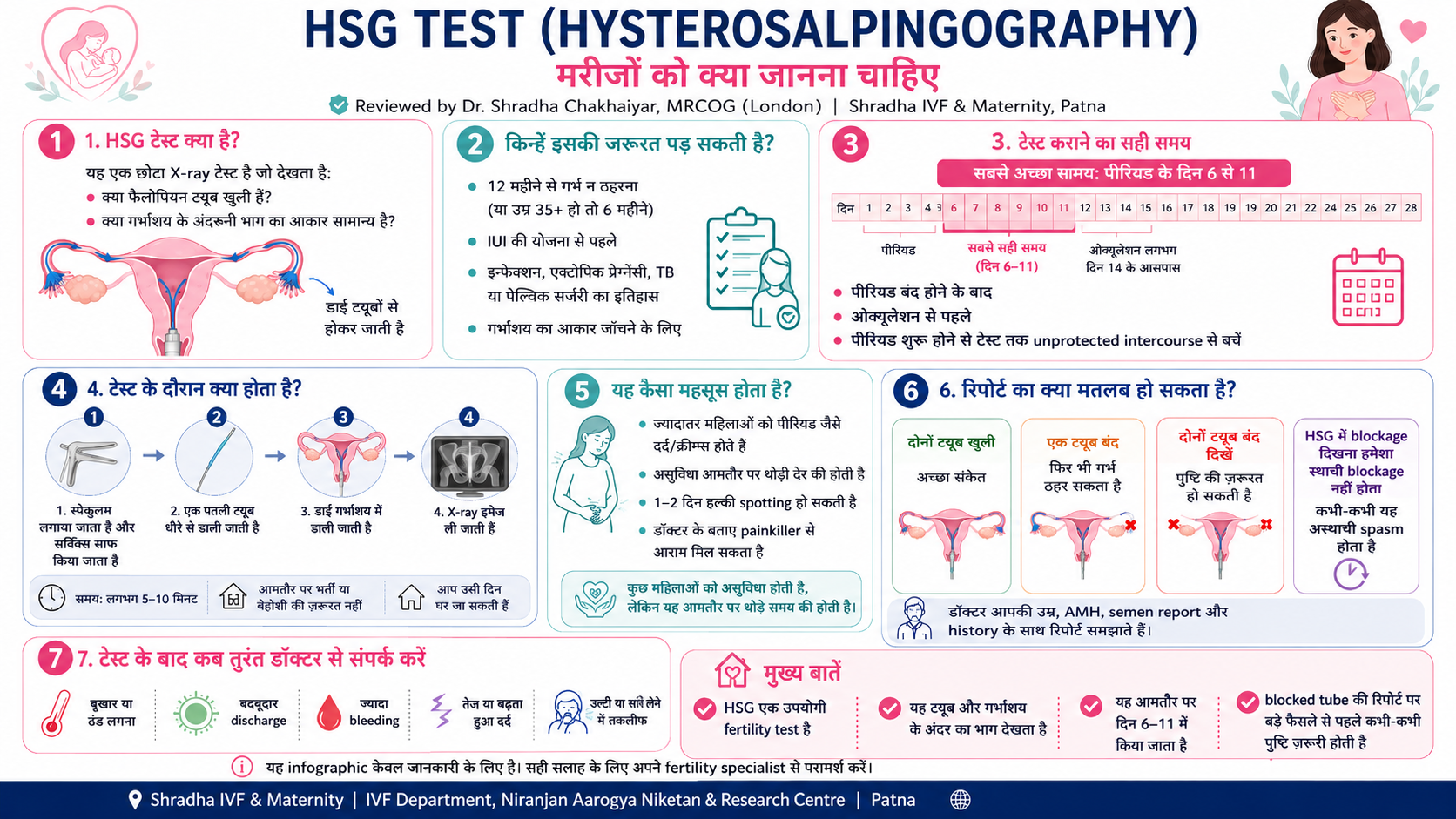
Your report says… what happens next?
| HSG finding | The usual next step |
|---|---|
| Both tubes open, normal cavity | Tubal factor unlikely. Attention shifts to ovulation, egg reserve, sperm quality and timing |
| One tube blocked, one open | Natural conception and IUI remain possible. Depends on age, AMH and semen report |
| Both tubes blocked at the cornual end | Confirm before deciding — repeat study, hysteroscopic cannulation, or laparoscopy with dye test |
| Both tubes blocked at the outer end, or hydrosalpinx | IVF is the definitive route. A hydrosalpinx is often treated first, because the fluid reduces implantation |
| Polyp, fibroid, septum or adhesions in the cavity | Hysteroscopic correction before proceeding with fertility treatment |
No HSG report should be read on its own. It becomes meaningful only alongside your age, ovarian reserve, semen analysis, duration of infertility and past history — which is why the report is best explained by the specialist who will plan your treatment.
Having your HSG done at Shradha IVF & Maternity, Patna
- The test is scheduled on the correct cycle day, and the procedure is explained to you in Hindi beforehand
- Performed and supervised by a female fertility specialist, with privacy respected at every step
- Gentle technique and a slow injection, with cramp management planned in advance rather than after the pain starts
- Your report is explained the same day by the doctor who will plan your treatment — not handed over at a counter without discussion
- If findings are borderline, we confirm before recommending IVF. No couple should begin IVF on the strength of a doubtful film
- All fertility care is provided in accordance with the ART (Regulation) Act, 2021
The cost of an HSG varies with the type of contrast used and whether it is combined with other tests in the same visit. Please ask at the time of consultation so you receive an accurate figure for your situation.
Frequently asked questions
Is the HSG test very painful?
Most women describe strong period-like cramps at the moment the dye is injected, settling considerably within about half an hour. A prescribed painkiller beforehand, a gentle unhurried technique, and knowing what to expect all make a real difference.
On which day of my period should the HSG be done?
Between day 6 and day 11, counting the first day of full flow as day 1 — after bleeding has stopped and before ovulation.
Can I go home and return to work after an HSG?
Yes. There is no admission and usually no anaesthesia. Most women rest for half an hour and resume normal activity the same day.
Can I try for pregnancy in the same cycle after an HSG?
In most cases yes, once the doctor confirms there is no infection and no significant abnormality. Your doctor will tell you if a gap is needed in your situation.
Does HSG open blocked tubes?
It is not a treatment for a truly blocked tube. The flushing action can clear mucus or fine debris, and research shows a modest increase in natural conception afterwards — mainly in younger women with unexplained infertility. A genuinely scarred tube is not opened by the test.
Is the X-ray radiation harmful for a future pregnancy?
No. The exposure is low-dose and focused on the pelvis, and the test is deliberately done before ovulation so no early pregnancy is exposed. It does not affect future pregnancies.
What if only one tube is blocked?
Pregnancy is still possible through the open tube. Whether to try naturally, proceed to IUI, or move to IVF depends on your age, ovarian reserve, semen report and how long you have been trying.
Will I need antibiotics after the test?
Not routinely. Antibiotics are advised selectively — for instance where there is a history of pelvic infection, or where dilated tubes are seen during the test.
HSG or sonography-based tubal testing: which is better?
Both are good tests with comparable accuracy. Sono-HSG avoids radiation and iodine and assesses the ovaries at the same time; X-ray HSG gives a permanent image and may carry the flushing benefit. The right choice depends on your history.
If I am going for IVF anyway, do I still need an HSG?
Not always. But it can still matter, because a hydrosalpinx found on HSG reduces IVF success and is usually treated before embryo transfer. Your specialist will decide whether the test will change your plan.
My HSG is normal but I am still not conceiving. Why?
A normal HSG rules out one cause, not all of them. Ovulation problems, low ovarian reserve, endometriosis, sperm factors and unexplained infertility all remain possible — which is why the tube test is only one part of a complete fertility evaluation. Diet and lifestyle also play a supporting role.
Talk to a fertility specialist
If an HSG has been advised, or you have a report you do not fully understand, bring it to us. A twenty-minute conversation with a specialist often replaces months of uncertainty.
Shradha IVF & Maternity (IVF Department, Niranjan Aarogya Niketan & Research Centre)
Behind Devarun Apartment, Bhikna Pahari, Patna – 800004
Appointments: 9334014489 | WhatsApp: 9523748755
Book online: taponn.me/shradhaivf
Consultation hours: Monday to Saturday, 10:00 AM – 6:00 PM
Reviewed by Dr. Shradha Chakhaiyar, MRCOG (London), Chief Consultant & IVF Specialist, Shradha IVF & Maternity, Patna.
Medical disclaimer: this article is for general education and does not replace a personal consultation. Investigations and treatment must be individualised. No fertility treatment can be guaranteed to succeed.