

Medically Reviewed by Dr. Shradha Chakhaiyar, MBBS, DGO, MRCOG (London) | IVF & Fertility Specialist, Shradha IVF & Maternity, Patna
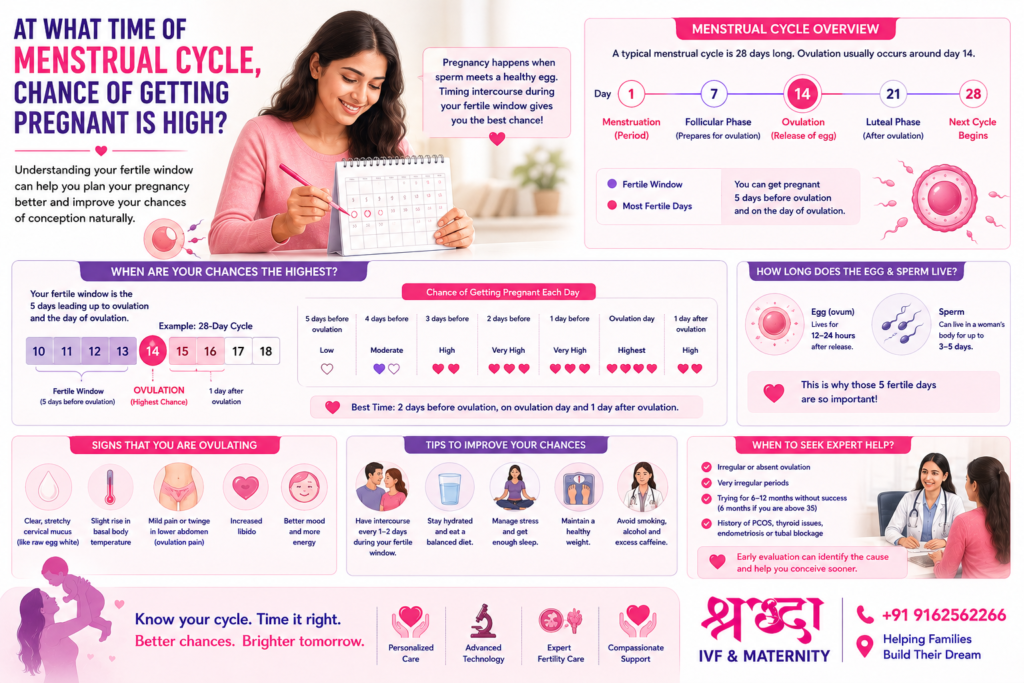
You can only get pregnant during a window of about six days each cycle — the five days before ovulation and the day of ovulation itself. The chance is highest on the day before ovulation and the day of ovulation. In a 28-day cycle that is usually around Days 12 to 14, but ovulation timing depends on your own cycle length, not on a calendar rule. To estimate your ovulation day, subtract 14 from your usual cycle length. Even with perfect timing, a healthy couple under 35 has around a 20 to 25% chance of conceiving in any single cycle.
If you are trying to conceive, the most useful thing you can learn about your body is when your fertile window falls. Most couples who take longer than expected are not facing a medical problem — they are simply mistiming.
The difficulty is that almost every article repeats the same rule: ovulation happens on Day 14. For a large proportion of women that is wrong. This guide explains how to work out your window from your cycle.
What are The Four Phases of the Menstrual Cycle?
| Phase | Typical days | What is happening | Chance of pregnancy |
|---|---|---|---|
| Menstrual | Days 1–5 | The uterine lining sheds. Oestrogen and progesterone are at their lowest. | Very low — but not zero if your cycle is short |
| Follicular | Days 1–13 | Follicles mature; one becomes dominant. Oestrogen rises and the lining thickens. | Rising — significant from about 5 days before ovulation |
| Ovulation | ~Day 14 in a 28-day cycle | The LH surge triggers release of the mature egg, viable for 12–24 hours. | Highest |
| Luteal | Days 15–28 | Progesterone rises and prepares the lining for implantation. | Effectively zero once the egg’s 24 hours have passed |
The luteal phase is the fixed one
This is the detail that makes prediction possible. The luteal phase — from ovulation to your next period — is fairly constant at around 14 days for most women, regardless of total cycle length.
What varies is the follicular phase. A woman with a 35-day cycle does not ovulate late in a normal-length first half; she has a longer first half and then the same 14-day luteal phase. This is why counting backwards from your next period is more accurate than counting forwards from your last one.
If your luteal phase is consistently shorter than 10 days, that is worth investigating — it can indicate low progesterone, which affects implantation.
When Do You Ovulate? Work It Out From Your Own Cycle
Subtract 14 from your usual cycle length. Day 1 is the first day of full bleeding, not spotting.
| Your cycle length | Likely ovulation day | Your fertile window | Most fertile days |
|---|---|---|---|
| 21 days | Day 7 | Days 2–7 | Days 6–7 |
| 24 days | Day 10 | Days 5–10 | Days 9–10 |
| 26 days | Day 12 | Days 7–12 | Days 11–12 |
| 28 days | Day 14 | Days 9–14 | Days 13–14 |
| 30 days | Day 16 | Days 11–16 | Days 15–16 |
| 32 days | Day 18 | Days 13–18 | Days 17–18 |
| 35 days | Day 21 | Days 16–21 | Days 20–21 |
Notice how far apart these are. A woman with a 21-day cycle has finished her fertile window before a woman with a 35-day cycle has started hers.
Why the Fertile Window Is Six Days, Not One
The egg survives only 12 to 24 hours after release. That alone would give a window of less than a day.
What extends it is sperm. Healthy sperm survive three to five days in the reproductive tract, protected and nourished by fertile cervical mucus. So intercourse several days before ovulation can still result in pregnancy, because sperm are already waiting when the egg arrives.
This produces a window of roughly six days: the five days before ovulation, plus the day itself. It closes almost immediately afterwards — which is the part most people get wrong.
What are the Best Days to Get Pregnant?
| Day relative to ovulation | Relative chance of conception |
|---|---|
| 5 days before | Low but real |
| 4 days before | Low |
| 3 days before | Moderate |
| 2 days before | High |
| 1 day before | Highest |
| Day of ovulation | Highest |
| 1 day after | Very low |
| 2+ days after | Effectively zero |
Aim to be early rather than exact. Intercourse every two to three days across the fertile window, rather than trying to hit one perfect day, produces the best chance and considerably less stress. The most common ovulation timing mistakes are worth reading alongside this.
Can You Get Pregnant During Your Period?
It is unlikely, but not impossible — and the reason is worth understanding.
With a short cycle of 21 to 24 days, you may ovulate as early as Day 7. Sperm from intercourse on Day 3 or 4, while you are still bleeding, can survive to meet that egg.
The reverse is also true: with a 35-day cycle, ovulation may not happen until Day 21, so intercourse in the week after your period ends may be too early. “After the period is over” is not a reliable guide in either direction — and the same reasoning is why so-called safe days are unreliable as contraception.
How to Identify Your Fertile Window?
1. Cervical mucus
The most reliable free method. As oestrogen rises, mucus becomes clear, stretchy and slippery, like raw egg white. That change means the window is open. See our guide to fertile ovulation discharge.
2. Ovulation predictor kits
Detect the LH surge 24 to 36 hours before release, giving direct advance notice. See how to use an ovulation kit and read the result — the most common error is treating a faint line as positive.
3. Basal body temperature
Progesterone raises resting temperature by 0.3 to 0.5°C after ovulation. Useful for confirming a pattern over several months, but it tells you only after the window has closed.
4. Ovulation pain and other signs
Some women feel a one-sided cramp (mittelschmerz), breast tenderness or increased libido. Supportive rather than definitive.
5. Follicular monitoring
Ultrasound tracking across the cycle. The only method that confirms an egg was actually released, and the right choice for irregular cycles, PCOS, or repeated unexplained negative cycles.
What Are Realistic Chances to Get Pregnant when Ovulating?
Even with perfect timing, conception does not happen every cycle. For a healthy couple under 35:
- Around 20 to 25% chance in any single cycle with well-timed intercourse
- Around 60% conceive within six months
- Around 85% conceive within twelve months
These decline with age, particularly after 35. But for most couples the important point is that three or four unsuccessful cycles is entirely normal. Our guide on why pregnancy may not happen even after confirmed ovulation covers this in detail.
When Timing Is Not the Problem to Get Pregnant
See a fertility specialist if:
- You have been trying for 12 months under 35, or 6 months over 35
- Your cycles are irregular, very short (under 21 days) or very long (over 35 days)
- You have PCOS, thyroid disorder or endometriosis
- You have had two or more miscarriages
- Your periods have become much shorter or lighter
- There is any concern about male fertility — semen analysis is the simplest first test and the most commonly delayed
— Dr. Shradha Chakhaiyar, MBBS, DGO, MRCOG (London), Shradha IVF & Maternity, Patna
Call (+91) 916 256 2266 · Book an appointment
Frequently Asked Questions on Fertile Window
What is the best time of the menstrual cycle to get pregnant?
The day before ovulation and the day of ovulation. In a 28-day cycle that is usually around Days 13 and 14, but it depends on your own cycle length. Subtract 14 from your usual cycle length to estimate your ovulation day.
How do I calculate my fertile window?
Subtract 14 from your usual cycle length to find your approximate ovulation day, then count back five days. On a 30-day cycle, ovulation is around Day 16 and the fertile window runs roughly Days 11 to 16. If your cycles vary, use your shortest recent cycle.
Can I get pregnant right after my period?
Yes, if your cycle is short. With a 21 to 24-day cycle you may ovulate around Day 7, and sperm surviving from intercourse during or just after bleeding can reach that egg. With longer cycles it is much less likely.
How many days after ovulation can I still get pregnant?
Realistically less than one. The egg survives 12 to 24 hours after release, so the window closes almost immediately. This is why timing intercourse before ovulation matters far more than after.
Does ovulation always happen on Day 14?
No. Day 14 applies only to a 28-day cycle. Ovulation happens roughly 14 days before your next period, so with a 32-day cycle it falls around Day 18. Assuming Day 14 is one of the commonest reasons couples miss their fertile window.
How often should we try during the fertile window?
Every two to three days across the window works better than trying to hit one exact day. It keeps sperm continuously present without the pressure of precise timing, and it performs as well as daily intercourse.
Are safe days reliable for avoiding pregnancy?
No. Cycle length varies, ovulation can shift by several days, and sperm survive up to five days. Calendar-based methods have a high failure rate in typical use and should not be relied on as contraception.