

Reviewed by Dr. Shradha Chakhaiyar, MBBS, DGO, MRCOG (London), IVF Specialist & Reproductive Surgeon
Shradha IVF & Maternity, Patna, Bihar · 20+ Years Clinical Experience
Myth or Fact? The Fertility Quiz
7 quick questions. See how many myths you can spot — then challenge friends and family to beat your score.
The Short, Honest Answer about Fertility and Age
No — being young does not guarantee fertility. Youth strongly improves the odds: fertility peaks in the late teens to late 20s, when egg quantity and quality are highest. But young people can still have conditions like PCOS, endometriosis, blocked tubes, or low sperm count. And fertility declines gradually with age — slowly through the early 30s, faster after 35. Age matters; it’s just not the only thing, and there’s no need to panic.
If you’re a parent or teacher reading this, here’s the reassuring headline first: a healthy young person in their late teens or twenties usually has fertility firmly on their side. Nothing here is meant to frighten anyone. But “the odds are good” is not the same as “guaranteed” — and the belief that youth is a lifetime guarantee is exactly what leaves people surprised later. The goal isn’t worry. It’s awareness: understanding the body now so that decisions later are calm and informed.
The Biology of Fertility and Age No One Explains in School
Here’s the single most important fact — and most young adults have never been told it: a girl is born with all the eggs she will ever have, and that number only ever goes down. Unlike boys, who produce new sperm throughout life, the ovaries never make new eggs.
A baby girl has the most eggs she’ll ever have before she’s even born (around 6–7 million in the womb), down to roughly 1–2 million at birth, and about 300,000–400,000 by puberty. From there, the supply steadily falls — gradually until about age 32, faster to about 37, then more steeply. This is called ovarian reserve, and you can read more in our guide to what low ovarian reserve means (or, in Hindi, AMH kya hai).
It’s not only about quantity. As eggs age, more of them carry chromosomal errors — which is why both the chance of conceiving falls and the risk of miscarriage rises with age. This is the heart of why your eggs won’t wait — a reality worth understanding early rather than fearing.
0 newEggs made after birth
Fertility by Age — Move the Slider
Drag to any age and watch the realistic chance of conceiving within a year change. Notice it's a gentle slope — not a sudden cliff.
The Most Surprising Truth: Fertility Is a Curve, Not a Straight Line, When it Comes to Age
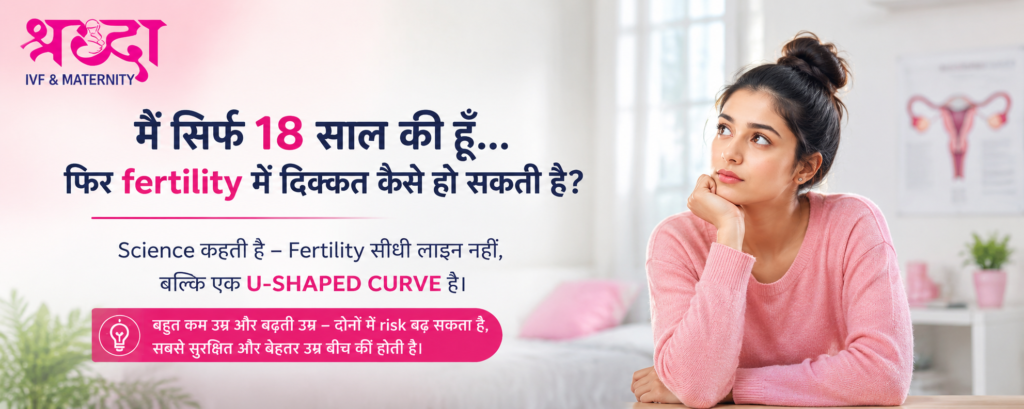
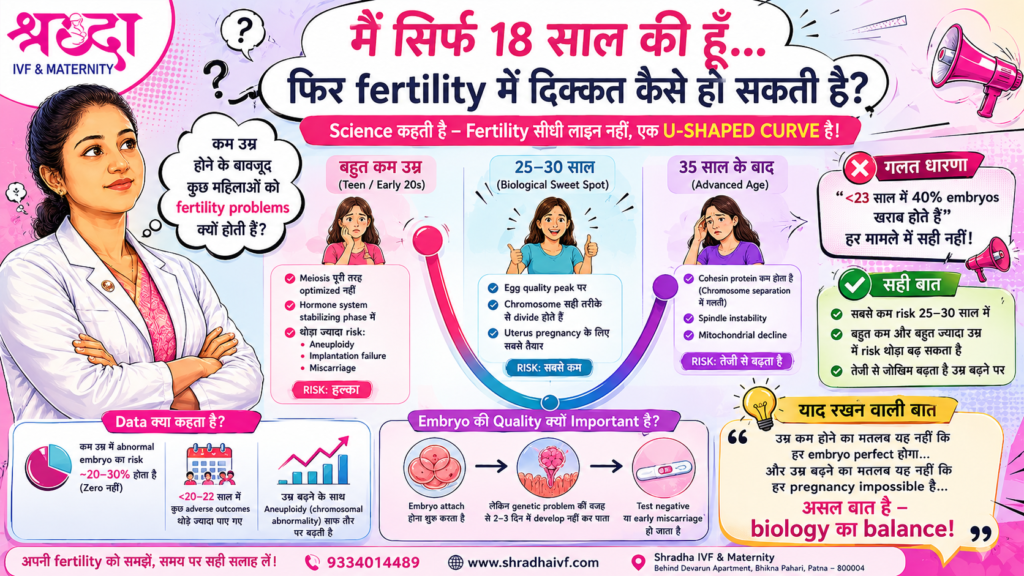
Here’s the part that surprises almost everyone — including many young patients who assume “young age = no fertility problem.” Reproductive science tells a more nuanced story. Egg quality and embryo chromosomal health don’t simply get worse in a straight line as you age. They follow a U-shaped curve: the risk of chromosomal abnormalities is mildly higher at both ends of the reproductive span, and lowest in the middle.
Why the Two Ends of the Curve Behave Differently
- Younger age (teens & early 20s). At this stage, meiosis — the cell division that makes eggs — isn’t fully optimised yet, and the hormonal (HPO) axis is still stabilising. The result can be a slightly increased risk of chromosomal abnormalities (aneuploidy), implantation failure, or miscarriage compared with the mid-20s. The key word is slightly: this rise is mild, and it is nowhere near the scale of age-related risk later on.
- Mid-to-late 20s (the biological sweet spot). This is the most efficient reproductive phase — egg quality is at its peak, chromosome segregation is most accurate, and the uterine lining is most receptive. This is when the rate of chromosomally abnormal embryos is at its lowest.
- Age 35 and beyond. Here, the science is very clear. Loss of “cohesin” proteins that hold chromosomes together leads to separation errors, the spindle that divides chromosomes becomes less stable, and the egg’s energy machinery (mitochondria) declines. The result is a rapid rise in aneuploid embryos, IVF failure, and miscarriage — for example, chromosomal abnormality in eggs rises from roughly 30% around age 31 to about 36% at 36, then climbs steeply toward 80–90% by the mid-40s. This is why your eggs won’t wait and how age affects IVF matters so much.
📱 Where Social Media MisleadsYou may have seen viral claims like “under 23 = 40% abnormal embryos.” That specific figure isnotwell-supported by scientific data. The honest picture: abnormal-embryo rates in young women are roughly20–30%(lower in the mid-20s, mildly higher at the extremes) — and they rise dramatically only with increasing age. Don’t let a scary statistic convince a young person that something is wrong when, statistically, the odds are still strongly in their favour.
There’s one more truth hiding in all this: “young” does not mean “every embryo is perfect.” Even in the best years, a meaningful share of embryos carry chromosomal errors — that’s normal biology, not a problem. Chromosomal abnormalities are actually the most common single cause of IVF failure, implantation failure, and early miscarriage: many embryos begin to attach, then stop developing within days because of a chromosomal error. That can show up simply as a negative pregnancy test or a very early miscarriage — and it happens at every age.
(Being young doesn’t mean every embryo will be perfect — and being older doesn’t mean pregnancy is impossible. What really matters is the balance of biology.)
So the most useful question isn’t only “Is my age okay?” It’s “Is my embryo genetically healthy — and is my whole picture right?” Because real fertility depends on four things together: egg quality, embryo genetics, the uterine environment, and a correct diagnosis. Age is one important piece — not the whole story.
6 Fertility Myths Worth Clearing Up About Age and Fertility Chances
These are the ones we hear most often in clinic — and the ones worth correcting gently with the young people in your life:
“I’m young, so I’m definitely fertile.”
Youth improves the odds but guarantees nothing. PCOD/PCOS, endometriosis, blocked fallopian tubes, thyroid issues, and low sperm count affect people in their teens and twenties, too — and being young can even delay diagnosis.
“Fertility falls off a cliff at 35.”
Also false — the opposite myth. Fertility declines gradually, not suddenly. 35 is just where the slope steepens a little. Many women conceive naturally well beyond it.
“It’s all about the woman’s age.”
Roughly half of all fertility difficulties involve a male factor. See male infertility, and does male fertility last forever? — sperm quality declines with age too.
“A healthy lifestyle guarantees fertility.”
Healthy habits genuinely help both partners — but can’t override age, genetics, or a medical condition. Worth knowing which lifestyle mistakes quietly damage fertility (yes, including screen addiction).
“I’ll just do IVF later.”
IVF is powerful but not an age eraser — it still uses your own eggs, so its success also falls with age. Here’s how age affects IVF.
“Fertility myths on social media are harmless.”
They’re not — misinformation drives both panic and false comfort. We tackle the big ones in busting fertility treatment myths.
Why Young People Can Still Have Fertility Issues
This is the part “you’re young, relax” advice gets wrong — and the part that leaves young people feeling dismissed. Even at peak age, common conditions can affect conception: PCOD/PCOS (very common and rising among young Indian women), endometriosis (often diagnosed late), blocked tubes, thyroid imbalance, and male-factor issues. The message isn’t “panic” — it’s the opposite of dismissal: if something feels off (very irregular cycles, severe period pain, or a long time trying), being young is a reason to get a clear answer early, when things are most treatable. Understanding your fertile window and cycle is a great first step, and good preconception health helps everyone.
Fertility Awareness in India — Why This Matters Here
Awareness is strikingly low. One study of Indian women found 85% were unaware of the fertile window in their cycle, and only 8% knew that being over 35 is a major fertility risk factor. Meanwhile, marriage and childbearing are being delayed, PCOS is rising among young urban women, and lifestyle pressures are mounting. That’s exactly why calm, accurate education — the kind a parent or teacher can pass on — matters so much. (For the bigger picture: how fertility has changed over 50 years.)
So What Should You Actually Do? Know Your Body, Don’t Panic
Instead of asking: “Is my age okay?” You should ask: “Is my embryo genetically healthy?” Because fertility is not just about age—it’s about: Egg quality, Embryo genetics, Uterine environment, and Correct diagnosis
For almost everyone, young and healthy, the answer is simply: live your life, and stay informed. Here’s the calm guide to when to do a little more — and you can use the checklist below to think it through.
"Is It Worth a Conversation With a Doctor?"
Tick anything that applies to you or the young adult you're thinking of. This isn't a diagnosis — just a calm way to decide if a chat with a specialist makes sense.
| Situation | What’s sensible |
|---|---|
| Young, healthy, not trying yet | Live your life. Know your cycle, stay generally healthy, and just be aware age matters over time. No testing needed. |
| Trying to conceive, under 35 | Give it time — see a doctor after about 12 months. When to see a specialist → |
| Trying to conceive, 35+ | See a specialist after about 6 months — time matters a little more now. |
| Irregular cycles, known PCOS/endo, or prior pelvic surgery | Get checked sooner — don’t wait. These are reasons to ask early. |
| Just want a baseline / to plan ahead | A simple consult and an AMH test give clarity and peace of mind. |
The Bottom Line
Is fertility guaranteed when you’re young? No — but that’s not a reason to worry. It’s a reason to be informed. Youth genuinely helps. Age matters, but gradually. It’s not only about women, and it’s not only about age. And knowing your body — understanding your cycle, the basics, and when it’s worth asking a doctor — beats both anxiety and false reassurance every time. For the young people in your life, that knowledge is a quiet superpower. Know your body, don’t panic.
How Shradha IVF Can Help — Without the Pressure
Whether you simply want to understand ovarian reserve, you have a condition like PCOS/PCOD you’d like managed, or you want to learn how to improve egg quality, a calm consultation gives a clear picture — led personally by Dr. Shradha Chakhaiyar, MRCOG (London). The first consultation is free.
FAQs: Best Age to Get Pregnant
There is no single “perfect” age for pregnancy because emotional, financial, and personal readiness also matter. From a biological perspective, fertility is generally highest in the 20s and early 30s, with many experts considering the late 20s to early 30s as a favorable reproductive period. During these years, egg quality and quantity are usually better, and the risk of pregnancy complications is generally lower.
However, many women also have healthy pregnancies in their mid-30s and beyond with proper medical care. The “right age” ultimately combines biological factors with individual life circumstances.
Women are born with around 1–2 million eggs, but this number naturally declines over time. By puberty, the number drops to approximately 300,000–500,000 eggs. Research suggests that around age 30, a woman may already have lost roughly 90% of her original egg reserve, meaning only about 10–12% of the eggs present at birth remain.
The decline becomes more noticeable after age 35, and both egg quantity and quality continue to decrease with age. However, fertility is influenced by more than just egg numbers — egg quality, hormonal health, overall reproductive health, and lifestyle factors also play important roles.
At 18, fertility is generally high because egg quality and quantity are usually healthy. However, while pregnancy is biologically possible, 25–30 years is considerable a favourable age range, as it often balances fertility with physical and emotional readiness.
Share It With Someone Who Should Read This
Help a young adult, a parent, or a friend know their body — calmly and accurately.
Know Your Body. Plan With Confidence.
Awareness is empowering, not frightening. If you’d like a clear picture — for yourself or someone you love — talk to Dr. Shradha Chakhaiyar at Shradha IVF & Maternity, Patna.
Book a Free Consultation →