


Medically Reviewed by Dr. Shradha Chakhaiyar, MBBS, DGO, MRCOG (London) — IVF Specialist & Reproductive Surgeon, Shradha IVF & Maternity, Patna
20+ Years of Experience · www.shradhaivf.com
Female fertility declines with age because both the number and quality of eggs fall — slowly through the 20s and early 30s, then faster after 35. A woman is born with all her eggs and loses about 1,000 every month. The best age to freeze eggs is your late 20s to early-mid 30s (before 35), when eggs are healthiest. An AMH blood test shows how many eggs remain.
📋 What This Guide Covers
- The biology: you’re born with all your eggs
- How egg count changes with age
- What is AMH, and what does it reveal?
- Why timing matters — the 35 cliff
- Your uterus doesn’t age — your eggs do
- Egg freezing: how it works
- The best age to freeze your eggs
- Egg-freezing success rates by age
- How many eggs should you freeze?
- Egg freezing in Patna & Bihar
- What you can do now
- FAQs
The Biology: You Are Born With All the Eggs You’ll Ever Have
This is the single most important fact about female fertility, and the one most women aren’t told until it matters: no new eggs are made after birth. You are born with your entire lifetime supply, and it only ever decreases. Every month, nearly 1,000 eggs are lost through a natural process called atresia — and this happens whether or not you are menstruating, ovulating, on contraception, or pregnant. The decline never pauses.
How Egg Count Changes With Age
The numbers are dramatic when you see them laid out. A baby girl has 1–2 million eggs at birth. By puberty, that’s already down to around 300,000–400,000. And the decline continues — and accelerates — through adulthood:
| Age | Approximate Eggs Remaining | Approx. % Genetically Healthy |
|---|---|---|
| At birth | 1–2 million | — |
| Age 30 | ~150,000 | ~75% |
| Age 35 | ~25,000 | ~50% |
| Age 40 | ~5,000 | 25% or less |
Notice that two things fall at once: the number of eggs (quantity) and the proportion that are genetically normal (quality). This double decline is why fertility drops faster than most people expect — and why age is the single strongest predictor of female fertility. (If you want to understand how to support egg quality in the months before trying, see our guide on how to improve egg quality.)
What Is AMH, and What Does It Reveal?
AMH (Anti-Müllerian Hormone) is a simple blood test that estimates how many eggs you have left — your “ovarian reserve.” It can be done at any point in your cycle, and it’s one of the most useful early signals of your fertility timeline.
- Normal range: roughly 2.0–4.0 ng/mL
- Low / reduced reserve: below about 1.0 ng/mL
A low AMH means a low egg count — it’s about quantity, not quality, and it cannot be raised by any supplement or treatment. It’s a number worth knowing early, especially if you’re planning to delay motherhood, because it tells you how much time and flexibility you realistically have. If your AMH comes back low, our dedicated guide on [LINK: low ovarian reserve] explains exactly what it means and what your options are.
Why Timing Matters — The “35 Cliff”
Fertility doesn’t fall in a straight line. It declines gradually through your 20s and early 30s, then drops more steeply from about 35 onwards — both because fewer eggs remain and because a larger share of them carry chromosomal errors. The practical effect:
- At 30, a healthy woman has roughly a 20% chance of conceiving in any given cycle.
- At 40, that falls to under 5% per cycle — and the miscarriage rate rises too.
This is why the honest framing is so simple. Your career can wait. A house can be bought later. Travel can happen any time. But your eggs are on a biological clock that doesn’t care about your schedule — and the earlier you understand your own numbers, the more choices you keep open.
An Important, Reassuring Truth: Your Uterus Doesn’t Age — Your Eggs Do
Here’s a nuance that brings real comfort and is rarely explained. When we talk about “age-related fertility decline,” we are almost always talking about the eggs — their number and their chromosomal quality. The uterus itself does not meaningfully age in the same way. A healthy uterus can carry a pregnancy well into the 40s and beyond.
This is why two things are true: a woman who freezes her eggs at 30 and uses them at 40 is, in effect, using 30-year-old eggs — the clock was paused. And it’s why donor-egg IVF has high success rates at almost any age — because the limiting factor was egg quality, not the womb. Understanding this turns “I’ve left it too late” into “I have more options than I thought.”
Egg Freezing: How It Works
Egg freezing (medically, oocyte cryopreservation) lets you preserve your eggs at their current age, to use later. In effect, it pauses the biological clock for the eggs you store. The process is essentially the first half of an IVF cycle:
- Ovarian stimulation — about 10–12 days of hormone injections encourage the ovaries to mature multiple eggs in one cycle (instead of the single egg you’d ovulate naturally).
- Monitoring — blood tests and ultrasound scans track the eggs as they mature.
- Egg retrieval — a short procedure (about 20–30 minutes) under light sedation collects the mature eggs.
- Vitrification (flash-freezing) — the eggs are frozen instantly using modern vitrification, which avoids ice-crystal damage and gives survival rates above 90%.
- Storage — the eggs are stored safely until you’re ready, then thawed, fertilised, and transferred when the time is right.
Importantly, egg freezing does not reduce your natural fertility — the eggs collected in a cycle would otherwise have been lost that month anyway. It simply rescues some of them.
The Best Age to Freeze Your Eggs
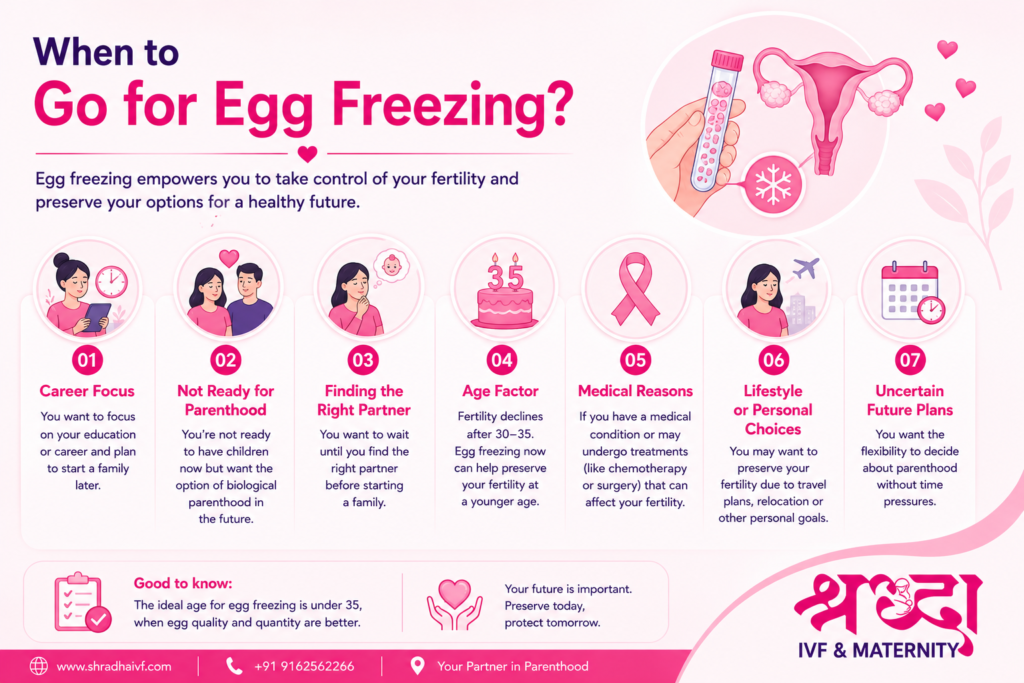
The honest answer: the best age to freeze your eggs is your late 20s to early-mid 30s — ideally before 35. Younger eggs are both more numerous and more likely to be chromosomally normal, so freezing earlier means you store better-quality eggs and need fewer cycles to bank enough. Freezing is still possible and worthwhile in the late 30s and even early 40s, but more eggs (and sometimes more than one cycle) are needed to reach the same odds.
Egg-Freezing Success Rates by Age
Success depends heavily on the age at which eggs are frozen, because that determines how many will survive thawing and go on to become healthy embryos. As a general guide drawn from international outcome data:
| Age at freezing | Egg → healthy embryo | Outlook |
|---|---|---|
| Under 35 | ~20–30% of eggs become genetically normal embryos | Strongest odds; fewest eggs needed |
| 35–37 | Still strong, slightly lower | Good outcomes; freeze without much delay |
| 38–40 | ~8–9% of eggs become normal embryos | More variable; bank more eggs |
| 41–42 | Lower still | Possible, but more eggs / cycles needed |
| 43+ | Very low | Donor eggs may be discussed as an option |
Survival of frozen eggs through thawing is excellent at younger ages (above 90%) and falls in the early 40s. The takeaway is consistent: the younger you freeze, the more each egg is worth.
How Many Eggs Should You Freeze?
For a good chance of at least one live birth later, most specialists aim to bank around 15–20 mature eggs. Below roughly 10 eggs, the odds drop noticeably; with 20 or more frozen at a younger age, success rates are strong. How many you can collect in one cycle depends on your age and your ovarian reserve (your AMH and antral follicle count) — which is exactly why testing first is so useful. Some women reach their target in one cycle; others, particularly over 37, may need two.
Egg Freezing in Patna & Bihar
Egg freezing is fully legal in India and regulated under the ART (Regulation) Act, 2021. For women in Bihar, the encouraging news is two-fold: you no longer need to travel to Delhi or Mumbai to preserve your fertility, and the cost in India is a fraction of what it is abroad. At Shradha IVF & Maternity, Patna, fertility preservation is overseen personally by Dr. Shradha Chakhaiyar, MRCOG (London), with the same advanced embryology and vitrification standards used at leading metro centres.
What You Can Do Now to Freeze Your Eggs?
Whatever your age, knowledge is power — and the worst position is acting on assumptions instead of facts. Here’s the practical path:
- Test your AMH early — even in your 20s if you’re planning to delay motherhood. It’s a simple blood test, and it tells you how much time you realistically have.
- Know your numbers, not your guesses. Many women assume they have “plenty of time” because they feel young and healthy. Egg reserve is invisible — only a test reveals it.
- Consider freezing if you’re not ready but want the option. Freezing younger eggs is the most effective way to keep your future choices open.
- Support your egg quality in the meantime — see our 90-day egg quality guide for the evidence-based steps that genuinely help.
- If you’ve been trying for a while, don’t wait. If you’re under 35 and have been trying for 12 months (or 6 months if over 35), see a fertility specialist now. Time is the one variable we can never recover.
Learn From Others’ Regret
One of my patients, at 33, told me, “I wish I had frozen my eggs at 28. Now I’m doing IVF with my last few good eggs.” She is far from alone. The most common pattern I see in over twenty years of practice in Bihar is not medical complexity — it’s delay. Couples wait three, four, or even six years before seeking help, hoping things will resolve on their own. That hope is understandable, but it quietly costs the one thing that can’t be bought back: time. Don’t let time make your decisions for you.
Know Your Numbers — Before They Decide For You
A simple AMH test and a conversation with Dr. Shradha can show you exactly where you stand and what your options are — whether that’s egg freezing now or simply peace of mind. The first consultation is free.
FAQs on Egg Freezing
The best age to freeze eggs is your late 20s to early-mid 30s, ideally before 35. Younger eggs are more numerous and more likely to be chromosomally normal, so you store better-quality eggs and need fewer cycles. Freezing in the late 30s and early 40s is still possible but requires more eggs.
A woman is born with 1–2 million eggs. By age 30 around 150,000 remain (about 75% genetically healthy), by 35 around 25,000 (about 50% healthy), and by 40 around 5,000 (25% or fewer healthy). Roughly 1,000 eggs are lost every month throughout life.
Egg freezing is the first half of an IVF cycle: about 10–12 days of hormone injections mature multiple eggs, which are collected in a short procedure under light sedation, then flash-frozen by vitrification (over 90% survival) and stored. Later they are thawed, fertilised, and transferred when you're ready.
No. Egg freezing does not reduce your natural fertility or your ability to conceive later. The eggs collected in a freezing cycle would otherwise have been lost that month through the body's natural process. Freezing simply rescues some of those eggs instead of letting them go.
For a good chance of at least one live birth later, specialists generally aim to bank around 15–20 mature eggs. Fewer than 10 lowers the odds; 20 or more (frozen younger) gives strong success rates. How many you collect per cycle depends on your age and ovarian reserve.