

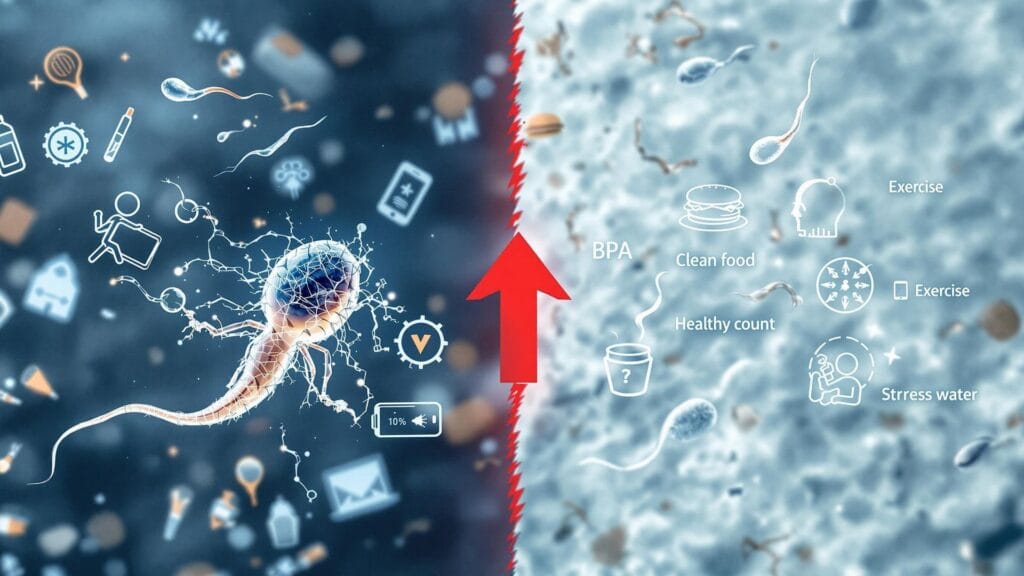
Why has fertility declined over the past 50 years? | Learn the reasons and solutions.
Fertility has declined dramatically over the past 50 years. Learn how pollution, chemicals, and lifestyle are combining to attack human fertility.
Sperm counts in men have declined by 50% (1973–2018)
Infertility in women ages 35–39 has increased by 84% (1990–2021)
Having a baby without IVF and IUI may become more difficult in the coming years

Is it true that humans are no longer capable of producing children?
Why Fertility Has Been Declining Over the Last 50 Years – An Eye-Opening Truth
“When my grandmother was 25, she had already had 3 children… and today, I am 32 and have been yearning for just one ‘positive report’ for 3 years…”
This story is not just about one woman, it is the reality of today’s world.
What’s going on? – “Sperm count has dropped by half!”
Sperm counts in men have declined by more than 50% over the past 50 years.
From 99 million/ml in 1973, they have now dropped to less than 47 million/ml.
And these statistics aren’t just from a research lab—they’re data that’s now reflected in the exhaustion and breakdown of every other couple.
The situation is no better for women either.
Between 1990 and 2021, infertility rates among women aged 35-39 increased by 84%.
Many women are experiencing menstrual irregularities, ovulation disorders, and declining egg quality.
This doesn’t mean women are doing anything wrong—the world just isn’t the same anymore.
Why is there such a decline? / Why is fertility declining?
1 Toxic Chemicals (EDCs)
Plastics, perfumes, chemical-laden food packaging—they’re all attacking hormones.
Plastic bottles, canned food, scented soaps—chemicals like BPA and phthalates in them directly attack your hormonal system.
“These chemicals slowly enter the body, weakening sperm and eggs… and we don’t even realize it.”
2. Pollution:
Declining air quality directly impacts women’s ability to ovulate and men’s sperm quality.
Gases like dust, smoke, PM2.5, and nitrogen dioxide all have a direct impact on female fertility.
3. Unhealthy lifestyle and obesity
Obesity = hormonal imbalance → low fertility
Today’s diet, stress, spending hours on mobile – all these together disturb the hormonal balance.
4. Delaying childbearing:
Delayed marriage, career pressures, and advancing age—all of these impact egg and sperm quality.
As careers, education, and marriage advance, women often consider having children, but their bodies may not support them.
5. Microplastics
The excessive use of plastics poses a silent but dangerous threat to our reproductive health—especially in the form of microplastics. Recent research has shown that microplastics are accumulating in the testicles of humans and dogs, which have been linked to decreased sperm count and testicular weight. For example, a study published in Toxicological Sciences found that the average level of microplastics (PVC, PET, etc.) in humans was three times higher than in dogs, and the presence of these plastic particles can disrupt sperm production.

The ability to be human – slowly disappearing?
Scientists believe that if this pace continues, having children without techniques like IVF may become rare in the coming decades.
❝Nature is being quietly overridden by pollution, pressure, and pace.❞
💔 Story of an ordinary couple:
“It had been 5 years since our marriage. Everything was fine, but we were not able to have a child. People said – it must be an evil eye, but when I got it tested, I found out that my sperm count is very low. I never imagined that this would happen to me…”
❤️ So what to do? What’s the solution?
Accept the truth:
Infertility is nothing to be ashamed of—it’s a reality of today’s world. The sooner you understand it, the sooner you’ll find a solution.
- Awareness is the first cure
- Stay away from plastic
- Eat healthy food
- Keep body weight under control
- Reduce stress
- Get regular checkups
✅ Consult a doctor at the right time
Technologies like IVF, IUI, egg freezing are very advanced today – planning and consultation in advance is essential.
📚 Scientific Citations:
Levine et al., 2022 – Human Sperm Count Decline (Nature Reviews Urology)
WHO GBD 2021 – Infertility Burden & Trends
Nature Scientific Reports, 2024 – Female Age-Related Infertility Analysis
Environmental Health Perspectives – Impact of EDCs on Reproductive Health
🔔 Finally, a thought-provoking thought:
“We have changed the planet so much that even maintaining a healthy body is a struggle.”
If this blog makes you think—please share it with a couple who needs it.
Because sometimes, one click can be the path to becoming a mother.
✨📍Shraddha IVF & Maternity Bhikna Pahadi, Patna |
📞 9162562266
🌐 www.shradhaivf.com
Why has fertility declined over the past 50 years? Know the causes and remedies
Fertility has declined drastically in the last 50 years. Know how pollution, chemicals and lifestyle are attacking human fertility.
- 50% decline in sperm count in men (1973-2018) Infertility in women
- aged 35-39 increased by 84% (1990-2021)
- Having a baby without IVF and IUI can be more difficult in the coming years
Is man really no longer capable of bearing children?
Why has fertility declined over the past 50 years? An Eye – Opening Truth When my grandmother was 25 years old, she already had 3 children… And today, at 32, I have been yearning for just one ‘positive report’ for 3 years… “This is not just a woman’s story, this is the reality of today’s world.
What’s happening? “The sperm count has halved! “
In the last 50 years, the sperm count in men has declined by more than 50%.
Yes, in 1973 where it was 99 million / ml, now it has gone below 47 million / ml.
And it’s not just any research lab. This is the data that is now reflected in the fatigue and brokenness of every other couple.
The situation is no better for women:
- Between 990 and 2021, the rate of infertility among women aged 35-39 has increased by 84%.
- Many women suffer from irregular periods, irregular ovulation and poor egg quality.
- That doesn’t mean women are wrong. The world is no longer the same.
Why is there such a decline? Why is fertility declining?
1. Toxic Chemicals (EDCs)
Plastic, Perfumes, Food Packaging containing Chemicals- All of them attack the hormones.
Plastic bottles, canned food, scented soaps – chemicals like BPA and phthalates present in them directly attack your hormone system.
“These chemicals slowly enter the body and weaken the sperm and egg... and we don’t even know. “
2. Pollution
The deterioration in air quality has a direct impact on the ovulation capacity of women and sperm quality of men.
Gases like dust, smoke, PM 2.5, nitrogen dioxide have a direct impact on women’s fertility.
3. Unhealthy lifestyle and obesity
Obesity = Hormone disturbances Low fertility Today’s diet, stress, spending hours on mobile – all these together disturb the hormonal balance.
4. Late child planning,
delayed marriage, career pressures and increasing age. All this affects the quality of the egg and sperm.
With the increasing age of career, studies and marriage, when women think of a child, the body does not support.
5. Microplastics
Excessive use of microplastics has become a silent but dangerous threat to our reproductive health – especially in the form of microplastics. Recent research has shown that microplastics are also accumulating in the testes of humans and dogs, which have been found to be associated with a decline in sperm count and testis weight. For example, according to a study published in Toxicological Sciences, the average level of microplastics of inferior science (PVC, PET, etc.) in humans was three times higher than in dogs, and the presence of these plastic particles can disrupt sperm production.
The ability to become a person – gradually disappears?
Scientists believe that if this pace continues, it may be rare to have children without techniques such as IVF in the next few decades.
“Nature is being quietly overridden by pollution, pressure, and speed”
Story of a Common Couple:
“It had been 5 years of marriage. Everything was fine, but the baby wasn’t. People said that they must have noticed, but when they got the test done, it was found that my sperm count is very low. I never thought this would happen to me.
So what to do? What is the solution?
Accept the truth, infertility is nothing to be ashamed of. This is a reality of today’s world. The sooner you understand it, the better it will be.
Awareness is the first treatment
- stay away from plastic,
- eat healthy food,
- keep body weight under control,
- reduce stress,
- get regular check-ups.
Consult a fertility specialist at the right time
Techniques like IVF, IUI, egg freezing are very developed today. Consulting and planning ahead of time is essential.
Scientific citations
- Levine et al. Human Sperm Count Decline (Nature Reviews Urology)
- WHO GBD 2021 – Infertility Burden & Trends
- Nature Scientific Reports, 2024 – Female Age-Related Infertility Analysis
- Environmental Health Perspectives – Impact of EDCs on Reproductive Health
Finally, something to think about:
We changed the earth so much that it is now a struggle even to keep the body fit for childbirth. “If this blog makes you think – pass it on to a couple who needs it.
Because many times one click, can become the way to become someone’s mother.