


Reviewed by Dr. Shradha Chakhaiyar, MRCOG (London), MS (Obstetrics & Gynaecology), IVF Specialist
Chief Consultant, Shradha IVF & Maternity, Patna, Bihar
📋 Table of Contents
- What Is IVF?
- Who Needs IVF?
- The IVF Process — Step by Step
- Types of IVF Treatment
- IVF Success Rates by Age
- How Much Does IVF Cost?
- Risks and Side Effects
- How to Prepare for IVF
- IVF vs IUI vs ICSI
- After the Embryo Transfer
- IVF at Shradha IVF, Patna
- Frequently Asked Questions
What Is IVF?
IVF was first used successfully in 1978, when Louise Brown was born in the UK. In India, the first IVF baby, Kanupriya Agarwal, was born in Kolkata in 1986. Since then, over 8 million IVF babies have been born worldwide, and India now performs approximately 2.5–3 lakh IVF cycles annually — a number growing at 15–20% every year. IVF is no longer experimental. It is a well-established, evidence-based treatment that has given parenthood to millions of couples who could not conceive naturally.
What are the Benefits of IVF Treatment?
IVF (In Vitro Fertilisation), also known as Test Tube Baby treatment, is one of the most advanced and trusted fertility treatments for couples facing difficulty in conceiving naturally. It has helped millions of families worldwide by offering safe, effective, and personalised solutions for infertility.
- Helps Couples Achieve Pregnancy: IVF treatment gives hope to couples who are unable to conceive naturally. It increases the chances of pregnancy by assisting the fertilisation process.
- Useful for Multiple Infertility Problems: IVF can help in cases such as blocked fallopian tubes, low sperm count, ovulation disorders, endometriosis, PCOS, and unexplained infertility.
- Higher Success Rates: Compared to many other fertility treatments, IVF often offers higher pregnancy success rates, especially with expert care and advanced technology.
- Better Control Over Fertilisation: Eggs and sperm are combined in a laboratory under controlled conditions, allowing doctors to monitor embryo development closely.
- Healthy Embryo Selection: Specialists can select the highest-quality embryos for transfer, which may improve the chances of implantation and pregnancy.
- Helpful for Older Women: Women facing age-related fertility decline may benefit from IVF, as it can offer better conception chances in many cases.
- Option for Frozen Embryos: Extra embryos can be frozen for future use, helping with future pregnancy planning and reducing repeat procedures.
- Supports Genetic Screening: IVF can include embryo testing when medically advised to help detect certain genetic conditions before transfer.
- Useful for Different Family Needs: IVF supports couples, single parents, and those requiring donor eggs, donor sperm, or fertility preservation.
- Emotional Hope and Confidence: For many couples, IVF brings renewed hope after years of trying to conceive naturally.
- Customised Treatment Plans: IVF treatment is personalised based on age, fertility condition, and medical history for better outcomes.
- Safe and Widely Trusted Procedure: IVF is a well-established treatment that has helped millions of families worldwide with modern medical safety standards.
Who Needs IVF? When to Consider It
IVF is recommended when other fertility treatments have not succeeded, or when a medical diagnosis makes IVF the most appropriate first-line treatment. The following situations are the most common indications:
- Blocked or damaged fallopian tubes: If one or both tubes are blocked, scarred, or absent (after removal), eggs cannot travel naturally to the uterus. IVF bypasses the tubes entirely, making it the most effective solution for tubal factor infertility.
- Severe male factor infertility: When the sperm count is very low, sperm motility is severely impaired, or DNA fragmentation is high, natural conception or IUI is unlikely to succeed. IVF combined with ICSI (where a single sperm is injected directly into each egg) is the recommended approach.
- Failed IUI cycles: If 3–4 IUI (Intrauterine Insemination) cycles have not resulted in pregnancy, IVF is the recommended next step.
- Endometriosis: Moderate to severe endometriosis affects egg quality, tube function, and the uterine environment. IVF offers better outcomes than continued natural attempts in established endometriosis.
- Polycystic Ovary Syndrome (PCOS) with failed ovulation induction: When medications like Clomiphene or Letrozole have failed to result in pregnancy, IVF with controlled ovarian stimulation is the next step.
- Low ovarian reserve: A low AMH (Anti-Müllerian Hormone) level indicates a declining egg supply. IVF allows maximum egg retrieval in a monitored cycle, making the most efficient use of remaining reserve.
- Unexplained infertility: When no cause has been found after thorough investigation and 12+ months of trying, IVF is often recommended because it addresses potential fertilisation or implantation issues that standard tests cannot identify.
- Age-related fertility decline: Women over 35 experience an accelerating decline in egg quality. IVF combined with advanced embryology (blastocyst culture, PGT-A screening) offers the best chance of pregnancy when time is a factor.
- Genetic conditions: Couples with heritable genetic disorders may choose IVF with PGT (Preimplantation Genetic Testing) to test embryos before transfer, reducing the risk of passing on the condition.
What is the IVF Process? — Step by Step at Shradha IVF, Patna
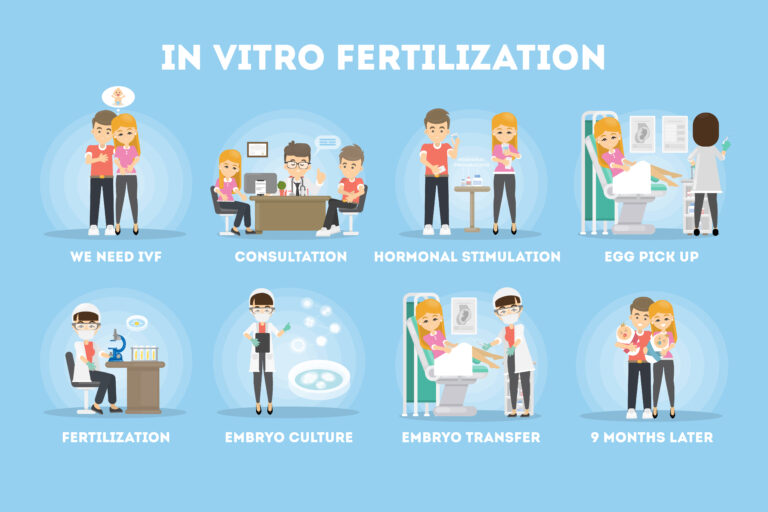
A complete IVF cycle from the start of stimulation to the pregnancy test takes approximately 4–6 weeks. Here is what happens at each stage:
Initial Evaluation and Treatment Planning (Weeks Before Cycle)
Before any injections begin, both partners undergo a comprehensive fertility evaluation. For women: AMH (ovarian reserve), Day 3 FSH/LH/E2, TSH, prolactin, and a baseline transvaginal ultrasound to count antral follicles. For men: semen analysis, and if needed, sperm DNA fragmentation testing. Based on these results, Dr. Shradha designs a personalised stimulation protocol — including the type and dose of medications most appropriate for your ovarian reserve and clinical profile. All consultations and ultrasounds during the treatment period are included in the Shradha IVF treatment package.
Ovarian Stimulation with Injections (Days 2–12)
On Day 2 or 3 of your menstrual cycle, daily hormone injections (gonadotropins — FSH and/or LH) begin. These stimulate the ovaries to develop multiple follicles simultaneously, rather than the single egg that matures naturally each month. The goal is to retrieve 6–15 mature eggs, giving the embryologist multiple chances to create high-quality embryos. Monitoring ultrasounds and blood tests every 2–3 days allow the stimulation dose to be adjusted precisely based on your response.
Trigger Injection (Day 10–14)
When the follicles have grown to the ideal size (typically 18–20mm), a “trigger” injection (hCG or GnRH agonist) is given. This finalises egg maturation and precisely times the egg retrieval procedure 36 hours later.
Egg Retrieval (Ovum Pick-Up) (Day 12–15)
A 15–20 minute procedure performed under mild sedation. A fine needle guided by transvaginal ultrasound is used to aspirate the fluid from each mature follicle, collecting the eggs within. There is no incision. You recover within 2–4 hours and can typically return home the same day. On the same day, a semen sample is collected from the partner (or frozen donor sperm is thawed).
Fertilisation in the Laboratory (Day 0–1)
Eggs and sperm are combined in the embryology laboratory — either by standard IVF (eggs and sperm placed together in a dish) or by ICSI (a single sperm injected directly into each egg). The following day, the embryologist checks which eggs have fertilised successfully (shown by the appearance of two pronuclei — one from the egg, one from the sperm).
Embryo Culture and Development (Days 1–5)
Fertilised eggs develop into embryos in the laboratory incubator over 3–5 days. By Day 3, embryos typically have 6–8 cells. By Day 5, the strongest embryos reach blastocyst stage — a more advanced, compact structure with a clearly differentiated inner cell mass. Blastocyst-stage embryos have higher implantation rates than Day 3 embryos. The embryologist grades each embryo on standardised quality criteria.
Embryo Transfer (Day 3 or 5)
The best quality embryo (or embryos, based on your age and clinical situation) is loaded into a fine catheter and placed gently into the uterus through the cervix — a painless, 5-minute procedure requiring no anaesthesia. You can lie quietly for 20–30 minutes and then go home. Remaining high-quality embryos are vitrified (frozen) for potential use in future Frozen Embryo Transfer (FET) cycles.
Luteal Support and Pregnancy Test (Days 14–16 After Transfer)
Progesterone supplements (pessaries, injections, or gel) are prescribed to support the uterine lining during the implantation window. A blood pregnancy test (beta-hCG) is done 12–14 days after the embryo transfer. A positive result is followed by a confirmatory ultrasound at 6–7 weeks to visualise a heartbeat and confirm an intrauterine pregnancy.
What are the Different Types of IVF Treatment?
IVF is not one-size-fits-all. Different patients benefit from different approaches:
Standard IVF
The conventional approach — controlled ovarian stimulation, egg retrieval, laboratory fertilisation, and embryo transfer. Most appropriate for the majority of patients.
IVF with ICSI
Intracytoplasmic Sperm Injection — a single sperm is injected directly into each egg. Recommended for severe male factor infertility, very low sperm count, or previous poor fertilisation rates.
Frozen Embryo Transfer (FET)
Surplus embryos from a previous IVF cycle are thawed and transferred in a subsequent natural or medicated cycle. FET cycles are often gentler, more affordable, and have comparable or better success rates than fresh transfers in many patients.
Donor Egg IVF
For women with very low ovarian reserve, premature ovarian failure, or repeated failed cycles with poor egg quality, using eggs from a carefully matched donor significantly improves success rates (50–65% per cycle).
Mini / Mild IVF
Uses lower doses of stimulation medication to retrieve fewer eggs with less physical and financial burden. Appropriate for women sensitive to medications or at risk of OHSS. May require multiple cycles to achieve pregnancy.
IVF with PGT-A
Preimplantation Genetic Testing for Aneuploidy — embryos are biopsied and screened for chromosomal normality before transfer. Recommended for women over 38, those with recurrent miscarriage, or repeated IVF failure.
IVF Success Rates — By Age, in India, at Shradha IVF
Success rate is the question every couple asks first — and deserves an honest, complete answer. IVF success rates are typically reported as clinical pregnancy rate per embryo transfer or live birth rate per cycle started. These are not the same number, and inflated statistics often confuse the two. Here are realistic figures based on current Indian and global data:
| Age Group | Success Rate / Cycle (Own Eggs) | Visual | Key Note |
|---|---|---|---|
| Under 35 | 50–60% | 50–60% | Best age for IVF. High egg quality, good ovarian reserve. Most couples achieve pregnancy within 2 cycles. |
| 35–37 | 40–50% | 40–50% | Egg quality is beginning to decline, but still good outcomes with appropriate stimulation. PGT-A increasingly valuable. |
| 38–40 | 25–40% | 25–40% | Meaningful decline. More cycles may be needed. Blastocyst culture and PGT-A are strongly recommended. |
| 40–42 | 15–25% | 15–25% | Donor egg IVF should be discussed as an option to significantly improve chances. |
| Over 42 | 5–15% (own eggs) | 5–15% | Donor egg IVF offers a 50–65% success rate and is often the recommended path at this age. |
| Any age (Donor Egg) | 50–65% | 50–65% | Success is primarily determined by the donor’s age (typically under 30) rather than the recipient’s age. |
How Much Does IVF Cost in Patna and India?
IVF cost varies significantly based on the type of cycle, medications required, and any additional procedures. Here is a transparent breakdown of what is typically included and what affects the final figure:
| Component | What It Covers | Estimated Cost (Shradha IVF) |
|---|---|---|
| Consultation & Evaluation | Initial consultation, medical history, fertility workup planning | Included in cycle |
| Hormonal Injections | Gonadotropin stimulation medications — the largest variable cost | ₹30,000–₹60,000 |
| Monitoring | Ultrasound scans + blood tests during stimulation | Included at Shradha IVF |
| Egg Retrieval | OPU procedure, sedation, embryologist fee, lab setup | Included in cycle |
| Laboratory & Embryology | Fertilisation, embryo culture, embryologist grading | Included in cycle |
| Embryo Transfer | Transfer procedure, catheter, monitoring | Included in cycle |
| ICSI (if required) | Sperm injection for male factor — per egg | Additional ₹15,000–₹25,000 |
| Embryo Freezing (vitrification) | Freezing surplus embryos for future FET cycles | Additional ₹15,000–₹20,000 |
| PGT-A Genetic Testing | Chromosomal screening of embryos before transfer | Additional ₹40,000–₹80,000 |
| Standard Cycle Total | All of the above (excluding optional additions) | ~₹1,50,000 |
At Shradha IVF, our commitment is that a standard IVF cycle for an average couple is completed within ₹1,50,000 when donor services or additional advanced procedures are not required. EMI options from 12 to 24 months are available.
What are the Risks and Side Effects of IVF treatment?
IVF is a safe and well-established procedure — but like any medical treatment, it carries risks that deserve honest discussion. Understanding these risks allows you to be prepared, ask the right questions, and make informed decisions.
- Ovarian Hyperstimulation Syndrome (OHSS): The most important IVF-specific risk. When the ovaries are over-stimulated, they become enlarged and fluid can accumulate in the abdomen. Mild OHSS (bloating, mild discomfort) occurs in 10–20% of cycles. Severe OHSS (requiring hospitalisation) is rare — approximately 1–2% of cycles at experienced centres. The risk is higher in women with PCOS and is minimised through careful monitoring, protocol adjustments, and appropriate triggering. At Shradha IVF, stimulation protocols are personalised to reduce OHSS risk.
- Multiple pregnancy: If more than one embryo is transferred, the risk of twins or triplets increases. Multiple pregnancies carry higher risks of preterm birth, low birth weight, and maternal complications. The trend in modern IVF is towards single embryo transfer (SET) in most patients — a philosophy Shradha IVF follows to prioritise both pregnancy success and maternal safety.
- Ectopic pregnancy: In approximately 2–5% of IVF pregnancies, the embryo implants outside the uterus (usually in the fallopian tube). This is a medical emergency requiring immediate treatment. Early monitoring ultrasounds after a positive pregnancy test are essential to rule this out promptly.
- Egg retrieval complications: Minor bleeding or infection at the retrieval site is rare. Injury to adjacent structures is very uncommon with ultrasound-guided retrieval.
- Cycle cancellation: If the ovaries do not respond adequately to stimulation (poor response) or if there is a risk of severe OHSS (over-response), the cycle may be converted to a “freeze all” cycle — where all embryos are frozen for a future FET — or cancelled. This is always done in the patient’s best medical interest.
- Emotional and psychological impact: This is the most common and underacknowledged side effect of IVF. The combination of daily injections, repeated monitoring appointments, uncertainty about outcomes, and the emotional weight of each cycle affects virtually every couple who goes through IVF. At Shradha IVF, we support patients through the emotional journey with honest communication, realistic expectation-setting, and dedicated follow-up at every stage.
How to Prepare for IVF — The Pre-Cycle Window
The 90 days before your IVF cycle are among the most important in the entire process. Eggs take approximately 90 days to mature, meaning that the preparation you undertake now directly affects the eggs that will be retrieved in your cycle. Here is what to focus on:
- Complete your fertility evaluation: AMH, AFC, Day 3 hormones, TSH, vitamin D, prolactin, and semen analysis should all be done and reviewed before stimulation begins. Untreated hormonal issues (especially hypothyroidism — TSH should be below 2.5 for IVF) directly reduce success rates.
- Stop smoking and all tobacco use: Female smokers have 30% lower IVF pregnancy rates. Male smokers reduce ICSI success rates from 38% to 22%. Stop smoking at least 3 months before the cycle starts.
- Start a prenatal vitamin with folate: Folate (400–800 mcg/day) supports DNA synthesis in developing eggs. Begin at least 3 months before the cycle. Vitamin D supplementation is also important — deficiency is extremely common in Indian women and is independently associated with poor IVF outcomes.
- Improve egg quality where possible: CoQ10 (200–400 mg/day ubiquinol) supports mitochondrial energy in developing eggs. Most beneficial for women over 35 or with low AMH. Start 3 months before the cycle.
- Achieve a healthy BMI: Both obesity (BMI above 30) and low body weight (BMI below 18.5) reduce IVF success rates. A 5–10% reduction in weight in overweight women measurably improves ovarian response.
- Manage stress and sleep: Chronic stress elevates cortisol, which disrupts the hormonal cascade needed for ovulation. 7–8 hours of sleep is directly linked to better melatonin production — a natural antioxidant in ovarian follicular fluid.
- Prepare your support system: IVF requires time — multiple clinic visits during stimulation, flexibility around the retrieval and transfer dates, and emotional resilience. Discuss the timeline and logistics with your partner and family before starting.
IVF vs IUI vs ICSI — Which Is Right for You?
These three fertility treatments are often discussed together but serve very different purposes:
| Feature | IUI | IVF | ICSI |
|---|---|---|---|
| How it works | Prepared sperm placed directly into the uterus at ovulation | Eggs and sperm combined in a laboratory; embryo transferred to uterus | Single sperm injected into each egg during IVF — not a standalone treatment |
| Invasiveness | Minimal — no sedation, 5-minute procedure | Moderate — requires egg retrieval under sedation | Same as IVF; ICSI is the fertilisation technique used within IVF |
| Success rate / cycle | 10–20% per cycle | 30–60% (age-dependent) | Same as IVF — ICSI improves fertilisation rate, not independently measured |
| Best for | Mild male factor, unexplained infertility, cervical issues | Blocked tubes, low AMH, failed IUI, severe male factor, endometriosis | Severe male factor, poor previous fertilisation, very few eggs retrieved |
| Cost | ₹8,000–₹20,000 / cycle | ₹1,20,000–₹1,80,000 / cycle | Additional ₹15,000–₹25,000 to IVF cost |
After the Embryo Transfer — What to Expect?
The two weeks between embryo transfer and the pregnancy test are often described by couples as the most emotionally difficult part of the IVF journey. Here is what to expect, and what the evidence says about activity, symptoms, and waiting:
- Rest is not required (beyond the first day): Despite the traditional advice to “rest completely after transfer,” randomised controlled trials have shown that strict bed rest does not improve implantation rates and may actually be counterproductive. Normal gentle activity — light walking, working from home, normal household tasks — is appropriate from Day 2 onwards. Avoid intense exercise, swimming, or heavy lifting during the two-week wait.
- Progesterone supplements continue: The vaginal pessaries, injections, or gel prescribed after transfer are essential to maintaining the uterine lining. Continue these exactly as prescribed, without stopping on your own.
- Symptoms are unreliable: Both implantation and the progesterone supplementation cause similar symptoms — bloating, breast tenderness, mild cramping. The presence or absence of symptoms is not a reliable indicator of whether the embryo has implanted. The only reliable answer comes from the blood test on Day 14.
- The blood test (beta-hCG): A blood pregnancy test 12–14 days after transfer, measures the pregnancy hormone. A positive result is followed by a repeat test 48 hours later (to confirm rising hCG) and an ultrasound at 6–7 weeks to confirm heartbeat and intrauterine location.
- If the result is negative: A negative result does not mean IVF cannot work for you. Most couples who ultimately achieve an IVF pregnancy do so within 2–3 cycles. The embryologist’s report from the cycle provides valuable information that can guide protocol adjustments for the next attempt. Remaining frozen embryos make subsequent FET cycles more affordable and less physically demanding than a full stimulation cycle.
IVF at Shradha IVF & Maternity, Patna — What Makes Us Different
Shradha IVF & Maternity is the dedicated fertility department of Niranjan Aarogya Niketan & Research Centre (NANRC), Patna — established with a specific mission: to make internationally standard IVF care genuinely accessible to families across Bihar and Eastern India.
- MRCOG-qualified specialist: Dr. Shradha Chakhaiyar holds the MRCOG (Member of the Royal College of Obstetricians and Gynaecologists, London) — one of the most prestigious qualifications in reproductive medicine globally. Her fellowship training at Birla IVF Delhi, WLH Gurgaon, and Neelkanth Gurgaon brings national-level expertise to Patna.
- Same doctor, every appointment: Unlike large IVF chains where patients see different doctors at each visit, Dr. Shradha personally handles every case from first consultation to embryo transfer. Continuity of care is one of the most important factors in IVF success — and something no chain clinic can replicate.
- Transparent pricing: A standard IVF cycle at Shradha IVF is designed to be completed within ₹1,50,000 for an average couple. All monitoring scans and consultations during the treatment period are included. No hidden charges. No unnecessary add-ons.
- EMI available: IVF on easy EMI from 12–24 months — because financial planning should not delay medically time-sensitive treatment.
- Delivery included after successful IVF: Couples who conceive through IVF at Shradha IVF do not need to worry about separate maternity charges. The journey from conception to delivery is supported under one roof.
Related FAQs on IVF
IVF (In Vitro Fertilisation) is a fertility treatment where eggs are retrieved from the ovaries, fertilised with sperm in a laboratory, and the resulting embryo is placed into the uterus. The process takes approximately 4–6 weeks per cycle and is the most effective assisted reproductive technology currently available. It is used when natural conception is not possible due to blocked tubes, male factor infertility, PCOS, low ovarian reserve, or unexplained infertility.
From the start of stimulation injections to the pregnancy test, one complete IVF cycle takes approximately 4–6 weeks. The monitoring phase (injections and scans) is typically 10–14 days. Egg retrieval and embryo transfer follow within a day or two of each other. The two-week wait between transfer and pregnancy test is the final phase. Planning and pre-evaluation can begin a month or two before the cycle starts.
A negative result from a first cycle is discouraging but does not mean IVF cannot work for you. Most couples who achieve IVF pregnancy do so within 2–3 cycles. The embryology report from the first cycle provides valuable information — about fertilisation rate, embryo quality, and development — that guides protocol adjustments for the next attempt. If good-quality embryos were frozen, a Frozen Embryo Transfer (FET) is typically the more affordable and less physically demanding next step.
IVF is appropriate at any age where infertility is present and conventional treatments have not succeeded — but timing matters significantly. Success rates are highest under 35, decline meaningfully after 37, and fall sharply after 40. If you have been trying to conceive for 12 months without success (6 months if over 35), or if you have a known diagnosis such as blocked tubes, low AMH, or severe male factor, consult a fertility specialist promptly. Delay in seeking specialist care is the most common and most correctable factor in IVF outcomes.