


Written by Dr. Shradha Chakhaiyar, MS (OB-GYN), MRCOG (London), IVF Specialist
📋 Table of Contents
- The Direct Answer — No, Not Automatically
- Why 35 Actually Matters — The Biology
- Egg Quality vs Egg Quantity
- What Your AMH Means at 35
- Your Treatment Ladder at 35
- IVF Success Rates — What to Expect
- When IVF IS Your Right First Step
- Your Next 30 Days — Action Plan
- A Message from Dr. Shradha for Bihar Couples
Is IVF Your Only Option at 35?
No. IVF is not automatically your only option at 35. The right treatment depends entirely on your specific diagnosis — not your age alone. Your AMH level, whether your fallopian tubes are open, your partner’s semen parameters, and how long you have been trying are all more important than the number 35. Many 35-year-old women conceive with ovulation induction, IUI, or lifestyle optimisation. IVF is the appropriate first step only in specific clinical situations — not for everyone who has turned 35.
The fear that 35 is a fertility deadline — a line after which everything becomes drastically harder and IVF becomes mandatory — is one of the most common and most harmful misconceptions I see at Shradha IVF in Patna. It causes women to panic into premature treatment they do not yet need. It also causes women to delay consulting, assuming they are somehow “too old” to benefit from evaluation. Both responses cost time and cost chances.
The truth about 35 is more nuanced and, ultimately, more hopeful than the “biological clock” narrative suggests. Yes, 35 is a real biological threshold. Yes, fertility does decline more noticeably from this point. But the decline is gradual, the treatment options are real, and the outcomes for women in their mid-to-late 30s who receive appropriate care are genuinely encouraging. The worst thing a 35-year-old can do is either panic into IVF too early or wait too long doing nothing. The right response to being 35 and trying to conceive is neither of those — it is to get evaluated, understand exactly where you stand, and follow an evidence-based fertility treatment path tailored to your specific situation.
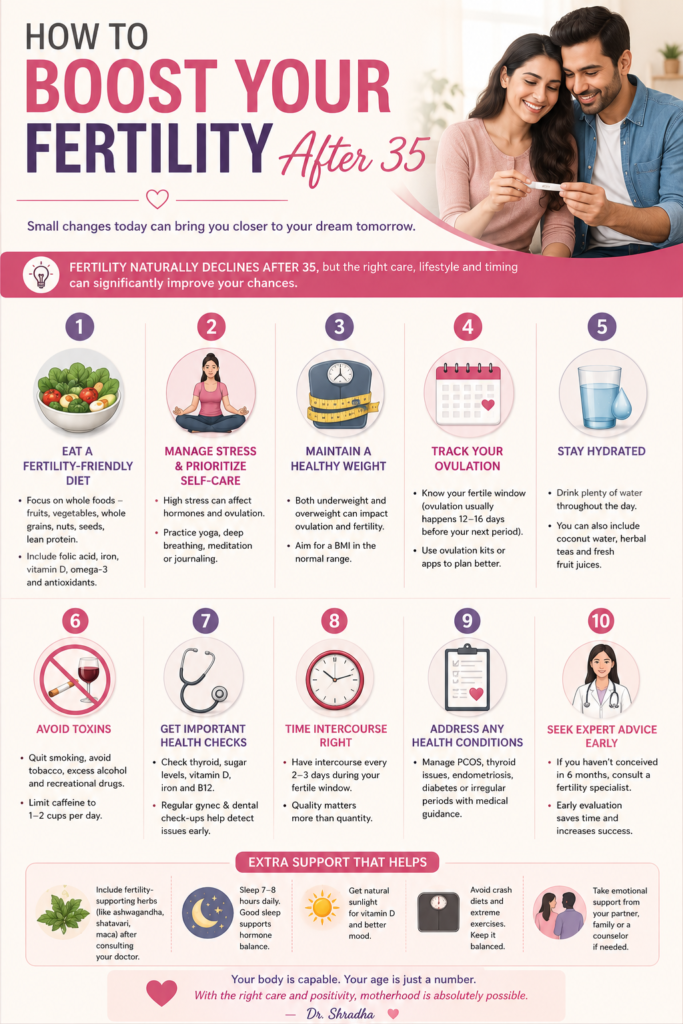
Why & How to Boost Your Fertility After 35?
One of the most common questions couples ask is, “Why is pregnancy becoming difficult after 35, even when everything seems normal?” The reason is simple — fertility naturally changes with age. After 35, both the number and quality of eggs gradually start declining. Ovulation may become less regular, hormone balance can fluctuate, and the chances of implantation may reduce compared to earlier years.
But this does not mean pregnancy is not possible. Many women conceive naturally and through fertility treatment after 35 with the right guidance and timely care.
Why Fertility Declines After 35
Women are born with a fixed number of eggs, and over time, both egg count and egg quality reduce naturally. This can affect fertilization, embryo quality, and pregnancy chances. The risk of conditions like PCOS, endometriosis, thyroid imbalance, fibroids, and low ovarian reserve also increases with age, making early fertility planning more important.
Don’t Ignore Lifestyle Changes
After 35, the body becomes more sensitive to stress, poor sleep, unhealthy eating, smoking, alcohol, and weight fluctuations. These factors can affect hormone levels, ovulation, and even egg quality. Small improvements in lifestyle can make a noticeable difference in fertility outcomes.
Nutrition Matters More Than Ever
Fertility-supporting foods help nourish reproductive health. Iron, folic acid, protein, antioxidants, omega-3, and vitamin D may support hormone balance and egg health. Crash diets and processed foods can negatively impact fertility and energy levels.
Timing Becomes Important
Many couples miss their fertile window without realizing it. Tracking ovulation helps identify the best time for conception and increases natural pregnancy chances.
Don’t Delay Fertility Evaluation
One of the biggest mistakes couples make after 35 is waiting too long. If pregnancy is not happening within 6 months of trying, a fertility evaluation is recommended. Early diagnosis helps identify problems before they become more complicated.
Fertility Treatment Is More Effective with Early Action
Treatments like ovulation induction, IUI, or IVF often have better outcomes when fertility concerns are addressed early. Delaying evaluation may reduce available treatment options later.
Most Importantly — Stay Positive
Fertility after 35 is not impossible. With proper medical support, healthy habits, and emotional support as a couple, many families successfully achieve pregnancy and parenthood.
Why 35 Actually Matters — The Biology Your Doctor May Not Have Fully Explained
To make an informed decision about your fertility at 35, you need to understand two things that are often conflated but are biologically distinct: egg quantity (how many eggs you have) and egg quality (how chromosomally healthy those eggs are). They decline together with age, but at different rates and for different reasons.
Egg Quality vs Egg Quantity — Two Different Problems
Ovarian reserve — the number of eggs remaining in your ovaries — is what AMH and antral follicle count (AFC) measure. This number declines continuously throughout a woman’s reproductive life, and the rate of decline accelerates from the mid-30s. A woman with low ovarian reserve has fewer eggs available for stimulation, which means fewer embryos in an IVF cycle and fewer chances per cycle. But quantity is not everything.
Egg quality refers to the chromosomal accuracy of each individual egg — specifically, whether each egg contains exactly the right 23 chromosomes that, when combined with the 23 from sperm, produce a chromosomally normal 46-chromosome embryo. This is largely determined by age, not by reserve. A woman with normal AMH at 35 has plenty of eggs — but a higher proportion of those eggs will be chromosomally abnormal (aneuploid) than they were at 28. It is this quality decline, not quantity alone, that drives age-related fertility changes.
Chromosomal Abnormality Rates by Age — What the Numbers Show
The data on chromosomal abnormality rates in eggs is striking — and explaining it clearly to patients is one of the most important things a fertility specialist can do:
What do these numbers mean in practice? At 25, when a woman ovulates an egg, approximately 75–80% of those eggs are chromosomally normal and capable of producing a healthy embryo. At 35, that proportion has dropped to approximately 60–65%. At 40, fewer than half of eggs are chromosomally normal. This is why natural conception rates decline with age, why miscarriage rates increase (many early miscarriages are chromosomally abnormal embryos that the body rejects), and why IVF success rates fall so significantly after 38.
Importantly, these are population averages. Individual variation is substantial. A 38-year-old with excellent ovarian reserve and a healthy lifestyle may have significantly better egg quality than average. A 34-year-old who smokes heavily may have accelerated quality decline. Age is the most powerful predictor, but it is not the only one — which is why testing, not assumptions, should guide your decisions.
The Window Between 35 and 38 — Why This Period Is Uniquely Important
If there is one message I want every 35-year-old woman to take from this article, it is this: the three years between 35 and 38 represent the most important fertility window most couples ever face. The biological difference between 35 and 38 is measurable and clinically significant — in ovarian reserve, in egg quality, in IVF response, in miscarriage risk, and in cumulative success rates across treatment cycles.
What Your AMH Means at 35 — The Test That Determines Your Next Step
AMH (Anti-Müllerian Hormone) is a blood test that measures ovarian reserve — effectively, how many eggs you still have relative to what is expected for your age. It can be taken on any day of your cycle. It is the single most important test a 35-year-old woman can have before making any fertility decision, because the result directly determines whether simpler treatments are realistic or whether moving faster toward IVF is genuinely the right recommendation.
AMH Normal Ranges at Age 35
| AMH Level (ng/mL) | Interpretation at Age 35 | What This Means for Treatment |
|---|---|---|
| Above 2.5 | High for age — possible PCOS morphology | Excellent reserve. All options open. OHSS risk in IVF stimulation — discuss with your specialist. |
| 1.5 – 2.5 | Normal for age 35 | Good reserve. IUI is a reasonable first step if tubes are open and sperm is adequate. IVF is not urgently needed unless other factors indicate it. |
| 1.0 – 1.5 | Low-normal | Adequate reserve but trending lower. IUI is still an option, but the window for it is narrower. 2–3 cycles maximum, then IVF if unsuccessful. |
| 0.5 – 1.0 | Low | Reduced reserve. IVF is more appropriate than repeated IUI cycles. Time matters — do not delay. Discuss protocol optimisation with your specialist. |
| Below 0.5 | Very low (Diminished Ovarian Reserve) | IVF should be your first step. Minimal IUI benefit when AMH is this low. Modified stimulation protocols. Consider embryo banking. Act now. [INTERNAL LINK: Low Ovarian Reserve guide] |
What Low AMH at 35 Actually Means — and What It Does Not
Being told you have “low AMH” at 35 is not a sentence. It is an instruction to act promptly. AMH measures the quantity of eggs remaining, not their quality. A 35-year-old with AMH of 0.7 ng/mL still has eggs — and at 35, those eggs are still more likely to be chromosomally normal than they will be in two years. The danger of low AMH is not that pregnancy is impossible; it is that the reserve is declining faster than average, and every additional cycle of delay costs more than it would for a woman with a normal ovarian reserve.
It is also important to understand what AMH cannot tell you. AMH does not predict whether you will respond to IVF stimulation well or poorly with certainty — it is a population-level predictor, not an individual guarantee. Some women with AMH of 0.4 respond unexpectedly well to modified protocols. Some women with an AMH of 2.0 respond poorly. The antral follicle count (AFC) ultrasound provides a confirmatory view that helps your specialist build the most appropriate protocol for your specific ovaries. AMH alone should never be used to make a final treatment decision — it should always be interpreted alongside the AFC and your full clinical picture.
The Test AMH Does Not Replace — Semen Analysis
Every conversation about fertility at 35 focuses on the woman. But the male factor contributes to infertility in 40–50% of couples. A man whose sperm were normal at 30 may have developed varicocele, new health conditions, or lifestyle changes that have reduced his sperm parameters in the years since. A semen analysis should always be one of the first tests — not an afterthought — and it should be done at the same time as the female evaluation, not after months of investigating the woman alone. This single principle is one of the most frequently violated in Bihar fertility practice, and it costs couples months of unnecessary delay.
Your Treatment Ladder at 35 — What Comes Before IVF
This is the section most fertility pages skip. “See a doctor” is not a treatment plan. Here is what the evidence-based treatment pathway actually looks like for a 35-year-old woman — and what determines which rung of the ladder you start on.
Complete Bilateral Evaluation — Both Partners, Simultaneously
Before any treatment decision, both partners need a complete evaluation. For the woman: AMH, Day 3 FSH and oestradiol, antral follicle count (AFC) ultrasound, TSH (thyroid — commonly elevated in Indian women and frequently missed), and HSG (fallopian tube test). For the man: semen analysis (count, motility, morphology) and ideally sperm DNA fragmentation if there is any suggestion of IVF failure risk. This evaluation takes 2–3 weeks and costs approximately ₹8,000–₹15,000 — a fraction of what a single IUI cycle costs. The information it generates is irreplaceable: it tells your doctor whether simpler treatments are likely to work, or whether the diagnosis calls for IVF from the beginning.
Ovulation Induction — For Women with PCOS or Ovulatory Disorders
If investigation reveals that the cause of non-conception is irregular or absent ovulation — the most common finding in women with PCOS — then ovulation induction medication (Letrozole or Clomiphene, sometimes with FSH injections) may be all that is needed. For a 35-year-old woman with PCOS, good ovarian reserve, open tubes, and a partner with normal sperm parameters, ovulation induction with timed intercourse or IUI can produce conception rates of 15–20% per cycle — without the cost or complexity of IVF.
This step is appropriate when: diagnosis is ovulatory disorder (PCOS, thyroid dysfunction), tubes are confirmed open, semen analysis is normal or only mildly abnormal, and AMH is normal for age. It is not appropriate when AMH is very low, tubes are blocked, or the male factor is significant.
IUI with Ovarian Stimulation — When Tubes Are Open, and Sperm Is Adequate
IUI (Intrauterine Insemination) places washed, concentrated sperm directly into the uterus at the time of ovulation, bypassing the cervix and significantly increasing the sperm density at the site of fertilisation. Combined with ovarian stimulation (to produce 1–3 follicles rather than 1), IUI achieves success rates of approximately 10–15% per cycle at age 35–37.
IUI is appropriate at 35 when: tubes are open on HSG, semen analysis is adequate (count above 10 million motile sperm post-wash), ovarian reserve is normal-to-low-normal (AMH above 1.0), and the diagnosis is unexplained infertility or mild ovulatory disorder. The recommendation at 35 is to attempt a maximum of 2–3 IUI cycles before reassessing — not the traditional 6 cycles advised for younger women, because each failed IUI cycle at 35 costs more biological time than it does at 30.
IVF — When the Diagnosis or the Results Call for It
IVF is the next step when: 2–3 IUI cycles have failed without explanation, the diagnosis specifically indicates IVF (see section below), ovarian reserve is declining faster than expected, or the couple wants to maximise their chances per cycle given their age and timeline. IVF at 35 — with good ovarian reserve and a well-executed protocol — gives success rates of 30–40% per cycle and cumulative rates over 3 cycles reaching 65–70%.
Importantly, IVF at 35 is not a last resort. It is not a failure. For some couples, it is simply the most efficient path to parenthood — more efficient than spending 6 months trying IUI, which the evidence suggests has a lower chance of working than their specific profile would achieve through IVF. The decision should be driven by diagnosis and biology, not by fear of IVF or by social pressure to “try naturally first.”
IVF Success Rates at 35 — A Realistic, Evidence-Based Picture
The most important piece of clinical information for a 35-year-old considering IVF is not “does IVF work?” — it works — but “what are my actual odds, and how do they change if I wait?” This table answers both questions:
| Age Group | IVF Success / Cycle (own eggs) | Cumulative (3 cycles) | With PGT-A Testing | Donor Egg IVF |
|---|---|---|---|---|
| Under 35 | 50–60% | ~80% | 60–65% per transfer | 55–60% (age-independent) |
| 35 – 37 | 30–40% | 65–70% | 55–60% per transfer | 55–60% |
| 38 – 40 | 20–26% | ~50% | 45–55% per transfer | 55–60% |
| 41 – 42 | 13–18% | ~35% | 40–50% per transfer | 55–60% |
| Over 42 | 5–10% | ~20% | 30–40% per transfer | 55–60% |
Two features of this table deserve emphasis. First: donor egg IVF produces success rates of approximately 55–60% per cycle, regardless of the woman’s age, because success is determined by the age of the egg, not the age of the uterus. This is the clearest illustration that the uterus itself does not age in the same way that eggs do. For women with very low ovarian reserve or repeated IVF failure at older ages, donor egg IVF changes the entire picture.
Second: PGT-A (Preimplantation Genetic Testing for Aneuploidies) — testing embryos for chromosomal normality before transfer — increases per-transfer success rates substantially at 35 and above because it ensures that only chromosomally normal embryos are transferred. At 35, where 35–40% of eggs may be aneuploid, PGT-A is not just a luxury — for some patients, it is the evidence-based way to avoid transferring abnormal embryos and experiencing preventable miscarriages.
When IVF IS Your Right First Step at 35 — Not a Last Resort
The treatment ladder above assumes investigation is normal except for the identified cause. There are specific clinical situations where skipping the ladder and proceeding directly to IVF at 35 is the evidence-based, patient-centred recommendation — and telling a patient in these situations to “try IUI first” is not conservative, it is a disservice:
- Bilateral fallopian tube blockage: IVF is the only treatment pathway. The tubes carry the egg to the sperm — when both fallopian tubes are blocked, IUI and ovulation induction simply cannot work. Waiting to confirm this with a failed IUI cycle wastes 6–8 weeks.
- Severely diminished ovarian reserve (AMH below 0.5 ng/mL at 35): Each month of delay costs reserve. The eggs available today are the best eggs this woman will ever have for IVF. Multiple IUI cycles that are unlikely to succeed cost both time and reserve. IVF, with an appropriate minimal stimulation protocol, is the right immediate step.
- Severe male factor (very low count or azoospermia): IUI requires a post-wash total motile sperm count of at least 5–10 million. When the sperm parameters fall far below this, IUI cannot work. IVF with ICSI — where a single sperm is injected into each egg — is the appropriate immediate treatment regardless of the woman’s age or ovarian reserve.
- Duration of infertility over 2–3 years at 35: A couple who has been trying for 3 years and is now 35 is not the same clinical situation as a couple who has been trying for 6 months. The longer the duration of infertility, the lower the per-cycle natural and IUI success rates — and the stronger the case for IVF as the most efficient use of the remaining reproductive window.
- Endometriosis Stage 3–4: Moderate-to-severe endometriosis significantly reduces IUI success rates and may require laparoscopic surgery followed by IVF. The clinical literature clearly favours IVF over IUI for this profile.
- Prior failed IUI cycles (2–3 cycles without success): Three failed IUI cycles in a woman with adequate sperm and open tubes is a signal that the barrier to conception is not simply sperm access — IVF, which fertilises eggs in the laboratory and eliminates the need for natural fertilisation, is the appropriate escalation.
Your Next 30 Days — A Practical Action Plan
If you are 35 and reading this article, here is exactly what to do. Not “see a doctor.” Not “try naturally for a few more months.” Specifically, concretely, in sequence:
Week 1 — Book These Blood Tests (Can Be Done at Any Lab)
AMH, TSH, and Day 3 FSH + Oestradiol (must be done on Day 2, 3, or 4 of your period). AMH can be done on any day. Prolactin and LH can be added. Total cost at a decent diagnostic laboratory: approximately ₹2,500–₹4,500. These results will tell you, within one week, what your ovarian reserve is and whether thyroid dysfunction is contributing to any difficulty conceiving. They are available the same day or next day at most labs in Patna and Bihar.
Week 1 (Simultaneously) — Your Partner Books a Semen Analysis
A semen analysis must be done at the same time as the female evaluation — not after. It is non-invasive, costs approximately ₹800–₹1,500 at a fertility or diagnostic laboratory, and takes 2–3 days for results. If this test reveals a significant male factor, it changes the entire treatment recommendation. Do not wait for female results before getting this done.
Week 2–3 — Book a Consultation with a Fertility Specialist
Go to your consultation with your blood test results and your partner’s semen analysis in hand. The consultation should include a transvaginal ultrasound for antral follicle count (AFC) — this takes 5 minutes, causes minimal discomfort, and is one of the most important single pieces of information a fertility specialist needs to plan your care. At Shradha IVF in Patna, the initial consultation includes this ultrasound as standard.
Week 3–4 — HSG (Fallopian Tube Test) if Not Done Before
HSG (Hysterosalpingography) takes 15 minutes at a radiology centre, causes some cramping, and tells you definitively whether your fallopian tubes are open. This is the most important single test for determining whether IUI is even a viable option. If one or both tubes are blocked, this result alone changes the entire treatment recommendation and should shorten the path to IVF significantly. HSG costs approximately ₹2,500–₹4,000 and can be scheduled on Day 7–12 of your cycle.
End of Week 4 — Review Results and Build Your Treatment Plan
With AMH, AFC, Day 3 hormones, TSH, semen analysis, and HSG results in hand, your fertility specialist has everything needed to give you a personalised, honest treatment recommendation: whether ovulation induction, IUI, or IVF is the appropriate starting point, what the realistic success rates are for your specific profile, and what the timeline looks like. This is the conversation that ends the uncertainty — and it is available to you within 30 days.
The total cost of this complete evaluation — all blood tests, semen analysis, ultrasound, HSG, and first consultation — is approximately ₹10,000–₹18,000. That is the price of having a complete, personalised answer rather than another month of hoping and wondering. It is one of the highest-return investments a 35-year-old woman trying to conceive can make.
A Message from Dr. Shradha — To 35-Year-Old Women in Bihar
I want to address each of these directly. “Give it more time” is appropriate advice for a 28-year-old who has been trying for 4 months. It is not appropriate for a 35-year-old who has been trying for 12. Fear of what evaluation might find is understandable, but the information an evaluation provides — even if the results are difficult — is always better than not knowing, because it allows you to act. And the quality of fertility care available in Patna at Shradha IVF — including access to PGT-A genetic testing, advanced embryology, and ICSI — is equivalent to what you would receive at leading clinics in Delhi or Mumbai.
If you are 35, trying to conceive, and have been putting off evaluation: the evaluation is the least frightening step. It is the uncertainty that is frightening. Come and let us give you information — honest, complete, specific to your situation. What you do with that information is your choice. But you deserve to make that choice with full knowledge, not in the dark.
Couples nowadays face specific pressures that amplify the delay problem. The social expectation that fertility “should” happen naturally — and that seeking medical help is somehow a failure or a sign of weakness — is deeply embedded in parts of Bihar’s social landscape. The reality is the opposite: the couples who come to us at 35 and act on the information we give them have dramatically better outcomes than those who come at 38 after years of hoping. There is no nobility in delay. There is only a biological cost.
Tips for Getting Pregnant Between 30–35 by Dr Shradha
If you are planning a pregnancy between the ages of 30 and 35, the first thing I want you to know is — don’t panic. Many couples successfully conceive during this phase, but this is also the age when fertility can slowly begin to change. A few timely lifestyle changes and the right guidance can make a big difference.
Tip 1: Track Your Fertile Days Carefully
One of the most common mistakes couples make is not understanding the ovulation window properly. Knowing your fertile days and timing intercourse accordingly can naturally improve your pregnancy chances.
Tip 2: Don’t Ignore Lifestyle Habits
I always advise couples to focus on sleep, stress, diet, and physical activity before starting fertility treatment. Smoking, tobacco, alcohol, irregular sleep, and excessive stress can affect both egg and sperm quality.
Tip 3: Nourish Your Body for Pregnancy
Your fertility health starts with your daily routine. Include protein, green vegetables, fruits, nuts, iron-rich foods, and folic acid in your diet. Hydration and maintaining a healthy weight are equally important.
Tip 4: Don’t Wait Too Long for Help
If you have been trying for 6 months to 1 year without success, please don’t keep delaying evaluation. Conditions like PCOS, thyroid imbalance, endometriosis, blocked tubes, or male infertility are common and treatable when diagnosed early.
Tip 5: Fertility Treatment Is Not Always the First Step
Every couple does not need IVF immediately. Sometimes simple ovulation support, lifestyle correction, or IUI can help achieve pregnancy naturally or with minimal intervention.
Tip 6: Most Important — Stay Positive Together
Fertility journeys can feel emotionally exhausting, but supporting each other matters as much as medical treatment. Early guidance, patience, and the right fertility plan often lead to successful outcomes.
FAQs Related to Fertility at 35
To prepare for pregnancy between 30–35, focus on a healthy lifestyle, balanced diet, regular exercise, proper sleep, and stress management. Track ovulation, avoid smoking and alcohol, and manage conditions like PCOS or thyroid imbalance. A pre-pregnancy health checkup can also help identify fertility concerns early.
No, 35 is not too late to try for a baby. Many women naturally conceive and have healthy pregnancies after 35. However, fertility may gradually decline with age, so timely evaluation, healthy habits, and early medical guidance can improve pregnancy chances and reduce delays.
There is no magic drink for fertility, but staying hydrated and consuming nutrient-rich drinks may support reproductive health. Fresh fruit juices, milk, smoothies, coconut water, and antioxidant-rich drinks can help overall wellness. Limiting alcohol, sugary drinks, and excessive caffeine is also beneficial for fertility.
To conceive faster at 35, track ovulation carefully, maintain a healthy weight, improve diet and sleep, reduce stress, and avoid smoking or tobacco. Have regular intercourse during fertile days and don’t delay fertility evaluation if pregnancy does not happen within six months of trying.
You Are 35 — Not Out of Options. Out of Uncertainty.
The most powerful thing a 35-year-old woman can do for her fertility is to understand exactly where she stands — with real data, honest interpretation, and a specialist who will tell her the truth about her options. At Shradha IVF in Patna, that conversation is waiting for you.
Book Your Consultation at Shradha IVF →