

Reviewed by Dr. Shradha Chakhaiyar, MS (OB-GYN), MRCOG (London), IVF & Laparoscopic Surgeon
📋 Table of Contents
- What Is Laparoscopy for Infertility?
- When Is It Recommended?
- Diagnostic vs Operative Laparoscopy
- Hystero-Laparo — Combined Procedure
- Step-by-Step: What Happens
- Recovery Day by Day
- Do I Need It Before IVF?
- How It Improves IVF Success
- How Long Before I Can Start IVF?
- Laparoscopy in Bihar — Cost & Access
- When Laparoscopy Is NOT the Right Step
- Frequently Asked Questions
What Is Laparoscopy for Infertility?
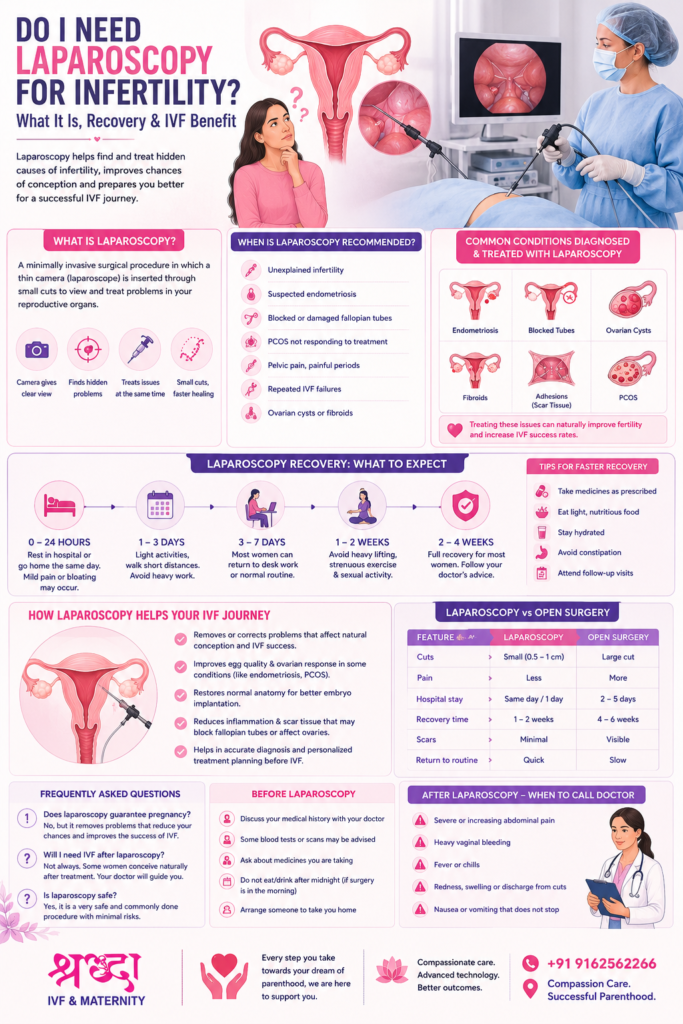
Laparoscopy for infertility is a minimally invasive surgical procedure in which a thin camera (laparoscope) is inserted through a small incision near the navel to directly examine the uterus, fallopian tubes, ovaries, and pelvic cavity. It detects and treats conditions that cannot be seen on ultrasound or HSG — including endometriosis, pelvic adhesions, tubal blockages, and ovarian cysts. It is both diagnostic (identifying a cause) and operative (treating it) — often in the same procedure, under a single general anaesthetic, as a day-care surgery.
The name comes from the instrument: a laparoscope is a thin, rigid tube — typically 5–10 mm in diameter — fitted with a fibre-optic light source and a high-definition camera. Once inserted through a small incision and with the abdomen inflated with carbon dioxide gas to create working space, the laparoscope transmits real-time magnified images to a monitor. The surgeon can see the reproductive organs in far greater detail than any imaging test provides — and with specialised instruments passed through additional small incisions, can treat problems immediately upon finding them.
This single-procedure, diagnose-and-treat capability is the most important advantage of laparoscopy. A woman does not need a second surgery if endometriosis is found, if adhesions are identified, or if an ovarian cyst needs removal. The treatment happens in the same sitting. For couples who have been on a lengthy infertility investigation journey, this represents a significant emotional and practical relief.
When Is Laparoscopy Recommended for Infertility?
Laparoscopy is not the first investigation in infertility — it follows standard non-invasive tests. It is recommended when those tests suggest a pelvic cause, when they are inconclusive, or when a couple has failed treatment that should have worked if the pelvis were normal. Specific indications include:
Unexplained Infertility After Normal Standard Tests
If a complete standard infertility workup — semen analysis, AMH, HSG, pelvic ultrasound, thyroid, hormone panel — returns normal results and the couple has been trying for 12 months or longer, laparoscopy is strongly considered. A landmark NIH-cited study found that among women with unexplained infertility who underwent laparoscopy, 57.9% were found to have endometriosis or pelvic adhesions — conditions that would never have been found by any other test. “Unexplained” is often more accurately “undiagnosed” — and laparoscopy is the investigation that makes the correct diagnosis.
Suspected or Confirmed Endometriosis
Laparoscopy is the only definitive diagnostic test for endometriosis — no blood test, scan, or MRI can confirm it. If a woman has painful periods, pelvic pain, pain during intercourse, or an elevated CA-125, laparoscopy both confirms the diagnosis and treats the disease in the same procedure. Surgical treatment of endometriosis — excision of endometriotic deposits and division of adhesions — has been shown in multiple studies to significantly improve natural conception and IVF success rates.
Blocked or Damaged Fallopian Tubes
HSG (hysterosalpingography) is the standard test for tubal patency — but it can produce false positives (apparent blockage that is actually spasm) and misses pelvic adhesions around the tubes. Laparoscopy is the gold standard for confirming and characterising tubal disease. Under direct vision, the surgeon can perform chromopertubation — injecting coloured dye through the uterus and watching it flow through both tubes — and simultaneously treat adhesions or attempt to repair damage.
Pelvic Adhesions and Scar Tissue
Adhesions — bands of scar tissue that stick organs together — form after pelvic infections (PID), previous surgeries, appendicitis, or C-sections. They can kink or tether the fallopian tubes, prevent ovum pick-up, and create mechanical barriers to conception. They are completely invisible on ultrasound. Laparoscopic adhesiolysis (surgical division of adhesions) restores normal pelvic anatomy and significantly improves fertility outcomes, particularly when adhesions are responsible for the infertility. This is an especially relevant cause in Bihar, where post-delivery infections and untreated RTIs create adhesions that go undetected for years before infertility investigations begin.
Ovarian Cysts (Including Endometriomas)
Ovarian cysts that are persistent, growing, or symptomatic — and particularly endometriomas (chocolate cysts from endometriosis) — may warrant laparoscopic removal before IVF. Large endometriomas can impair ovarian response to stimulation, risk infection during egg retrieval, and contain inflammatory fluid that is toxic to eggs. The decision on whether to remove an endometrioma before IVF is complex and should be made with an experienced specialist — there are both benefits and risks of surgical intervention in this specific context.
PCOS — Laparoscopic Ovarian Drilling
In women with PCOS who do not respond adequately to ovulation induction medications (Clomiphene, Letrozole), laparoscopic ovarian drilling (LOD) is an option. The surgeon uses diathermy or laser to make small punctures in the ovarian surface, which reduces androgen production and can restore regular ovulation. Results are most effective in women with high LH levels and those who are not obese. LOD is not appropriate for all PCOS cases — its role is specifically in medication-resistant PCOS where IVF is not yet the preferred route.
Uterine Fibroids — Laparoscopic Myomectomy
Fibroids that distort the uterine cavity or compress the fallopian tube openings may require surgical removal before successful conception can occur. Laparoscopic myomectomy — removal of fibroids through keyhole surgery — is preferred over open surgery for most fibroid sizes and positions because of faster recovery and lower adhesion risk. The decision to operate is based on fibroid location (submucosal fibroids are most likely to affect fertility), size, and number.
Recurrent IVF Failure with No Identified Cause
When two or more IVF cycles have failed despite good embryo quality and normal uterine assessment, laparoscopy may reveal a pelvic pathology that was not detected during the standard IVF workup — most commonly, minimal endometriosis or pelvic adhesions. A published study found that following laparoscopy in women with recurrent unexplained IVF failure, 48% with endometriosis and 44% with adhesions achieved natural conception within 12 months of surgical correction — avoiding the need for additional IVF cycles entirely.
Diagnostic vs Operative Laparoscopy — What Is the Difference?
| Type | Purpose | What Happens | Typical Duration |
|---|---|---|---|
| Diagnostic Laparoscopy | Examination only — to identify or rule out pelvic causes | Surgeon inspects all pelvic organs, performs chromopertubation to test tube patency. No surgical treatment performed. | 20–30 minutes |
| Operative Laparoscopy | Diagnosis + treatment in the same procedure | Surgeon identifies pathology and immediately treats it — removes endometriosis, divides adhesions, removes cysts, performs myomectomy. | 45 minutes – 2+ hours |
| Hystero-Laparo (combined) | Complete internal + external pelvic assessment | Hysteroscope examines the uterine cavity simultaneously with the laparoscope examining the external pelvis. Most complete single-procedure evaluation available. | 45 – 90 minutes |
Combined Hysteroscopy + Laparoscopy (Hystero-Laparo) — Why Both Together?
In many fertility investigations — particularly for unexplained infertility — both laparoscopy (external pelvic view) and hysteroscopy (internal uterine view) are performed simultaneously in the same operating session. This combined procedure, often called Hystero-Laparo, provides the most complete possible pelvic assessment under a single general anaesthetic.
Laparoscopy alone cannot see inside the uterine cavity — it only shows the external surface of the uterus, the fallopian tubes, ovaries, and pelvic structures. Hysteroscopy, by contrast, inserts a thin camera through the cervix into the uterine cavity — revealing polyps, submucous fibroids, intrauterine adhesions (Asherman’s Syndrome), uterine septa, and abnormal endometrial lining that are invisible from outside.
The advantages of doing both together are significant:
- A single anaesthetic exposure instead of two separate procedures
- The surgeon can also verify that the hysteroscope’s dye flows through the fallopian tubes (chromopertubation) during the same session
- Intrauterine findings can be treated immediately — polyps removed, adhesions divided, septa resected — at the same time as external endometriosis treatment
- Significantly faster diagnostic resolution for the couple — one procedure answers both “is the inside of the uterus normal?” and “is the outside of the pelvis normal?”
At Shradha IVF, combined Hystero-Laparo is our standard approach for couples with unexplained infertility or recurrent IVF failure where both the uterine cavity and the pelvic structures need assessment. The decision is always individualised — some patients need only one of the two — but most unexplained infertility workups benefit from the comprehensive view that only the combined procedure provides.
Step-by-Step: What Happens During Laparoscopy for Infertility Treatment
Before the Laparoscopic Procedure — Preparation
- Pre-operative tests: Blood tests (CBC, coagulation profile, blood group), urine analysis, ECG, and a pre-operative ultrasound are performed 1–2 weeks before surgery
- Fasting: Nothing by mouth (food or water) for 6–8 hours before the procedure
- Medications: Aspirin, ibuprofen, blood thinners, and certain supplements are stopped 5–7 days before; your doctor will provide a specific list
- Bowel preparation: Mild laxatives or an enema may be prescribed the evening before surgery to ensure a clear view of the pelvic organs
- Consent: Full discussion of the procedure, possible findings, and potential operative interventions — including risks and benefits
During the Laparoscopic Procedure
- General anaesthesia is administered — you will be completely asleep throughout the procedure
- The abdomen is cleaned, and the surgical team positions you in a slight head-down (Trendelenburg) position to move the bowel away from the pelvis
- A small incision (5–10 mm) is made at or just below the navel
- Carbon dioxide (CO2) gas is gently inflated into the abdominal cavity through a Veress needle — this creates the working space the surgeon needs
- The laparoscope is inserted, and the surgeon examines the uterus, tubes, ovaries, and pelvic structures on a high-definition monitor
- Additional small incisions (2–3, each 5 mm) are made in the lower abdomen if operative instruments are needed
- Chromopertubation is performed — blue dye is injected through the uterus and the surgeon watches to confirm it flows freely through both fallopian tubes
- Any identified pathology — endometriosis deposits, adhesions, cysts, fibroids — is treated in the same session
- The instruments are removed, the CO2 gas is released as fully as possible, and the small incisions are closed with dissolving sutures or surgical tape
Recovery after Laparoscopic Treatment — What to Expect Day by Day
Day 1–2: Immediately After Surgery
You will wake up in recovery with a nurse monitoring your vital signs. Expect:
- Grogginess and nausea from the anaesthesia — this clears in 4–6 hours for most people
- Mild-to-moderate incision pain — manageable with prescribed pain relief (paracetamol + ibuprofen, or stronger if needed). The incisions are small — each is less than 1 cm
- Abdominal bloating and cramping — from residual CO2 gas. This is normal and resolves over 24–48 hours
- Most patients are discharged within 4–6 hours of the procedure. Arrange for someone to drive you home — you will not be able to drive
- Sleep, rest, and gentle walking around the house is the prescription for day 1
The Shoulder Pain — The Symptom Nobody Warns You About
Day 3–5: At Home
- Pain significantly reduces. Most patients transition to over-the-counter pain relief only
- Light activity — short walks, gentle household tasks — is encouraged and beneficial for recovery
- Avoid lifting anything heavier than 2–3 kg, strenuous exercise, and sexual intercourse
- Shower is permitted once the wound dressing is removed (your surgeon will specify when)
- Bloating and gas sensation continues to reduce. Normal bowel movements typically resume by day 3–4
- Slight vaginal spotting is normal for a few days, particularly if hysteroscopy was combined
Day 7–14: Return to Normal Activity
- Desk work and light office duties: most patients return between day 5–7
- Physical or standing work: typically return after 10–14 days
- Driving: safe to resume when you can perform an emergency stop without pain — typically day 5–7
- Exercise: gentle walking and yoga resume at day 7; higher-impact exercise after 2–4 weeks depending on what was done operatively
- Your follow-up appointment is typically at day 7–10. At this appointment, the surgeon discusses findings, reviews the operative photographs, and discusses the next steps for your fertility treatment plan
Warning Signs — When to Call Immediately
Contact your surgeon or come to emergency immediately if you experience: fever above 38.5°C, heavy vaginal bleeding (soaking more than one pad per hour), severe worsening abdominal pain, inability to urinate, signs of wound infection (redness, swelling, discharge at the incision site), or difficulty breathing. These are rare but require prompt assessment.
Do I Need Laparoscopy Before IVF? — A Decision Guide
This is one of the most frequently asked questions by patients who have been recommended both laparoscopy and IVF. The answer is: it depends on your specific clinical situation. The following framework, based on ASRM and ESHRE guidelines, helps clarify the decision:
| Clinical Situation | Laparoscopy Before IVF? | Rationale |
|---|---|---|
| Suspected endometriosis (pelvic pain, dysmenorrhea, high CA-125) | Yes — strongly recommended | Laparoscopy diagnoses and treats; may enable natural conception. Improves IVF outcomes when done first. |
| Confirmed hydrosalpinx (fluid in tube visible on ultrasound) | Yes — salpingectomy recommended before IVF | Hydrosalpinx fluid is toxic to embryos. Removing the tube before IVF significantly improves implantation rates. |
| Unexplained infertility after 2+ failed IUI cycles | Strongly consider before IVF | High probability (57.9%) of finding treatable pathology. May avoid IVF entirely if endometriosis or adhesions found and treated. |
| Known pelvic adhesions from prior surgery or infection | Yes — adhesiolysis before IVF | Adhesions can impair ovum pick-up and tube function. Division improves natural conception and IVF access to ovaries. |
| Recurrent IVF failure (2+ failed cycles, good embryos) | Yes — investigate for hidden pathology | High rate of finding treatable endometriosis or adhesions. Can enable natural conception or dramatically improve next IVF cycle. |
| Severely diminished ovarian reserve (very low AMH) | No — go directly to IVF | Time is critical. Laparoscopy offers no benefit when the primary issue is egg quantity. Every cycle counts. |
| Severe male factor infertility (very low count or azoospermia) | No — IVF with ICSI is primary treatment | Even a perfect pelvis cannot overcome severely abnormal sperm. Laparoscopy delays the needed treatment. |
| Age over 40 with declining ovarian reserve | Only if specific indication exists | Time pressure from age means laparoscopy should only be done if a treatable and clearly identified cause is suspected. Otherwise, proceed to IVF. |
How Laparoscopy Improves IVF Success Rates?
Laparoscopy contributes to IVF success through several distinct mechanisms, each relevant to different patient profiles:
Treating Endometriosis Before IVF
Studies consistently show that surgical treatment of moderate-to-severe endometriosis before IVF improves both implantation rates and live birth rates per cycle. The mechanism involves reducing the inflammatory cytokine environment in the pelvis that endometriosis creates — which adversely affects egg quality, embryo development, and endometrial receptivity. Removing endometriotic deposits and endometriomas before IVF reduces this inflammatory burden.
Removing Hydrosalpinx — The Most Clear-Cut IVF Benefit
Hydrosalpinx — a fluid-filled, damaged fallopian tube — reduces IVF success rates by approximately 50% compared to women without hydrosalpinx. The fluid that accumulates in the tube leaks back into the uterine cavity and is directly embryotoxic. Salpingectomy (removal of the affected tube) before IVF — performed laparoscopically — restores IVF success rates to normal. This is the most evidence-supported laparoscopic intervention for IVF outcomes and is explicitly recommended by ESHRE guidelines when hydrosalpinx is confirmed.
Improving Ovarian Access for Egg Retrieval
Dense pelvic adhesions can fix the ovaries in positions that make transvaginal ultrasound-guided egg retrieval difficult or impossible. Laparoscopic adhesiolysis before IVF restores normal ovarian position and accessibility, making egg retrieval safer and more complete.
Providing Diagnostic Information That Changes the IVF Protocol
The findings of laparoscopy directly inform how IVF is planned. The grade of endometriosis found guides medication choices for ovarian stimulation. The degree of tubal damage informs the decision on whether to remove or clip the tubes before transfer. Knowledge of adhesions around the ovaries allows the embryologist and clinician to plan for potentially challenging egg retrieval. In this sense, laparoscopy does not just prepare the pelvis for IVF — it informs the entire treatment strategy.
How Long After Laparoscopy Can I Start IVF?
For diagnostic laparoscopy (no operative intervention): IVF can typically begin from the next menstrual cycle — usually 4–6 weeks after the procedure. For operative laparoscopy (endometriosis excision, adhesiolysis, myomectomy): most surgeons recommend waiting 1–3 menstrual cycles to allow the pelvis to heal and reduce post-operative inflammation before beginning IVF stimulation. Your specific timeline will be confirmed at your post-operative review appointment.
The reasoning behind the waiting period after operative laparoscopy is important to understand: ovarian stimulation for IVF involves high doses of hormones that amplify any residual pelvic inflammation. Beginning IVF too soon after surgery — before healing is complete — can increase the risk of complications and may reduce the benefit of the surgical intervention. The 1–3 month wait is an investment in optimising the environment for the embryo transfer that follows.
Laparoscopy for Infertility in Bihar — Cost, Access & What to Expect at Shradha IVF
At Shradha IVF & Maternity in Patna, laparoscopy for infertility is performed by Dr. Shradha Chakhaiyar — an MRCOG-qualified surgeon with over 20 years of gynaecological surgery experience in Bihar. The procedure is performed under general anaesthesia in a fully equipped operating theatre, with overnight monitoring available when needed.
Cost of Laparoscopy for Infertility in Patna, Bihar
The cost of laparoscopy for infertility at Shradha IVF depends on whether the procedure is diagnostic only or includes operative steps. As a general guide, laparoscopic procedures for infertility in Patna range from approximately ₹35,000–₹65,000 for diagnostic laparoscopy, with operative procedures (endometriosis excision, adhesiolysis, myomectomy) typically in the range of ₹65,000–₹1,20,000 depending on complexity. Pre-operative investigations, anaesthesia, and follow-up consultations may be additional. A detailed itemised estimate is provided at your pre-operative consultation — we do not surprise patients with bills.
Bihar-Specific Context: Why This Procedure Is Particularly Relevant Here
Several factors make laparoscopy for infertility specifically important in Bihar:
- High rates of undiagnosed PID and RTIs: Untreated reproductive tract infections create pelvic adhesions and tubal damage that are invisible on standard investigations. Bihar’s rural population, where RTI treatment is often delayed, presents a higher-than-national-average rate of adhesion-related infertility at our clinic.
- Post-C-section Asherman’s risk: Bihar’s elevated C-section rate means a significant cohort of women presenting with secondary infertility has potential uterine scarring from their delivery. Combined Hystero-Laparoscopy — examining both the uterine cavity and the external pelvis — is frequently indicated for these patients.
- Endometriosis underdiagnosis: In Bihar, endometriosis is frequently misattributed to “normal period pain” and goes undiagnosed for many years. Women who have been told their painful periods are normal, and who are now struggling to conceive, should specifically discuss endometriosis evaluation with their specialist.
When Laparoscopy Is NOT the Right First Step?
Honest guidance matters more than performing procedures. There are specific clinical situations where laparoscopy is not indicated or not beneficial — and any fertility specialist recommending laparoscopy in these situations without a clear reason should be asked to explain their rationale:
- Severely diminished ovarian reserve (AMH <0.5 ng/mL): When egg quantity is critically low, the most important action is to begin IVF immediately. Every cycle of delay — including time for surgical recovery — costs egg reserve that cannot be recovered. Laparoscopy will not improve ovarian reserve.
- Severe male factor infertility: When the primary barrier to conception is severely abnormal semen parameters, treating the pelvis does not change the clinical picture. IVF with ICSI is the appropriate first-line treatment.
- Woman over 40 with no specific structural indication: Age-related decline in egg quality is not addressable by laparoscopy. For women over 40, every month matters — proceeding to IVF (or donor egg IVF) without delay is generally the right decision unless there is a very specific structural indication for surgery.
- Normal ultrasound, normal HSG, normal hormones, and short duration of infertility in a woman under 30: In this profile, the probability of finding significant laparoscopic pathology is lower, and expectant management or IUI cycles are appropriate before escalating to surgery.
How Shradha IVF Can Help with Laparoscopy for Infertility Treatment?
At Shradha IVF & Maternity, laparoscopy is not treated as a routine procedure but as a carefully planned step within your overall fertility journey. The process begins with a detailed evaluation to understand whether laparoscopy is truly needed, ensuring patients avoid unnecessary procedures and receive the most effective care.
If recommended, laparoscopy is performed with precision to diagnose and treat conditions like endometriosis, ovarian cysts, fibroids, or blocked fallopian tubes. The goal is not just diagnosis but improving natural conception chances or preparing the body for better IVF outcomes.
Frequently Asked Questions on Laparoscopy
Yes, laparoscopy can be helpful for infertility when underlying issues like endometriosis, fibroids, adhesions, or blocked tubes are suspected. It allows both diagnosis and treatment in one procedure, which may improve natural conception chances or prepare the body for better IVF outcomes.
Most women can start trying to conceive within 2 to 6 weeks after laparoscopy, depending on recovery and the condition treated. In some cases, doctors may advise waiting slightly longer to allow proper healing before planning pregnancy or starting fertility treatment.
Recovery from laparoscopy is usually quick compared to open surgery. Most patients resume normal activities within 3 to 7 days, while complete internal healing may take a few weeks. Mild pain, bloating, or fatigue can occur but usually improves within days.
Yes, laparoscopy can sometimes help unblock fallopian tubes by removing adhesions or clearing minor blockages. However, success depends on the severity and location of the blockage. In severe cases, IVF may still be recommended as a more effective treatment option.
Yes, many women can conceive naturally after laparoscopy, especially if issues like endometriosis, adhesions, or mild tubal blockages are treated. Pregnancy chances often improve in the first few months after surgery, but outcomes depend on age, fertility condition, and overall reproductive health.