


Medically Reviewed by Dr. Shradha Chakhaiyar, MBBS, DGO, MRCOG (London) — Fertility Specialist & Reproductive Surgeon, Shradha IVF & Maternity, Patna
20+ Years of Experience · www.shradhaivf.com
A failed first IVF cycle is common — most first cycles don’t succeed — and the second cycle is often as successful or more so, because your doctor can personalise it using what the first revealed. Success comes from a careful review of why it failed, then targeted changes: adjusting the stimulation protocol, added testing (embryo, uterus, sperm), better lab techniques, treating any uterine issue, and lifestyle steps. Most couples wait 1–3 months between cycles.
📋 What This Guide Covers
- Is it normal for the first IVF to fail?
- Will the second cycle work? The real numbers
- Why a failed cycle is a diagnostic goldmine
- Why IVF cycles fail
- The most important step: the review
- What to change for round two
- Treating the uterus first
- How long to wait between cycles
- Should you change your clinic?
- Caring for yourself between cycles
- A note from Dr. Shradha
- FAQs
Is It Normal for the First IVF to Fail?
Yes — far more normal than most people realise, because nobody talks about it. The majority of first IVF cycles do not result in a pregnancy, even in excellent clinics, even for younger women. IVF is a powerful treatment, but it is not a guarantee, and a single cycle is genuinely a roll of several biological dice at once — egg, sperm, embryo, lining, timing. So if your first cycle failed, you are not an exception, you did nothing wrong, and this outcome does not mean you can’t have a baby. It means the first attempt didn’t work — which is a very different thing from “it won’t work.”
Will the Second IVF Attempt Work?
Here’s the genuinely hopeful part. For most couples, the second cycle carries similar or better odds than the first — not worse. Typical second-cycle success sits around the 50% mark for many patients, and what matters even more is the cumulative picture: the chance of success adds up across attempts. For women under 35, cumulative live-birth rates after three cycles commonly reach 65–70%, and most couples who succeed with IVF do so within their first three cycles. Success does depend on your individual situation — age and egg quality matter — but the overall message from the data is clear: persistence, with adjustments, pays off far more often than not.
Why a Failed Cycle Is a Diagnostic Goldmine?
This is the reframe I most want you to take away. Your first IVF cycle was not wasted — it handed your doctor the most detailed information they will ever have about how your body responds. Before the first cycle, a lot is predicted from tests. After it, we have real data: how your ovaries responded to the exact medications and doses, how many eggs we got, how they fertilised, how the embryos developed in the lab day by day, what the lining did, and how the transfer went. Every one of those is a clue. A first cycle is, in a real sense, the most informative diagnostic test in all of fertility medicine — and a second cycle built on it is not a repeat, but a smarter, personalised attempt.
Why IVF Cycles Fail in the First Attempt?
To fix it, we have to understand it. IVF failure usually comes down to one or more of these, and identifying which is the whole point of the review that follows:
| Area | What can go wrong | Where to read more |
|---|---|---|
| Embryo | Chromosomal abnormality or arrest — the most common reason; a “perfect-looking” embryo can still be genetically abnormal | See: why a perfect embryo fails |
| Uterus/lining | Thin lining, fibroids, polyps, adhesions, or chronic inflammation preventing implantation | See: uterine lining, hysteroscopy, fibroids |
| Eggs | Reduced egg quality or quantity, often age-related; poor response to stimulation | See: egg quality, low ovarian reserve, age & IVF |
| Sperm | Low count/motility or high DNA fragmentation affecting embryo quality | See: male infertility |
| Hormonal/other | Thyroid or other hormonal imbalance; sometimes truly unexplained; lab/technique factors | See: thyroid, unexplained infertility |
Often it’s a combination — and sometimes, honestly, we can’t pinpoint a single cause. But even narrowing it down changes what we do next.
The Single Most Important Step: The Post First IVF Cycle Review
Before changing anything, the crucial step is a proper failure review — a dedicated consultation where your specialist goes through the entire cycle in detail: your stimulation response, egg numbers and maturity, fertilisation rates, the embryology lab’s day-by-day notes on embryo development and grading, your lining, and the transfer itself. This is where the “clues” become a plan. If your first cycle was elsewhere, bring all reports and records you have. A properly analysed IVF cycle is worth far more than a repeated cycle — and this review is exactly what a good second opinion provides.
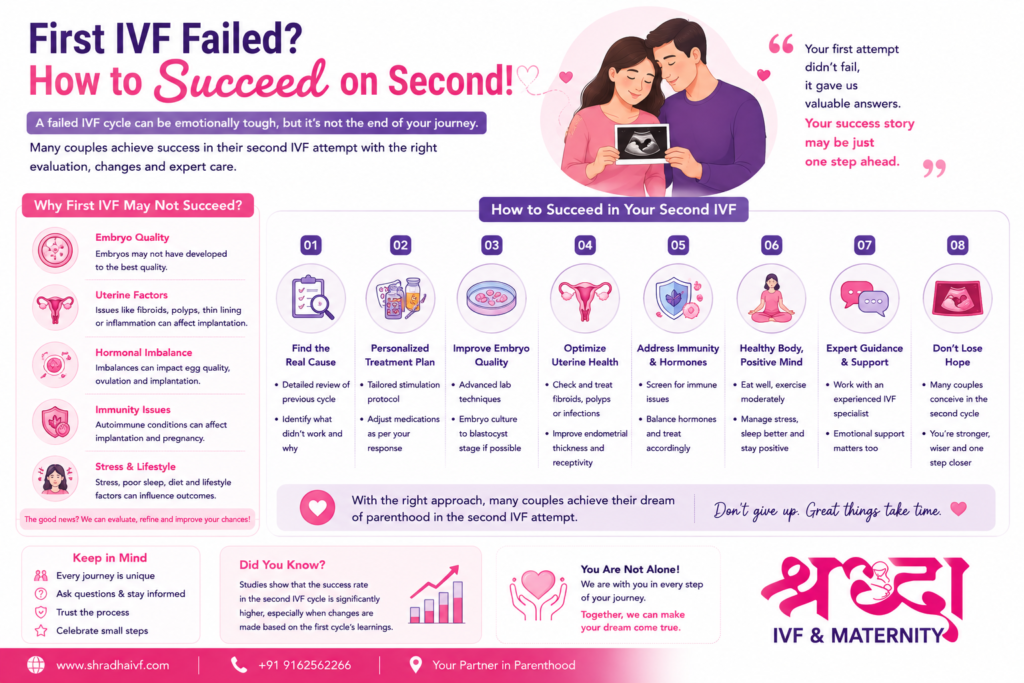
Still Wondering My First IVF Failed. What Next?
Your worry is normal about the second IVF attempt. Based on the review, your doctor tailors the next cycle. Not everything below applies to everyone — the art is choosing the right changes for your specific situation:
| Lever | What it means | When it’s considered |
|---|---|---|
| Stimulation protocol | A different drug protocol or dose, based on how your ovaries responded | Poor or excessive response first time |
| Added testing | Embryo genetic testing (PGT-A), endometrial receptivity/timing (ERA), a cavity check (hysteroscopy), sperm DNA-fragmentation, immune/hormone panels | To find a hidden cause |
| Lab technique | ICSI for fertilisation, time-lapse embryo monitoring for better selection, blastocyst (day-5) culture | Fertilisation or embryo-selection issues |
| Transfer strategy | A frozen (FET) instead of fresh transfer; single best-blastocyst transfer | Lining/synchrony issues; better selection |
| Treat the uterus | Fix a thin lining (e.g. PRP), or remove fibroids/polyps/adhesions/inflammation (hysteroscopy) before transfer | Any uterine factor found |
| Lifestyle | Weight/BMI, stopping smoking and alcohol, diet, and supplements your doctor recommends | Almost always worth optimising |
The point isn’t to change everything — it’s to change the right things. A thoughtful second cycle usually adjusts two or three targeted levers, not all of them at once.
Treating the Uterus First
One principle deserves special mention, because it’s often overlooked: a beautiful embryo cannot implant in a home that isn’t ready. If the review points to a uterine factor, it’s usually worth fixing that before the next transfer rather than hoping a better embryo overcomes it. That might mean a hysteroscopy to find and remove a polyp, fibroid, or adhesion, treating chronic inflammation of the lining, or improving a stubbornly thin lining (sometimes with PRP). Getting the uterine lining right is one of the most concrete, fixable ways to improve a second cycle — and it’s the theme that connects much of our other writing.
How Long Should You Wait Between IVF Cycles?
Medically, you can often start again after just one full menstrual cycle. In practice, most couples wait about one to three months, and there are good reasons to use that time well rather than rushing: it allows any additional tests to be done, gives your body a chance to recover from stimulation, creates space for lifestyle changes to take effect, and — just as importantly — lets you and your partner catch your breath emotionally. There’s no prize for restarting immediately; there is real value in restarting prepared.
Should You Change Your Clinic or Doctor for a Second IVF Attempt?
This is a fair and important question, and I’ll answer it honestly even though I run a clinic myself. IVF clinics are not all equal — and the embryology laboratory, in particular, makes an enormous difference to outcomes, because so much of IVF success is decided by how embryos are handled and cultured. If your first cycle was at a centre without an advanced lab, or you never received a clear explanation of what went wrong, then seeking a second opinion — and possibly a better-equipped clinic — is not disloyal; it’s sensible. What you’re looking for is a clinic that reviews your failed cycle thoroughly, has a strong lab, offers the relevant advanced techniques, and explains your plan clearly. Ask questions. You’re allowed to.
Caring for Yourself Between IVF Cycles
Please don’t treat the emotional side as a footnote. A failed cycle is a genuine loss, and grief, anger, guilt, and exhaustion are all normal. Lean on your partner, and consider talking to a counsellor experienced in fertility — it helps more than people expect. Go into the next cycle when you feel ready, not when pressure (internal or external) tells you to. A rested, supported you is not a luxury in this process; it’s part of the preparation.
A Note from Dr. Shradha, Patna
At Shradha IVF & Maternity, a thorough failed-cycle review and a personalised second-cycle plan are provided under the personal care of Dr. Shradha Chakhaiyar, MRCOG (London) — with an advanced embryology lab and on-site diagnostics. The first consultation is free.
FAQs Related to First IVF Failed What Next
Yes. Most first IVF cycles don't result in pregnancy, even in excellent clinics and for younger women. A failed first cycle is common and doesn't mean you can't have a baby — it means one attempt didn't work, which is very different from IVF not working for you.
Common reasons include embryo chromosomal abnormalities (the most frequent), a uterine issue like a thin lining, fibroids or polyps, egg or sperm quality problems, hormonal imbalances, or lifestyle factors. Often it's a combination, and sometimes no single cause is found. A post-cycle review helps identify what to change.
Often, yes — the second cycle usually carries similar or better odds, not worse. That's because your doctor can personalise it using everything the first cycle revealed about how your body responds, adjusting the protocol, techniques, and treatment to target what went wrong the first time.
It varies with age and individual factors, but second-cycle success is often around 50% for many patients. More importantly, success accumulates across cycles — cumulative live-birth rates after three cycles commonly reach 65–70% for women under 35. Most couples who succeed do so within their first three cycles.
It depends on why the first failed. Options include adjusting the stimulation protocol, adding tests (embryo genetic testing, endometrial receptivity, hysteroscopy, sperm DNA testing), using better lab techniques like ICSI or time-lapse, switching to a frozen transfer, treating any uterine issue, and optimising lifestyle. The right two or three changes matter most.
Had a Failed IVF Cycle? Let’s Understand Why — Together.
The most powerful next step isn’t rushing into another cycle — it’s a proper review of the last one. Dr. Shradha will go through your failed cycle in detail and build an honest, personalised plan for round two, with an advanced lab right here in Patna. The first consultation is free.
Book a Free Review → 💬 WhatsApp Us