

Medically Reviewed by Dr. Shradha Chakhaiyar, MBBS, DGO, MRCOG (London) — Fertility Specialist & Reproductive Surgeon, Shradha IVF & Maternity, Patna
20+ Years of Experience · www.shradhaivf.com
PRP (platelet-rich plasma) is an emerging fertility add-on made from your own blood, used two ways with different evidence. For a thin uterine lining (endometrial PRP), the evidence is more promising — studies show it can thicken the lining past 7 mm and improve implantation. For ovarian rejuvenation in low reserve, evidence is weaker and debated. PRP is supportive and experimental — not a guaranteed cure.
📋 What This Guide Covers
- What is PRP?
- The two lanes of PRP in fertility
- Endometrial PRP (thin lining) — the stronger evidence
- Ovarian PRP (“rejuvenation”) — the honest picture
- How PRP works
- Who might benefit
- The procedure, step by step
- Is it painful? Is it safe?
- Does it improve IVF success?
- Cost & who should not have it
- A note from Dr. Shradha
- FAQs
What Is PRP?
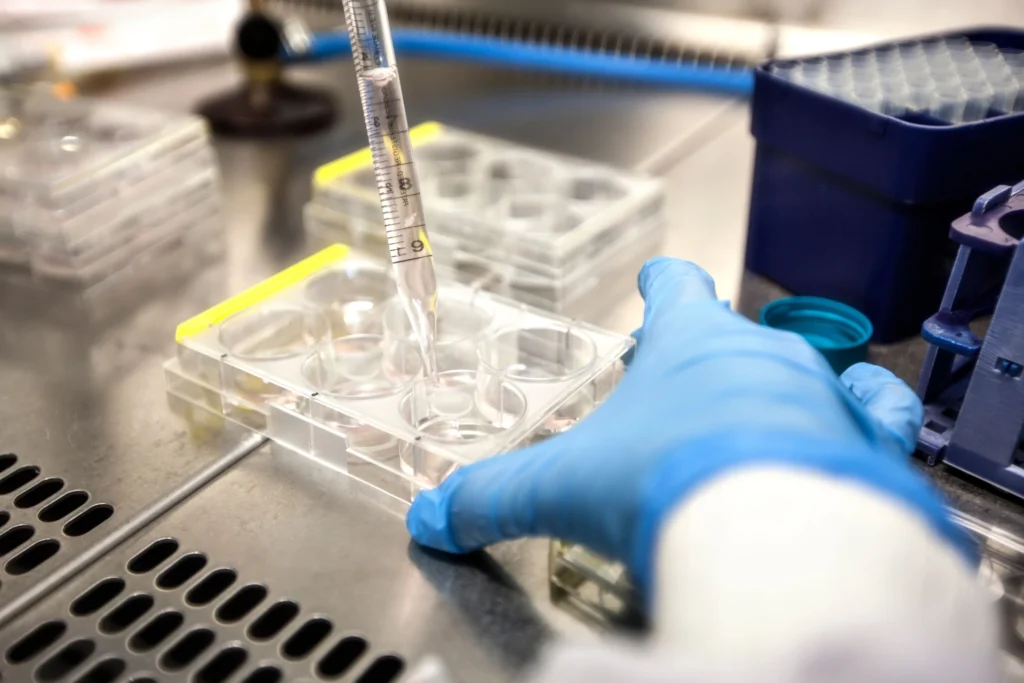
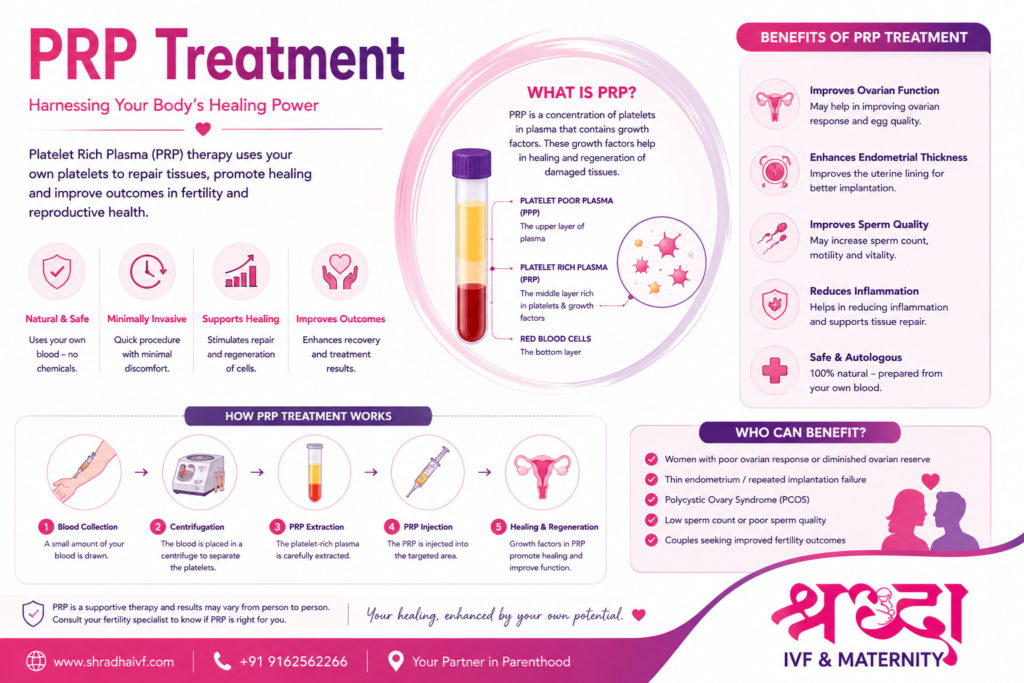
PRP stands for platelet-rich plasma. It’s made from a small sample of your own blood, spun in a machine called a centrifuge to concentrate the platelets. Platelets aren’t just for clotting — they release growth factors and cytokines, signalling proteins that drive tissue repair, new blood-vessel formation, and cell regeneration. The concentrated plasma is then placed where healing is wanted. Because it’s your own blood (autologous), the risk of allergy or rejection is very low.
In fertility, that “where” is the crux — and it defines the two very different treatments people lump together under one name.
To understand PRP treatment, it helps to know the basic components of blood. Blood contains two important elements involved in PRP therapy:
- Plasma – the liquid portion of blood that carries nutrients, hormones, and proteins throughout the body.
- Platelets – small blood cells responsible for blood clotting and tissue repair after injury.
Platelets release growth factors and cytokines, which are signaling proteins that help cells communicate during healing. These molecules help regulate tissue repair, blood vessel formation, and cellular regeneration. Platelets also have anti-inflammatory properties, which may help reduce inflammation in damaged tissues.
To prepare PRP, the collected blood sample is placed into a machine called a centrifuge. The centrifuge spins the blood at high speed, separating its components and concentrating the platelets in the plasma layer. This platelet-rich portion is then carefully collected and prepared for medical use.
In fertility medicine, PRP treatment may be used in two different ways:
- Injection into the ovaries, which aims to support ovarian function and follicle development.
- Infusion into the uterus, which is sometimes used to improve the uterine lining in patients with a thin endometrium.
The Two Lanes of PRP in Fertility (This Is the Key Distinction)
Most confusion about “does PRP work” comes from treating it as one thing. It isn’t. There are two separate applications, and — importantly — they don’t have the same level of evidence:
| Endometrial PRP | Ovarian PRP (“rejuvenation”) | |
|---|---|---|
| Where it goes | Infused into the uterine cavity | Injected into the ovaries |
| Aim | Thicken and improve a thin lining before embryo transfer | Stimulate ovarian tissue / dormant follicles in low reserve |
| Main candidates | Thin endometrium (<7 mm), repeated implantation failure, Asherman’s, chronic endometritis | Low ovarian reserve, poor responders, early ovarian ageing |
| Evidence level | More promising — studies show lining thickening & better implantation | Weaker & debated — mixed results, few solid RCTs |
Keeping these straight matters, because the honest answer to “does PRP work?” is “it depends which PRP, and for what.” Let’s take each in turn.
Endometrial PRP (Thin Lining) — the Stronger Evidence
This is the application with the most encouraging data — and, in my experience, the one that more patients should be asking about. Here’s the background: the uterine lining (endometrium)needs to reach a certain thickness — generally around 7 mm or more — to give an embryo the best chance of implanting. When the lining stays stubbornly thin despite standard hormone treatment, IVF success drops, and cycles are sometimes cancelled. In fact, a large share of implantation failures relates to poor endometrial receptivity rather than the embryo itself (see why a perfect-looking embryo fails).
For these women, intrauterine PRP — infused gently into the uterine cavity, typically a few days before embryo transfer — has shown genuinely promising results. Multiple studies report that PRP can:
- Increase endometrial thickness, often pushing a stubborn lining past the 7 mm threshold;
- Improve blood flow and vascularity in the lining;
- Improve implantation and clinical pregnancy rates in women who had previously failed with a thin lining.
One published cohort of women with persistent thin lining and previously failed or cancelled transfers reported clinical pregnancy and live-birth rates after PRP comparable to a general IVF population — a striking result for such a difficult group. PRP has also shown early promise in Asherman’s syndrome (scarring) and chronic endometritis — conditions your hysteroscopy may have diagnosed. The honest caveat: study methods vary, and larger trials are still needed, so this is “promising and well-tolerated,” not “proven cure.” But of the two PRP lanes, this is the stronger one.
Ovarian PRP (“Rejuvenation”) — the Honest Picture
The other lane is ovarian PRP, injected into the ovaries to try to improve response in women with low ovarian reserve, poor stimulation response, or early ovarian ageing. The idea is that PRP’s growth factors might stimulate dormant follicles and improve the ovarian environment, and some studies have reported increases in ovarian reserve markers (AMH, antral follicle count) and more eggs retrieved.
But here’s where honesty matters, and where your instincts should stay cautious. Women are born with all the eggs they will ever have, and the ovaries don’t normally create new ones. So the claim that PRP can meaningfully “rejuvenate” ovaries or increase egg numbers is biologically debated. Many supportive studies were small or lacked proper control groups, and rigorous randomised trials haven’t consistently shown a clear benefit. The ovaries already receive blood full of platelets, so whether adding more changes much is genuinely uncertain. For these reasons, most specialists — including me — view ovarian PRP as experimental: it may help some poor responders, sometimes as a step to consider before moving to donor eggs, but it should never be sold as a reliable fix. (For a realistic view of reserve and age, see how age affects IVF.)
How PRP Works?
Both lanes rely on the same biology. The concentrated platelets release growth factors and cytokines that regenerate and repair cells, promote new blood vessel formation (improving oxygen and nutrient supply), and reduce inflammation to support healing. In the lining, this can improve thickness and receptivity; in the ovary, the hope is improved local circulation and follicle activity. The mechanism is plausible — the open question, especially for ovaries, is how much real-world difference it makes.
Step-by-step PRP treatment process
- Blood sample collection: A small amount of blood is drawn from the patient’s arm, similar to a routine blood test.
- Platelet concentration: The blood sample is placed in a centrifuge that spins rapidly to separate platelets from other blood components.
- Preparation of platelet-rich plasma: The platelet-rich layer is extracted and prepared for injection.
- Injection into the ovaries: Using transvaginal ultrasound guidance, the fertility specialist injects the PRP directly into the ovarian tissue.
- Monitoring ovarian response: After the procedure, doctors monitor hormone levels and ovarian activity to determine whether there are signs of improvement.
The entire process typically takes 30 to 45 minutes. Because the procedure is similar to the egg retrieval process used in IVF, experienced fertility specialists can perform it safely.
Who Might Benefit from PRP treatment?
PRP isn’t for every IVF patient — it’s considered selectively, when there’s a specific problem it might address:
- Endometrial PRP: a thin lining (<7 mm) that hasn’t responded to standard treatment; repeated implantation failure; Asherman’s; chronic endometritis.
- Ovarian PRP: low ovarian reserve / low AMH; poor response to stimulation; early ovarian ageing; some women exploring options before donor eggs.
Every case is different, so a proper evaluation — including assessment, AMH, antral follicle count, and your IVF history — comes first.
Is PRP Treatment in IVF Painful?
This is a common concern for patients considering the procedure.
Most clinics perform PRP treatment under light sedation or local anesthesia, which means the patient should not feel significant discomfort during the procedure.
After the treatment, some patients may experience mild symptoms such as:
- light pelvic cramping
- abdominal pressure
- temporary bloating
These symptoms are usually mild and resolve within a day or two.
Overall, PRP treatment is considered a minimally invasive fertility procedure.
Does PRP Improve IVF Success?
Patients often ask whether PRP therapy can improve their chances of getting pregnant through IVF.
Some clinical studies have reported encouraging results, including:
- increases in AMH levels
- improvements in antral follicle countsA
- higher number of eggs retrieved during IVF cycles
For patients who previously produced very few eggs, PRP therapy may sometimes improve ovarian response during stimulation.
However, IVF success depends on many factors, including:
- age
- egg quality
- sperm quality
- embryo development
- uterine health
Because of these factors, PRP should be viewed as a supportive treatment rather than a guaranteed fertility solution.
More research is still needed to understand exactly which patients benefit the most from PRP therapy.
What Are the Benefits of PRP Treatment in IVF?
Although PRP therapy is still being studied, it offers several potential advantages for certain fertility patients.
Possible benefits include
- improved ovarian reserve markers in some patients
- increased follicle development
- potential to retrieve more eggs during IVF cycles
- minimally invasive procedure
- low risk of allergic reaction since PRP uses the patient’s own blood
Some studies have also reported that certain women with ovarian insufficiency experienced the return of menstrual cycles after PRP therapy.
These results have encouraged ongoing research into regenerative fertility treatments.
Are There Any Risks or Limitations?
Like any medical treatment, PRP therapy has limitations.
Important things to consider in PRP treatment
- Scientific evidence is still developing
- Results may vary between patients
- The procedure may not improve pregnancy rates for everyone
- PRP therapy may increase overall treatment cost
Minor side effects are uncommon but may include:
- temporary pelvic discomfort
- mild spotting
- rare risk of infection
These risks are generally low when the procedure is performed by an experienced fertility specialist.
How Is PRP Different from Traditional IVF?
PRP therapy is often misunderstood as a replacement for IVF, but it actually plays a different role.
| Feature | Traditional IVF | PRP Therapy |
| Main purpose | Fertilize eggs and create embryos | Improve ovarian response |
| Treatment type | Hormone stimulation and egg retrieval | Regenerative injection |
| When used | Core IVF process | Supportive treatment before IVF |
Doctors may recommend PRP therapy before starting a new IVF cycle to see whether ovarian activity improves.
How PRP Injection Helps Improve IVF Outcomes?
The idea behind PRP therapy is based on the regenerative properties of platelets. When platelets release growth factors and cytokines, they can stimulate biological processes involved in tissue healing and repair.
Researchers believe PRP injections into the ovaries may help fertility in several ways:
- improving blood circulation to ovarian tissue
- supporting tissue repair within the ovaries
- stimulating dormant follicles to begin developing
- encouraging better communication between ovarian cells
Improved blood flow is particularly important for ovarian health because follicles require oxygen and nutrients to grow and mature. If PRP improves the ovarian environment, it may support follicle growth and possibly improve egg quality.
Some early clinical studies have reported increases in ovarian reserve markers, such as Anti-Müllerian Hormone (AMH) levels or Antral Follicle Count (AFC), after PRP treatment. These markers are commonly used by fertility specialists to estimate ovarian reserve and predict how the ovaries may respond to IVF stimulation medications.
In certain patients, improved ovarian response could lead to a greater number of eggs retrieved during IVF treatment.
Why Might PRP Injection Not Improve IVF Outcomes?
Although PRP therapy has attracted significant interest, its effectiveness in fertility treatment is still being studied. Some scientists remain cautious because the available research has produced mixed results.
One important biological factor to understand is that women are born with all the eggs they will ever have. Unlike some tissues in the body, the ovaries do not normally generate new eggs during adulthood. Because of this, some experts question whether PRP therapy can truly increase the number of eggs available.
While some studies have reported improvements in AMH levels or follicle counts after PRP treatment, many of these studies have limitations. For example, some lacked proper control groups or involved small numbers of patients. More reliable research methods, such as randomised controlled trials, have not consistently demonstrated significant improvements in ovarian reserve after PRP therapy.
Another scientific consideration is that ovarian tissue already receives blood containing normal levels of platelets. Since platelets are naturally present in the bloodstream, some researchers argue that introducing additional platelets through PRP injections may not significantly change ovarian function.
For these reasons, most fertility specialists currently view PRP therapy as an experimental or emerging treatment rather than a standard IVF procedure. Some patients may benefit from it, while others may not experience measurable improvements.
How Does PRP Therapy Work for Fertility?
One of the most common questions patients ask is: What exactly does PRP do in the ovaries?
Researchers believe PRP may help ovarian tissue in several ways, although studies are still ongoing.
Possible ways PRP may support ovarian function
PRP therapy may help by:
- stimulating dormant ovarian follicles
- improving blood circulation in ovarian tissue
- delivering growth factors that promote tissue repair
- encouraging hormonal signaling within the ovaries
Better blood supply may help ovarian follicles receive more oxygen and nutrients, which are essential for development.
For women with low ovarian reserve, this regenerative stimulation may improve the body’s response to fertility medications during IVF cycles.
However, it is important to understand that PRP therapy does not guarantee improved fertility outcomes. Some patients see improvements in ovarian markers such as AMH or follicle counts, while others may not experience noticeable changes.
Because of this variability, fertility specialists carefully evaluate each patient’s medical history before recommending PRP therapy.
Who Might Benefit from PRP Treatment in IVF?
Not every IVF patient needs PRP therapy. In most cases, doctors recommend it only when there are signs that the ovaries are not responding well to fertility medications.
PRP treatment may be considered for patients who have:
- low ovarian reserve or low AMH levels
- Poor ovarian response during IVF cycles
- premature ovarian insufficiency
- repeated IVF failures
- age-related decline in ovarian function
Some women who are considering donor eggs may also explore PRP therapy first to see if their ovaries can produce eggs with additional stimulation.
Below is a simple overview of situations where PRP therapy may be discussed.
| Fertility Condition | Why PRP May Help |
| Low AMH | May stimulate dormant follicles |
| Poor IVF response | May improve ovarian stimulation results |
| Early ovarian aging | May temporarily enhance ovarian activity |
| Repeated IVF failure | May increase the chances of retrieving eggs |
Every fertility case is unique, so a detailed consultation and fertility testing are necessary before deciding whether PRP therapy could be helpful.
How soon can IVF begin after PRP treatment?
Doctors may recommend waiting several weeks after PRP therapy before beginning a new IVF cycle so that ovarian response can be evaluated.
Does PRP improve egg quality?
Some studies suggest PRP may improve ovarian function and follicle development. However, its impact on egg quality is still being studied.
Can PRP help women over 40?
PRP therapy may help certain women over 40 with low ovarian reserve, but success rates depend heavily on overall reproductive health and egg quality
How Much Does PRP Treatment Cost?
The cost of PRP treatment in IVF can vary depending on the fertility clinic and the specific treatment plan. PRP is usually an additional procedure, not part of a standard IVF treatment. So it adds to the overall cost (which varies with lab processing, expertise, and monitoring — we’ll give you a clear figure at consultation). It isn’t suitable for everyone: it’s generally not advised for women with complete ovarian failure and no follicles, severe ovarian damage, certain blood or platelet disorders, or conditions that raise procedural risk. A candid evaluation tells us whether PRP is realistic for you — or whether another path makes more sense.
Who Should Not Consider PRP Treatment?
PRP therapy may not be suitable for every patient.
Doctors may recommend alternative fertility options if a patient has:
- complete ovarian failure with no follicles present
- severe ovarian damage
- certain blood or platelet disorders
- medical conditions that increase procedural risks
Fertility specialists typically evaluate several factors before recommending PRP therapy, including:
- AMH levels
- antral follicle count
- age
- IVF treatment history
This helps ensure the treatment is appropriate and realistic for each patient.
Why Consider Shradha IVF for PRP Fertility Treatment?
Conclusion
PRP treatment in IVF is an emerging therapy that aims to support ovarian function using the regenerative properties of platelet-rich plasma. By stimulating ovarian tissue and improving blood circulation, PRP may help some patients with low ovarian reserve or poor IVF response.
Although research is still evolving, PRP therapy may offer an additional option for patients exploring ways to improve their chances of retrieving eggs during IVF.
Consulting with an experienced fertility specialist is the best way to determine whether PRP therapy fits into your fertility treatment plan. With the right medical guidance, patients can make informed decisions about the options available on their path to parenthood.
Wondering If PRP Could Help in Your Case?
The honest answer depends on why — a thin lining and low ovarian reserve are very different situations. Dr. Shradha will tell you plainly whether PRP is likely to help you, and what the evidence really shows. The first consultation is free.
Book a Free Consultation → 💬 WhatsApp UsFrequently Asked Questions About PRP Treatment
It depends which PRP and for what. For a thin uterine lining, endometrial PRP has promising evidence — studies show lining thickening and better implantation. For ovarian "rejuvenation" in low reserve, evidence is weaker and debated. PRP is a supportive, emerging add-on, not a guaranteed fertility cure.
PRP success rates vary widely between patients. Some studies report improvements in ovarian reserve markers and egg retrieval numbers, but pregnancy rates are not guaranteed. Age, egg quality, and overall fertility health play a major role in determining IVF outcomes after PRP treatment.
PRP treatment costs vary depending on the clinic, location, and treatment protocol. It is usually offered as an additional procedure alongside IVF rather than part of a standard IVF package. Costs may include blood processing, ultrasound-guided injection, and follow-up monitoring.
PRP treatment is generally not painful because it is usually performed under light sedation or local anesthesia. Patients may feel mild pelvic discomfort or cramping afterward, but these symptoms are typically temporary and resolve within a short time.
It varies widely by patient and by which PRP. For thin lining, some studies report pregnancy rates approaching a normal IVF population in previously-failing women. For ovarian PRP, results are mixed. Success still depends on age, egg quality, and overall health, so no fixed success rate applies.
This is uncertain. Some studies suggest PRP may support ovarian function and follicle development, but its effect on actual egg quality isn't established. Because women are born with all their eggs and ovaries don't make new ones, claims that PRP improves egg quality should be treated cautiously.
For endometrial PRP, it's done within the transfer cycle, a few days before transfer, and may be repeated in the same cycle if the lining needs more support. For ovarian PRP, doctors often wait a few weeks to assess response before an IVF cycle. The number of sessions is individualised.