

Medically Reviewed by Dr. Shradha Chakhaiyar, MBBS, MRCOG (London) — Fertility Specialist & Reproductive Surgeon, Shradha IVF & Maternity, Patna
20+ Years of Experience · www.shradhaivf.com
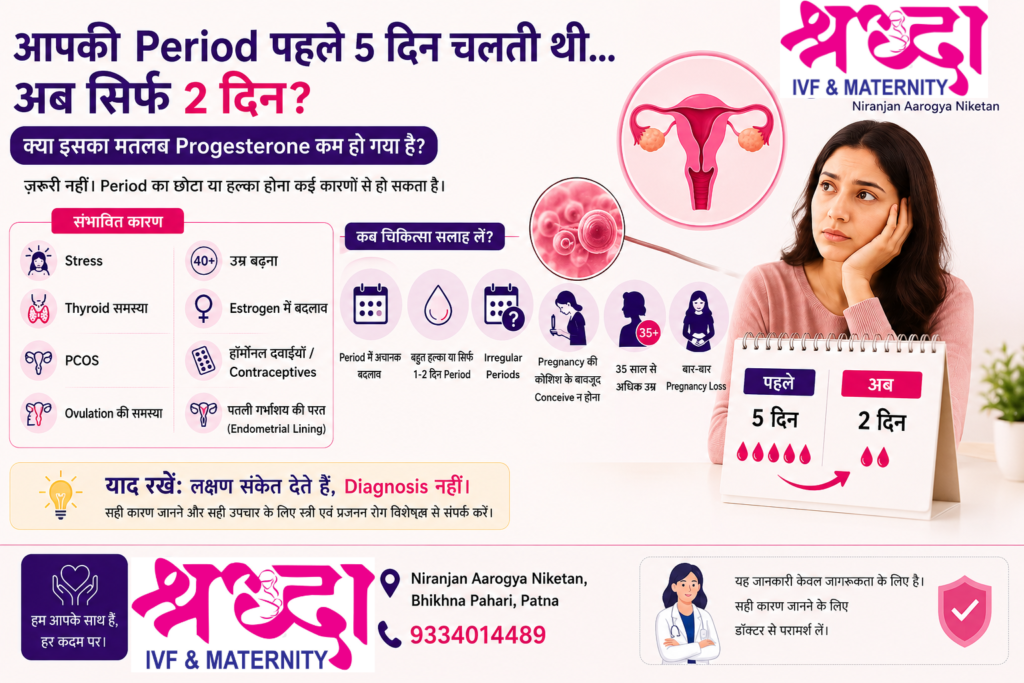
A short or light period is not the same as low progesterone, and neither one automatically means you can’t get pregnant. The fertility-relevant issue is a short luteal phase — fewer than about 10–11 days between ovulation and your next period — which can mean low progesterone and a lining that isn’t supported long enough for an embryo. However, luteal phase defect is over-diagnosed: it’s not proven to be an independent cause of infertility, and a single “low” progesterone reading isn’t a diagnosis. Low progesterone is usually a signal of an underlying cause — thyroid problems, high prolactin, PCOS, or weak ovulation — and treating that cause is what helps. In IVF, progesterone support is standard; in natural conception, the evidence is weaker.
📋 What This Guide Covers
- Short period vs short luteal phase — two different things
- What does progesterone actually do?
- What is a short luteal phase?
- Does low progesterone really cause infertility?
- Signs of low progesterone / a short luteal phase
- What causes it — the real question
- How is it tested (and why one reading isn’t enough)?
- Treatment: fix the cause, not just the number
- Progesterone in IVF vs natural conception
- When should you actually worry?
- A note from Dr. Shradha, Patna
- FAQs
Short Period vs Short Luteal Phase — Two Different Things
Let me clear up the confusion at the very heart of this topic, because almost every article blurs it and it causes needless panic.
- A short period means your bleeding is short or light — perhaps two days instead of four or five. This is about the days you actually bleed.
- A short luteal phase means the gap between ovulation and your next period is too short — fewer than about 10 to 11 days. This is the part that matters for fertility, and it’s the one connected to progesterone.
You can have one without the other. Plenty of women have short, light periods and completely normal fertility — a light flow is often simply their normal, or a sign of a thinner uterine lining that may have nothing to do with the luteal phase. What deserves attention is a consistently short luteal phase, because that’s what can leave too little time for the lining to prepare for an embryo. So the first useful thing is to work out which one you actually have — and if your periods have simply become shorter or lighter, our guide on short or light periods and what’s normal is the better starting point, while this page focuses on the hormone-and-fertility angle.
What Does Progesterone Actually Do?
Progesterone is the hormone of the second half of your cycle. After you ovulate, the follicle that released the egg transforms into a small temporary structure called the corpus luteum, and its whole job is to pump out progesterone.
That progesterone does two crucial things: it matures and stabilises the uterine lining, turning it into a receptive, nourishing bed, and it holds that lining in place long enough for a fertilised egg to arrive and implant. If a pregnancy begins, progesterone keeps supporting it in the earliest weeks until the placenta takes over. If no pregnancy occurs, progesterone falls, the lining is shed, and your period begins. So progesterone is, in a real sense, the hormone that keeps the door open for implantation.
What Is a Short Luteal Phase?
A normal luteal phase lasts about 12 to 14 days (anywhere from 11 to 17 can be healthy). It’s usually quite consistent from month to month — unlike the first half of the cycle, which varies more.
A short luteal phase is generally defined as 10 days or fewer between ovulation and your period. The concern is logical: if progesterone drops too soon, the lining may start to break down before an embryo has had the chance to implant and establish itself. That’s the mechanism behind the worry — and it’s a real, plausible mechanism. The important word, as you’ll see next, is plausible. To know your own luteal phase length, you need to know when you ovulated, which is where ovulation tracking with a kit helps — count from ovulation to the first day of your period.
Does Low Progesterone Really Cause Infertility? The Honest Answer
Here I’m going to tell you something most pages won’t, because I’d rather you had the truth than a scare.
“Luteal phase defect” is far less clear-cut than the internet makes it sound. Despite how confidently it’s discussed, it has never been established as an independent cause of infertility or recurrent miscarriage. There is no single reliable test that diagnoses it — the old method of dating an endometrial biopsy was abandoned as unreliable. And one frequently-cited study found that while an occasional short luteal phase might reduce fertility in that particular month, the chance of infertility over a full year was not significantly higher in women with a short luteal phase than in those without.
Why does this matter to you? Because it means a short cycle or one “low” progesterone reading is not a verdict on your fertility. Many women with occasionally short luteal phases conceive perfectly well. The condition is genuinely over-diagnosed, and a great deal of anxiety — and sometimes unnecessary treatment — flows from treating a normal variation as a disease. So please don’t read a short period as a closed door. It isn’t.
Signs of Low Progesterone or a Short Luteal Phase
A short luteal phase is one of the “quiet” fertility issues — cycles can look regular on the surface. But some signs point toward it:
- Spotting for several days before your period properly starts — the most classic sign, suggesting the lining is beginning to break down early.
- A consistently short gap (10 days or fewer) between ovulation and your period, noticed through tracking.
- Difficulty conceiving despite ovulating regularly.
- Recurrent very early pregnancy losses.
Note that a short or light period is not on this list by itself — spotting before the period is the relevant sign, not simply a light flow. If you’re trying to tell early spotting apart from other bleeding, our guides on spotting versus a real period and implantation bleeding or period may help.
What Causes Low Progesterone — the Real Question
This is the heart of the page, because the cause is what you actually treat. A short luteal phase or low progesterone usually traces back to one of these:
- Thyroid problems. An underactive (or overactive) thyroid disrupts the whole hormonal cascade, and it’s one of the commonest and most treatable causes. This is often the very first thing I check — see our guide on how thyroid disorders affect fertility.
- High prolactin. Raised levels of the hormone prolactin can interfere with ovulation and corpus luteum function, and it’s usually straightforward to correct.
- PCOS and ovulation problems. If ovulation is weak or irregular, the corpus luteum it produces is weak too — and weak progesterone follows. Here the answer is to improve ovulation, not to supplement downstream. Our guide on ovulating but still not getting pregnant covers this territory.
- Very low body weight or extreme physical strain. Both can suppress the hormones that drive a healthy cycle.
- Stress and life stage. Significant chronic stress, the approach to perimenopause, or the months after childbirth and during breastfeeding can all shorten the luteal phase — often temporarily.
Do you see the pattern? In almost every case, the low progesterone is the symptom. Find and fix the thyroid, the prolactin, the ovulation — and the progesterone tends to right itself.
How Is It Tested (and Why One Reading Isn’t Enough)?
The common test is a progesterone blood level drawn about a week after ovulation (often called a “day 21” test, though the right day depends on when you ovulate, not a fixed calendar date). It’s a useful test — but with an important caveat you deserve to know.
Progesterone is released in pulses, so its level swings up and down through the day. A single blood draw is a snapshot, and one “low” value doesn’t diagnose a defect on its own — it might simply have been drawn at a low point in the pulse, or on the wrong day relative to your ovulation. This is exactly why a careful doctor won’t label you on one number, and will instead look at the whole picture: your cycle pattern, your ovulation timing (which is why tracking ovulation and knowing your fertile window helps), your thyroid and prolactin, and your history. That fuller assessment is worth far more than chasing a single progesterone figure.
2 Days Period Treatment: Fix the Cause, Not Just the Number
Because low progesterone is usually a signal, good treatment starts by asking what it’s signalling:
- Correct the thyroid if it’s off — often this alone restores a healthy cycle.
- Lower high prolactin with appropriate medication where needed.
- Improve ovulation. Where the follicle and corpus luteum are the weak link, helping you ovulate more strongly (with medication your doctor may recommend) addresses the root, producing better natural progesterone — rather than just topping up the symptom.
- Address weight, extreme exercise, and stress where they’re contributing.
- Progesterone supplementation is sometimes used to support the luteal phase. In natural conception the evidence that it improves outcomes is genuinely weak, so it’s not an automatic answer — but your doctor may consider it in specific situations, such as a history of recurrent early loss. It should be a considered choice, not a reflex.
If simpler steps don’t lead to a pregnancy, treatments like IUI or IVF may be discussed — and that’s where the progesterone story changes, as I’ll explain next.
Progesterone in IVF vs Natural Conception
This distinction is almost never explained, and it resolves a lot of confusion, so let me be clear about it.
In natural conception, as above, the evidence for giving progesterone to fix a suspected luteal phase defect is weak, and it isn’t an automatic treatment.
In IVF and frozen-embryo transfer, progesterone support is standard and firmly evidence-based. The reason is simple: the IVF process itself — the medications, the egg retrieval — disrupts the body’s own progesterone production, so we deliberately supply it to support the lining through implantation and the early weeks. So if you’ve read that “IVF patients always get progesterone” and wondered why it’s not automatic for everyone, that’s the answer: IVF creates a specific, predictable progesterone gap that support is designed to fill. It’s a different situation from a natural cycle, and both things can be true at once.
When Should You Actually Worry?
Most women reading this are fine, and I don’t want to add to anyone’s anxiety. But here’s a clear, honest list of when a short cycle or suspected low progesterone genuinely warrants a proper look:
- Your luteal phase is consistently 10 days or fewer, cycle after cycle (not just once).
- You spot for several days before every period starts properly.
- You’ve been trying to conceive for a year (or six months if you’re over 35) without success.
- You’ve had two or more very early pregnancy losses.
- You have other signs of a hormonal issue — irregular cycles, symptoms of a thyroid problem, unusual milk-like nipple discharge (possible high prolactin).
If none of these applies — if your period is simply a bit lighter or shorter than it used to be and you’re otherwise well — it’s very likely just your normal, and not a fertility problem at all.
A Note from Dr. Shradha, Patna
At Shradha IVF & Maternity, short cycles and hormonal concerns are assessed thoroughly — thyroid, prolactin, ovulation and all — by Dr. Shradha Chakhaiyar, MRCOG (London), so you get the cause, not just a number. You can book a consultation here, and our note on preparing for your visit tells you what to bring.
FAQs Related to Short Period Due to Progesterone
1. Does a short period mean low progesterone?
Not necessarily. A short or light period (short bleeding) is different from a short luteal phase (a short gap between ovulation and your period), which is what’s linked to low progesterone. Many women with short, light periods have normal progesterone and normal fertility. The two are often confused.
2. Can you get pregnant with low progesterone?
Yes, usually. Low progesterone or a short luteal phase is not proven to be an independent cause of infertility, and many women with occasional short cycles conceive normally. If it’s persistent, treating the underlying cause — often thyroid, prolactin, or ovulation — typically restores healthy progesterone.
3. What is a short luteal phase?
The luteal phase is the time between ovulation and your next period, normally 12–14 days. A short luteal phase is 10 days or fewer. The concern is that progesterone may fall too soon, so the uterine lining isn’t supported long enough for an embryo to implant.
4. Does low progesterone cause infertility?
The link is plausible but not proven. Luteal phase defect has never been established as an independent cause of infertility, and one large analysis found no significant increase in infertility at one year. It’s genuinely over-diagnosed — usually a signal of a treatable underlying cause rather than a verdict.
5. What are the signs of low progesterone or a short luteal phase?
The classic sign is spotting for several days before your period properly starts. Others include a consistently short (10 days or fewer) gap between ovulation and your period, difficulty conceiving despite regular ovulation, and recurrent very early pregnancy losses. A short or light period alone is not a reliable sign.
6. How can I increase my progesterone to get pregnant?
The best approach is to treat the cause rather than the number — correcting a thyroid problem, lowering high prolactin, or improving ovulation usually restores natural progesterone. Progesterone supplements are sometimes used but have weak evidence in natural conception. A doctor should identify the underlying issue first.
One Low Progesterone Reading Isn’t a Diagnosis. Let’s Find the Real Answer.
If your periods have changed or you’ve been told your progesterone is low, Dr. Shradha will look at the whole picture — thyroid, prolactin, ovulation — and find what’s actually going on, instead of treating a single number. The first consultation is free.