

Medically Reviewed by Dr. Shradha Chakhaiyar, MBBS, MRCOG (London) — Fertility Specialist & Reproductive Surgeon, Shradha IVF & Maternity, Patna
20+ Years of Experience · www.shradhaivf.com
A “mildly bulky uterus” means your uterus measures slightly above the typical range on ultrasound — usually a small, borderline increase, not a major enlargement. It’s a description of size, not a disease. Common causes include small fibroids, early adenomyosis, hormonal fluctuation, or a uterus that hasn’t fully returned to size after childbirth. Many women have no symptoms and no fertility impact at all; when there is an impact, it usually comes from the underlying cause rather than the size itself.
📋 What This Guide Covers
- What does mildly bulky uterus mean?
- What uterus size counts as mildly bulky?
- What do the words on your ultrasound report mean?
- Is a mildly bulky uterus normal — should you worry?
- What causes a mildly bulky uterus?
- What are the symptoms of a mildly bulky uterus?
- Does a mildly bulky uterus affect fertility or IVF?
- How is a mildly bulky uterus diagnosed?
- How is a mildly bulky uterus treated?
- When should you see a doctor about a bulky uterus?
- A note from Dr. Shradha, Patna
- FAQs
What Does “Mildly Bulky Uterus” Mean?
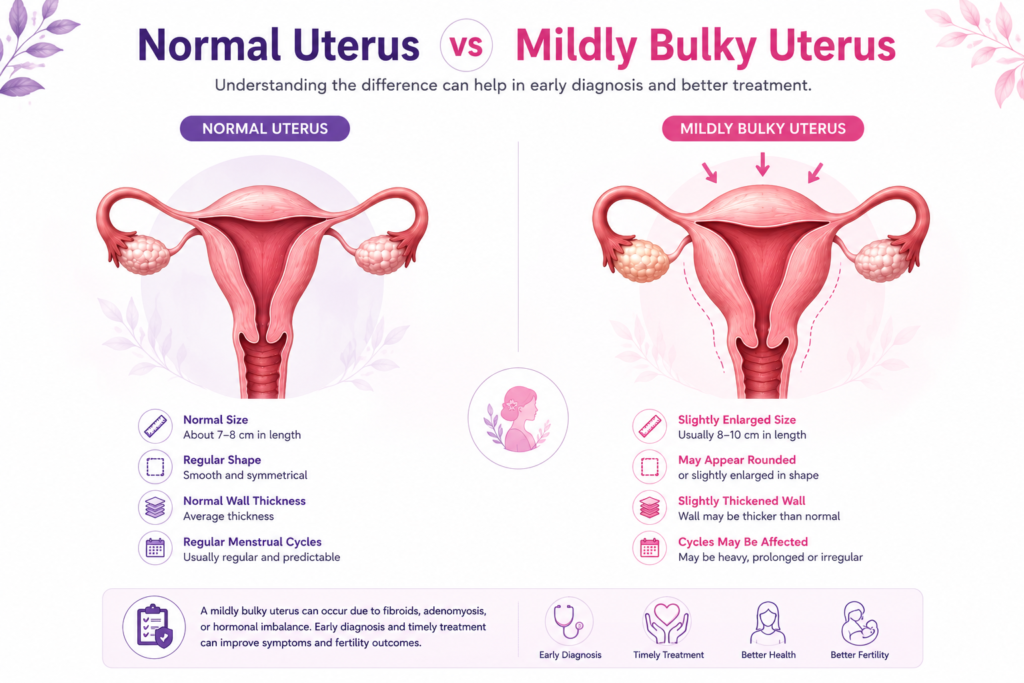
Your uterus is a muscular, pear-shaped organ, and like any organ, it has a typical size range for a woman of reproductive age who isn’t pregnant. When an ultrasound measures it slightly above that range, the radiologist notes it as “bulky uterus,” and when the increase is small, they add the word “mildly.” That’s the entire meaning of the phrase: a small, measured increase in size, not a diagnosis in itself. It’s a description, similar to a doctor noting your blood pressure is “mildly elevated” — it tells you where to look next, not what’s wrong.
It’s genuinely important to separate the finding from the fear it can trigger. A “mildly bulky uterus” on a report is one of the most frequently seen incidental findings in gynaecology — many women who have this exact note on a scan go on to have completely normal periods, completely normal pregnancies, and no further issues at all.
What Uterus Size Counts as Mildly Bulky?
Uterine size is usually reported against a rough normal range, and how far above that range a uterus measures is what separates “mildly” from “moderately” or “significantly” bulky. This isn’t an exact science — a woman’s age, whether she’s had children, and where she is in her cycle all shift the numbers slightly — but this is the general pattern doctors use to think about it:
| Category | What it usually means | Typical next step |
|---|---|---|
| Normal | Roughly 7–8 cm long, 4–5 cm wide, 2–3 cm deep in a non-pregnant woman of reproductive age | No action needed |
| Mildly bulky | Slightly above normal range — a small, borderline increase, often just a few millimetres to a centimetre or so over typical measurements | Identify the cause; often just monitoring |
| Moderately bulky | A more noticeable increase, more likely to correlate with a symptomatic fibroid, adenomyosis, or hormonal condition | Further evaluation, cause-specific plan |
| Significantly enlarged | Substantial increase, usually with an identifiable cause (larger fibroids, advanced adenomyosis, or other pathology) and more often symptomatic | Specialist evaluation and treatment plan |
The number on your report matters far less than what’s causing the increase — which is why the next two sections matter more than the measurement itself.
“Slightly Bulky,” “Mildly Enlarged,” “Big Uterus” — Same Thing?
Yes. Reports vary in wording between radiologists and between centres, and the differences carry no clinical meaning. All of the following describe the same finding:
- Mildly bulky uterus
- Slightly bulky uterus
- Mildly enlarged uterus
- Uterus mildly bulky in size
- Uterus appears slightly enlarged
“Big uterus” is not standard reporting language, but women searching for an explanation often use it, and it means the same thing. If you are comparing two reports and the wording has changed while the measurements are similar, that is a difference in phrasing, not a change in your condition.
What Do the Bulky Words on Your Ultrasound Report Mean?
Ultrasound reports are written for other doctors, not for patients, which is exactly why they cause so much unnecessary worry. Here’s what the most common phrases actually mean:
| What your report says | What it means |
|---|---|
| “Uterus mildly bulky” | A small, measured increase in overall uterine size — see the size table above |
| “Uterus bulky in size” | A similar finding, sometimes used loosely for a slightly larger increase than “mildly” |
| “Intramural fibroid noted” | A fibroid located within the muscular wall of the uterus, often the reason for the bulky appearance |
| “Normal endometrial thickness” | A genuinely reassuring line — it means the uterine lining itself looks normal for your cycle stage |
| “Heterogeneous myometrium” | The muscular wall looks uneven in texture, which can point toward early adenomyosis |
| “Bulky uterus with adenomyosis-like changes” | Features suggestive of adenomyosis were seen; it usually needs a specialist’s interpretation alongside your symptoms |
If your report uses a phrase not listed here, don’t try to self-diagnose from the wording alone — bring the report to your gynaecologist and ask them to walk through it with you line by line. That five-minute conversation resolves more anxiety than any amount of searching.
Is a Mildly Bulky Uterus Normal — Should You Worry?
In most cases, no, you should not be alarmed. A mildly bulky uterus is frequently found incidentally — during a routine scan, a fertility work-up, or a check-up for something unrelated — in women who have no symptoms whatsoever. It’s also genuinely common after childbirth: the uterus can take time to fully return to its pre-pregnancy size, and “mildly bulky” is a normal, temporary part of that process for some women.
That said, “mildly bulky” is not the same as “definitely nothing.” The honest, useful way to think about it is this: the size alone rarely tells the full story — the cause does. That’s why the right next step is never to panic over one word on a report, but also never to ignore it completely. The right step is a proper conversation with a gynaecologist who can look at the full picture: your symptoms (or lack of them), your age, your reproductive plans, and the rest of the ultrasound findings.
Is a Mildly Bulky Uterus Good or Bad?
Neither — and the framing of the question is where most of the worry comes from.
“Bulky uterus” is a description, not a diagnosis. Someone measured your uterus and recorded that it was above the reference range. Nothing in that sentence tells you whether anything is wrong. It is closer to “you are taller than average” than to a finding of disease.
So the useful question is not good or bad, but which of four situations you are in:
| Situation | What it means for you |
|---|---|
| Benign and temporary Recent childbirth, early pregnancy, cyclical hormonal change | Nothing to treat. Resolves by itself. |
| Benign and permanent Settled larger after births; small symptom-free fibroids | Also nothing to treat. A repeat scan to confirm it is stable, then left alone. |
| Manageable Adenomyosis or hormonal imbalance causing heavy or painful periods | Worth treating — for the symptoms, not the size. Medication usually controls it well. |
| Needs prompt attention Enlargement after menopause, especially with bleeding; rapidly increasing size | Uncommon, but this group must not be reassured by default. |
The great majority of women with a mildly bulky uterus are in the first two rows. The finding is reported at all to make sure nobody in the fourth row is missed.
What Causes a Mildly Bulky Uterus?
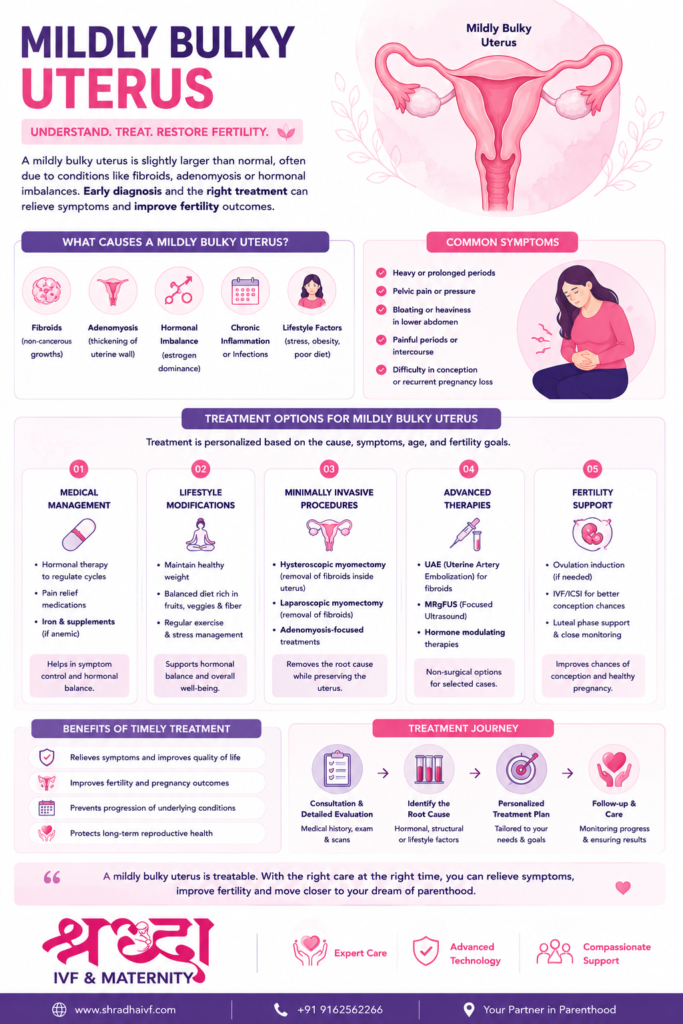
A mildly bulky uterus isn’t a condition on its own — it’s usually a sign of one of these underlying, usually manageable, causes:
| Cause | What’s happening | How common |
|---|---|---|
| Uterine fibroids | Small, non-cancerous growths in the muscular wall; even a modest fibroid can nudge overall size slightly above normal | Most common cause overall |
| Adenomyosis | Endometrial (lining) tissue growing into the muscular wall of the uterus, most often seen in women in their 30s–40s | Very common, often under-recognised |
| Hormonal imbalance | Higher oestrogen relative to progesterone can thicken the lining and modestly enlarge the uterus | Common, often cyclical |
| Postpartum changes | The uterus takes weeks to months to fully shrink back after pregnancy and delivery | Common and usually temporary |
| Endometrial hyperplasia | A thickening of the uterine lining, sometimes hormone-driven, that can add to overall size | Less common, worth ruling out |
It’s also worth knowing that more than one of these can be present at the same time — a small fibroid alongside early adenomyosis, for example — which is exactly why a scan alone rarely gives the complete answer.
What Are the Symptoms of a Mildly Bulky Uterus?
Many women with a mildly bulky uterus have no symptoms at all — it’s found purely by chance on a scan done for another reason. When symptoms do appear, they typically include:
- Heavier or longer periods than what’s usual for you
- Pelvic pain or a feeling of pressure or fullness in the lower abdomen
- More painful periods than before
- Frequent urination, from mild pressure on the bladder
- Bloating or a sense of abdominal fullness
- Irregular cycles
None of these, on their own, confirms a serious problem — but if you notice two or three together, especially heavier bleeding, it’s worth bringing up at your next appointment rather than waiting for the next routine scan.
Does a Mildly Bulky Uterus Affect Fertility or IVF?
This is usually the real question underneath the worry, so let’s answer it directly. A mildly bulky uterus, by itself, rarely prevents natural conception or IVF success. What matters for fertility is almost always the underlying cause and, in the case of fibroids, their exact location — a fibroid that distorts the uterine cavity or sits close to where an embryo would implant matters far more than a small, overall increase in uterine size.
In an IVF context specifically, what your embryologist and doctor care most about is the health of the uterine lining and whether the uterine cavity itself is normal in shape, which is why a hysteroscopy is sometimes recommended before transfer if there’s any doubt, and why the uterine lining gets so much attention in fertility treatment generally. A mildly bulky uterus with a healthy, normal-shaped cavity and good lining is very often entirely compatible with a successful pregnancy, IVF or otherwise.
How Is a Mildly Bulky Uterus Diagnosed?
The goal of diagnosis isn’t just to confirm the uterus is bulky — you already know that from your report. It’s to find out why, so the right (often very simple) plan can follow:
- Transvaginal or pelvic ultrasound — the first and most common test, used to assess size, shape, and internal structure, and to look for fibroids, adenomyosis, or lining changes
- Physical examination — your doctor may feel the uterus for size, tenderness, or irregularity, which adds useful clinical context
- MRI, if needed — used when a more detailed picture is required, particularly to distinguish adenomyosis from complex fibroids
This step-by-step approach is exactly how we work at Shradha IVF & Maternity — the aim is always to name the cause, not just the size.
How Is a Mildly Bulky Uterus Treated?
Treatment, if any is needed at all, is guided entirely by the cause and your symptoms — not by the word “bulky” itself:
- Watchful monitoring — for many mild, asymptomatic cases, periodic follow-up ultrasounds are all that’s needed
- Medication or hormonal therapy — to manage bleeding or hormonal imbalance, where that’s the driver
- Minimally invasive procedures — such as hysteroscopy to remove a polyp or a small fibroid affecting the cavity, or laparoscopy for certain fibroid locations
- Lifestyle steps — a balanced diet, regular exercise, and stress management support hormonal balance generally and are sensible regardless of cause
- Surgery — reserved for larger fibroids or more significant disease where other options aren’t suitable; a genuinely mildly bulky uterus rarely reaches this point
The right combination is a conversation, not a checklist — which is exactly why the diagnosis step above matters so much.
What does “watchful monitoring” actually involve?
If you have been told to monitor, here is what that means in practice. Typically a repeat pelvic ultrasound in about six months, usually transvaginal. It compares three things against the last scan: whether the measurements are stable, whether the lining thickness is appropriate for where you are in your cycle, and whether anything new has appeared.
A stable measurement is a good result. It means the enlargement is not progressing, which is the main thing being watched for. It does not need to shrink to be reassuring.
Two practical points. Where you are in your cycle affects the lining measurement, so if you are having repeat scans, try to have them at a similar point each time — it makes the comparison meaningful. And bring the previous report with you. Comparison against your own earlier scan is far more informative than comparison to a general reference range.
When Should You See a Doctor About a Bulky Uterus?
Most mildly bulky uterus findings can wait for your next routine appointment. See a gynaecologist sooner if you notice:
- Periods that are suddenly much heavier, longer, or more painful than usual
- Persistent pelvic pain or pressure that doesn’t ease
- Bleeding between periods or after menopause
- Difficulty conceiving alongside any of the above
A Note from Dr. Shradha, Patna
At Shradha IVF & Maternity, every ultrasound finding is reviewed personally with Dr. Shradha Chakhaiyar, MRCOG (London), so you leave with an actual explanation, not just a bigger word for what your report already said. If fertility is on your mind, you can also check your odds with our IVF success rate calculator. The first consultation is free.
FAQs Related to Mildly Bulky Uterus Treatment
1. What does mildly bulky uterus mean?
Mildly bulky uterus means your uterus measured slightly above the typical size range on an ultrasound — a small, borderline increase, not a diagnosis. It’s a description of size only. The real question is what’s causing it, which usually turns out to be a small fibroid, early adenomyosis, hormonal changes, or postpartum recovery.
2. Is a mildly bulky uterus normal?
Yes, in most cases. It’s one of the most common incidental findings on a pelvic ultrasound, often discovered in women with no symptoms at all during a routine or unrelated scan. It becomes worth attention only once the underlying cause and any symptoms are understood.
3. Can I get pregnant with a mildly bulky uterus?
Yes, in the large majority of cases. A mildly bulky uterus alone rarely prevents conception. What matters more is the underlying cause and whether the uterine cavity and lining are healthy — many women with this finding conceive naturally without any treatment.
4. Does a mildly bulky uterus affect IVF or embryo transfer?
Rarely by itself. IVF success depends far more on the health of the uterine cavity and lining than on overall uterine size. If there’s any concern, a hysteroscopy can confirm the cavity is normal before transfer, and treatment is targeted at the actual cause, not the size.
5. Is mildly bulky uterus the same as fibroid or adenomyosis?
No — “mildly bulky” describes size, while fibroids and adenomyosis are specific conditions that can cause that size increase. A mildly bulky uterus may have a fibroid, adenomyosis, both, or neither behind it; an ultrasound (and sometimes an MRI) is used to tell them apart.
6. Is a bulky uterus good or bad?
Neither. It is a description of size, not a diagnosis, so it is not good or bad in itself. What matters is the cause. Most mildly bulky uteruses are benign — either temporary after childbirth, or a stable finding that needs nothing done. Enlargement after menopause is the situation that needs prompt review.
7. Is “slightly bulky uterus” the same as “mildly bulky uterus”?
Yes. Radiologists word reports differently, and slightly bulky, mildly bulky and mildly enlarged all describe the same finding with no difference in meaning. If your wording has changed between two reports while the measurements are similar, that is a difference in phrasing, not in your condition.
8. How often should a mildly bulky uterus be rescanned?
Commonly about six months for a first follow-up, then less often if the size is stable and you have no symptoms. Your gynaecologist may advise a different interval based on the cause and your plans. Try to have repeat scans at a similar point in your cycle so the comparison is meaningful
Got “Mildly Bulky Uterus” on Your Report? Let’s Go Through It Together.
Dr. Shradha will review your ultrasound report personally, explain exactly what it means for you, and let you know — honestly — whether anything needs to be done at all. The first consultation is free.