

Medically Reviewed by Dr. Shradha Chakhaiyar, MBBS, DGO, MRCOG (London) — Fertility Specialist & Reproductive Surgeon, Shradha IVF & Maternity, Patna
20+ Years of Experience · www.shradhaivf.com
Quick answer
A bulky uterus means the uterus measures larger than its normal range — generally above about 9 cm in length in a woman who has not given birth. It is not a disease. It is a description on an ultrasound report pointing to an underlying cause, most often fibroids, adenomyosis, recent childbirth or a hormonal imbalance. Many women with a bulky uterus have no symptoms and conceive without difficulty. Whether treatment is needed depends on the cause, not the measurement.
For many women, a routine ultrasound brings an unexpected phrase — “You have a bulky uterus.” The words can feel confusing, even frightening. Does it mean something is serious? Will it affect my ability to get pregnant? Is surgery needed?
The truth is, a bulky uterus is not a disease in itself. It is a medical description that simply means your uterus is larger than its normal size. While this finding is common, it should never be ignored — especially if you are trying to conceive or are experiencing menstrual discomfort.
With the right diagnosis and timely treatment, most women go on to live healthy lives — and many achieve successful pregnancies, including through IVF treatment when needed.
In this comprehensive guide, Dr. Shradha Chakhaiyar — Patna’s leading fertility specialist — explains everything you need to know about a bulky uterus: what it is, what causes it, how it is diagnosed, how it affects fertility, and what treatment options are available in Patna, Bihar.
What Is a Bulky Uterus?
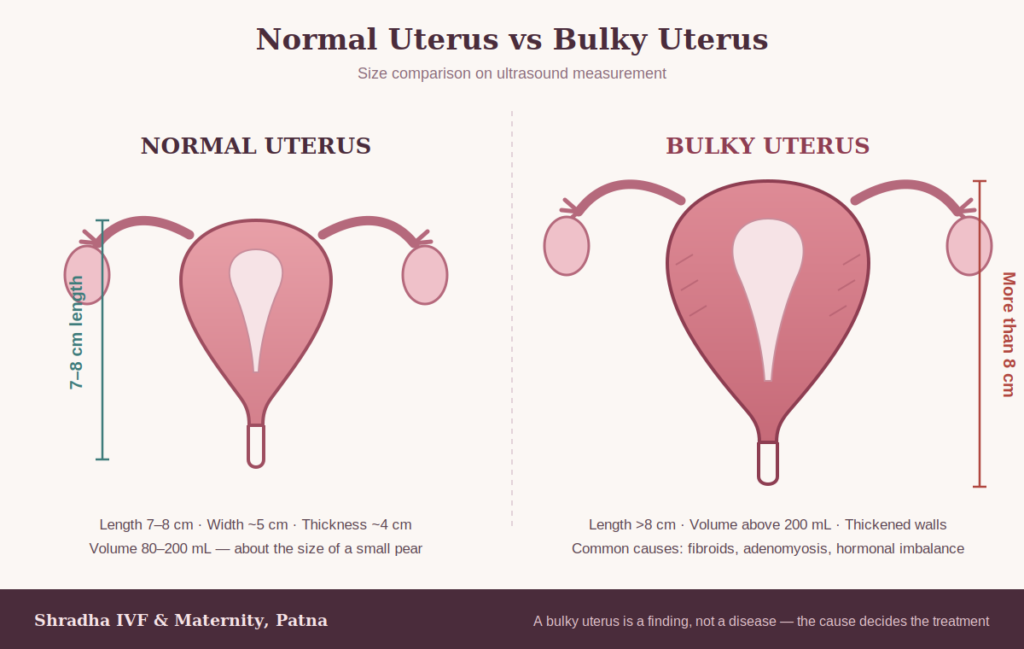
A bulky uterus means the uterus is larger than its normal size — approximately 7–8 cm long, 5 cm wide, and 4 cm thick in a non-pregnant adult woman. It is not a disease itself but a finding on ultrasound that points to an underlying cause, most commonly fibroids, adenomyosis, or hormonal changes. Many women with a bulky uterus conceive naturally; whether treatment is needed depends entirely on the cause.
It is important to understand three things clearly when we say the uterus is bulky:
- A bulky uterus is not a disease — it is a finding or observation on a scan
- It is a sign that something may be affecting the uterus internally — the underlying cause needs to be identified
- Many women with a bulky uterus live completely normal lives, particularly when the condition is detected early and managed appropriately
The term is commonly used by gynaecologists and radiologists across India and Bihar when an ultrasound report shows that the uterus dimensions are outside the standard normal range. You may also see it written as an “enlarged uterus” — the two mean the same thing.
Reports often qualify the finding. If yours describes the enlargement as slight rather than marked, the interpretation and next steps are different — see our guide to a mildly bulky uterus.
What Is Normal Uterus vs. a Bulky Uterus?
Understanding the difference between a normal uterus and a bulky uterus starts with knowing the standard measurements. These are the reference values used by gynaecologists and radiologists when interpreting an ultrasound report:
| Measurement | Normal Uterus | Bulky Uterus |
|---|---|---|
| Length | 7.5 cm (75 mm) | More than 9 cm (90 mm) |
| Width | 5.0 cm (50 mm) | More than 6 cm (60 mm) |
| Thickness | 2.5 cm (25 mm) | More than 4 cm (40 mm) |
| Weight | 50 – 70 grams | More than 80 grams |
| Appearance on Ultrasound | Pear-shaped, symmetrical | Enlarged, possibly irregular |
Does bulky uterus matter whether you have had children?
Yes, considerably — and this is where most online information becomes unhelpful, because sources disagree with each other. You will find the normal uterus quoted as 8 × 5 × 4 cm on one page and 7.5 × 5 × 2.5 cm on the next. Both are simplifications of the same point: uterine dimensions change permanently after childbirth and again after menopause.
A uterus of 9 cm can be entirely normal in a woman who has had two children and clearly enlarged in a woman who has had none. These are the ranges that account for that:
| Life stage | Length | Width | Depth (AP) | Typical volume |
|---|---|---|---|---|
| Reproductive age, no previous births | 7.0–8.0 cm 70–80 mm | 4.0–5.0 cm 40–50 mm | 2.5–3.5 cm 25–35 mm | up to ~90 mL |
| Reproductive age, one or more births | 8.0–9.5 cm 80–95 mm | 5.0–6.0 cm 50–60 mm | 3.0–4.0 cm 30–40 mm | up to ~130 mL |
| After menopause | 3.5–6.5 cm 35–65 mm | 2.0–4.0 cm 20–40 mm | 1.5–2.5 cm 15–25 mm | up to ~40 mL |
| Reported as bulky when | Length above roughly 9 cm with no previous births, or above roughly 10 cm after childbirth — or a uterine volume above about 200 mL. Some reports instead describe size by comparison to pregnancy, as in “10-week size uterus.” | |||
Two practical notes on reading your own report. Measurements are usually given in millimetres, so a length of “94 mm” is 9.4 cm. And transvaginal and transabdominal scans can differ by a few millimetres on the same uterus, which is why a single borderline measurement is rarely acted on by itself.
Bulky Uterus on Ultrasound Report — What Does It Mean?
If your ultrasound report contains any of the following phrases, it means your uterus is larger than normal:
- “Uterus appears bulky”
- “Uterus is bulky in size”
- “Bulky uterus with fibroid”
- “Bulky uterus with thickened endometrium”
- “Enlarged uterus noted”
These phrases on their own do not confirm a diagnosis — they are a starting point for further investigation. Your gynaecologist will review the full report, examine you clinically, and may recommend additional tests to understand why the uterus appears bulky and what — if any — treatment is needed.
Your report phrases about the uterus, decoded
| What your report says | What it means | What usually happens next |
|---|---|---|
| “Uterus is bulky in size” | Enlarged overall. No cause identified yet. | Clinical examination and history to narrow the cause. |
| “Bulky heterogeneous uterus” | Enlarged, and the muscle texture looks uneven rather than uniform. This pattern points more towards adenomyosis than towards discrete fibroids. | Often an MRI, which is the most reliable way to confirm adenomyosis. |
| “Globular uterus” / “diffusely enlarged” | Uniformly enlarged rather than lumpy — again more typical of adenomyosis. | Symptom review, often MRI. |
| “Bulky uterus with fibroid“ | The cause has been identified — one or more fibroids. | Fibroid size, number and position relative to the cavity determine everything that follows. |
| “Bulky uterus with thickened endometrium“ | Two findings together: the uterus is enlarged and the inner lining is thicker than expected for your cycle stage. | Where in the cycle the scan was done matters. Post-menopausal, this needs prompt review. |
| “Bulky cervix” / “cervix appears bulky” | The cervix specifically, not the body of the uterus. | A different set of causes — see the cervix section below. |
Why Does the Uterus Become Bulky? Common Causes
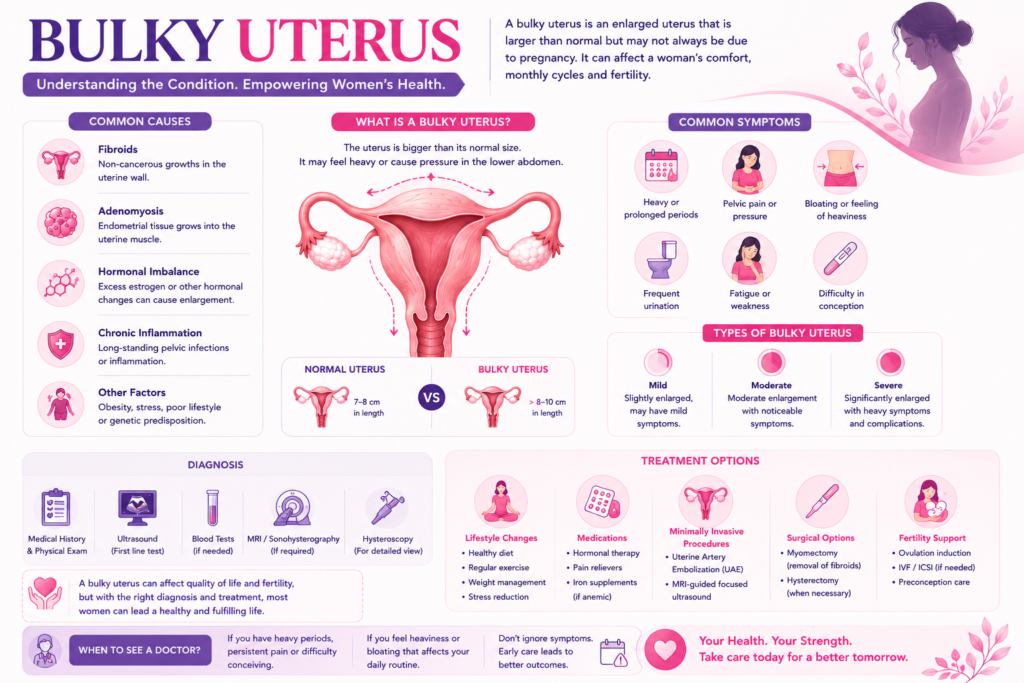
There are several reasons why the uterus may appear bulky on a scan. Some causes are temporary and resolve on their own, while others require medical or surgical treatment. Here are the most common causes:
1. Uterine Fibroids (Leiomyomas)
Fibroids are non-cancerous growths made of muscle and fibrous tissue that develop within or on the uterus wall. They are the single most common cause of a bulky uterus in women of reproductive age. Fibroids can range in size from a few millimetres to the size of a grapefruit, and can occur as a single growth or in clusters.
How fibroids cause a bulky uterus:
- Intramural fibroids (inside the uterine wall) directly increase the overall size of the uterus
- Multiple fibroids together can make the uterus significantly bulky
- Large fibroids can distort the shape and structure of the uterus
Symptoms associated with fibroids: heavy or prolonged periods, pelvic pain or pressure, lower back pain, frequent urination, and in some cases, difficulty conceiving.
What matters clinically is less the total size than the position — a fibroid pressing into the uterine cavity affects fertility very differently from one on the outer surface.
2. Adenomyosis
Adenomyosis is a condition in which the inner lining of the uterus (endometrium) grows into the muscle wall of the uterus (myometrium). This causes the uterine wall to thicken and the uterus to become enlarged and bulky. It is one of the most common causes of a diffusely bulky uterus, meaning the entire uterus appears uniformly enlarged rather than having a specific lump.
Adenomyosis is most commonly seen in women between the ages of 30 and 50, and in women who have previously had uterine surgery or multiple pregnancies. It can significantly affect fertility if left untreated, as it impairs the uterine lining’s ability to support embryo implantation.
Key signs of adenomyosis:
- severe menstrual cramps that worsen over time
- heavy and prolonged periods
- a feeling of uterine tenderness
- pain during intercourse.
3. Hormonal Imbalance
An imbalance in reproductive hormones — particularly excess oestrogen relative to progesterone — can cause the uterine lining and uterine muscle to thicken over time, making the uterus appear bulky.
- Excess estrogen can cause enlargement
- Irregular cycles may be present
- This is commonly seen in women with Polycystic Ovary Syndrome (PCOS), in perimenopausal women, and in women who have been on oestrogen-only hormonal therapy.
4. Endometrial Hyperplasia
Endometrial hyperplasia is a condition where the inner lining of the uterus (endometrium) becomes abnormally thick due to excess oestrogen stimulation without adequate progesterone. This thickened lining can make the uterus appear bulky on an ultrasound. In some cases, endometrial hyperplasia can be a precursor to uterine (endometrial) cancer if left untreated, which is why this condition requires prompt medical attention.
Symptoms include: abnormal uterine bleeding (particularly heavy or irregular periods), bleeding between periods, and post-menopausal bleeding.
5. Endometriosis
Endometriosis occurs when tissue similar to the uterine lining grows outside the uterus — on the ovaries, fallopian tubes, or pelvic lining. While endometriosis can persist even after menopause, it grows outside the uterus, and the chronic inflammation it causes can affect the uterus and contribute to a bulky appearance.
Endometriosis is also strongly linked to fertility problems and is an important condition to rule out when investigating a bulky uterus in women trying to conceive.
Changes in the uterine lining from infection, inflammation, or hormonal fluctuation can all contribute to the same appearance.
6. Pelvic Inflammatory Disease (PID)
Pelvic Inflammatory Disease is a bacterial infection of the female reproductive organs — the uterus, fallopian tubes, and ovaries. Chronic PID can cause ongoing inflammation, scarring, and structural changes in the uterus, leading to a bulky appearance on scan. If left untreated, PID can seriously damage the fallopian tubes and impair fertility, and it is one of the more common causes of blocked fallopian tubes.
In Bihar, this deserves particular attention, because genital tuberculosis — still present in our population — can produce a similar picture, and tuberculosis is a genuine cause of infertility here in a way it is not in most literature written abroad.
7. Post-Pregnancy Changes
After childbirth, the uterus normally contracts and returns to its pre-pregnancy size within 6–8 weeks — a process called uterine involution. In some women, especially those who have had multiple pregnancies or a complicated delivery, the uterus may take longer to return to its normal size or may remain slightly enlarged. This is usually temporary and not a cause for significant concern.
The uterus also enlarges from the moment of conception, so a bulky uterus in early pregnancy is simply the uterus doing its job.
8. Uterine Polyps
Uterine polyps are small, soft growths attached to the inner wall of the uterus. They develop from overgrowth of the endometrial lining and, when multiple or large, can contribute to a bulky uterine appearance. Polyps are associated with irregular bleeding and may affect embryo implantation during fertility treatment. Removal is usually a day-care hysteroscopy.
9. Uterine Cancer (Rare)
In rare cases, a bulky uterus may be caused by uterine or endometrial cancer. This is more common in post-menopausal women and is typically accompanied by post-menopausal bleeding, unusual vaginal discharge, or unexplained pelvic pain. If cancer is suspected, your doctor will recommend an endometrial biopsy immediately. It is important to note that benign (non-cancerous) conditions cause the vast majority of bulky uterus cases.
What are the Symptoms of a Bulky Uterus?
Symptoms of a bulky uterus vary widely depending on the underlying cause and the degree of uterine enlargement. Some women have no symptoms at all and discover the condition only during a routine gynaecological examination or ultrasound scan done for another reason.
Common symptoms include:
- Heavy or prolonged menstrual bleeding (lasting more than 7 days or soaking through pads/tampons unusually quickly)
- Severe or worsening menstrual cramps (dysmenorrhoea)
- Irregular menstrual cycles
- A feeling of heaviness, pressure, or bloating in the lower abdomen
- Lower back pain or pelvic pain that may be persistent or cyclical
- Pain during sexual intercourse (dyspareunia)
- Frequent urination or difficulty emptying the bladder, caused by the enlarged uterus pressing on the bladder
- Constipation or a feeling of pressure in the bowels
- Anaemia and fatigue caused by excessive menstrual blood loss
- Difficulty getting pregnant (infertility) or recurrent pregnancy loss
It is important to remember that symptoms alone cannot confirm the cause of a bulky uterus. A proper ultrasound and clinical examination by a gynaecologist are always needed to determine the exact underlying reason.
What Happens If the Uterus Is Bulky?
In practical terms, three things. First, your gynaecologist works out the cause — usually with a scan and an examination, sometimes with an MRI or a biopsy. Second, you are treated for the cause if it is causing symptoms or affecting your fertility, and monitored if it is not. Third, if you are trying to conceive, the uterine cavity is assessed before any fertility treatment, because a distorted cavity affects implantation regardless of everything else.
What does not happen is treatment aimed at the measurement itself. There is no medication that shrinks a uterus in the abstract. Hormonal treatment can reduce a uterus enlarged by adenomyosis or oestrogen excess; surgery can remove fibroids or polyps; a post-delivery uterus settles by itself. Each of those treats a cause. This is why “how to cure a bulky uterus” has no single answer — and why identifying the cause is not a delay before treatment but the whole of it.
Why the Cause Matters More Than the Size When You Read Your Uterus is “Bulky”?
This is one of the most common questions women ask after receiving this diagnosis — and the honest answer is: not always, but it should not be ignored.
A bulky uterus can be:
- Completely benign and temporary — for example, post-delivery enlargement that resolves on its own
- Manageable with medication — such as hormonal therapy for adenomyosis or fibroids
- Significant and requiring treatment — when linked to conditions like large fibroids, adenomyosis, or endometrial hyperplasia that affect quality of life or fertility
- Rare but serious — when caused by uterine cancer, which requires urgent intervention
What matters most is not just the size of the uterus, but the underlying cause. This is why a proper evaluation by an experienced gynaecologist is essential — so you receive the right diagnosis, the right reassurance, and the right treatment plan for your specific situation.
Key Insight: Many women with a bulky uterus go on to live perfectly normal lives and achieve healthy pregnancies. The key is timely diagnosis and appropriate management.
Can I Get Pregnant with a bulky uterus?
Yes — in some cases, a bulky uterus can impact a woman’s ability to conceive or maintain a healthy pregnancy. However, this is not always the case, and the impact depends entirely on the underlying cause and the severity of the condition.
When a Bulky Uterus May NOT Affect Fertility:
- Mild uterine enlargement with no structural distortion of the uterine cavity
- Small fibroids that do not project into the uterine cavity
- Temporary post-delivery enlargement
- Hormonal causes that are managed effectively with medication
When a Bulky Uterus CAN Affect Fertility:
- Large or multiple fibroids (especially submucosal fibroids that protrude into the uterine cavity) can block the fallopian tubes or prevent embryo implantation
- Adenomyosis significantly reduces the receptivity of the uterine lining, making it harder for an embryo to implant — this is a recognised cause of implantation failure in IVF
- Endometrial hyperplasia creates an abnormal uterine environment that is not conducive to pregnancy
- Chronic inflammation from PID or endometriosis can damage the uterine architecture and fallopian tubes
- A distorted uterine cavity increases the risk of recurrent miscarriage
The good news is that many of these causes are treatable. With the right intervention — whether medical, surgical, or through assisted reproduction — many women with a bulky uterus go on to conceive successfully. If you have been trying without success, our guide on when to see a fertility specialist sets out the reasonable timelines.
Is a Bulky Cervix Dangerous?
A bulky cervix is not always a sign of a serious medical condition. In many cases, it may result from temporary inflammation, hormonal changes, pregnancy, or benign growths such as cervical polyps.
A report describing the cervix as bulky is saying something different from one describing the body of the uterus. The cervix is the lower, narrow portion of the uterus opening into the vagina, and it enlarges for its own reasons.
The common causes are:
- Cervicitis — inflammation, usually from infection. The most frequent cause, and treatable.
- Cervical polyps — benign growths from the cervical canal, often causing spotting between periods or after intercourse.
- Nabothian cysts — small fluid-filled cysts, extremely common, entirely harmless, and a frequent reason for a cervix being described as bulky on a scan.
- Hormonal change and pregnancy — the cervix becomes softer and fuller in pregnancy, which is normal.
- Cervical fibroids — less common than uterine fibroids, but they occur.
A bulky cervix on its own, with no symptoms, is usually not a significant finding, and Nabothian cysts in particular need nothing done. However, if a bulky cervix is accompanied by symptoms like persistent pelvic pain, abnormal vaginal bleeding, unusual discharge, or pain during intercourse, it should be evaluated by a gynaecologist.
A pelvic examination, Pap smear, HPV test, or ultrasound may be recommended to identify the underlying cause. Early diagnosis helps ensure appropriate treatment and protects your overall reproductive health.
Bulky Uterus and Weight Gain — Is There a Connection?
Many women ask whether a bulky uterus itself can cause weight gain. The direct answer is that uterine enlargement alone does not cause generalised weight gain. However, the underlying conditions that cause a bulky uterus can create symptoms that feel like weight gain:
- Large fibroids can cause significant abdominal bloating and a visibly enlarged lower abdomen, which may resemble weight gain but is due to the fibroid mass itself
- Adenomyosis causes bloating and pelvic swelling, particularly before and during periods
- Hormonal imbalances linked to PCOS — which can also cause a bulky uterus — are associated with genuine weight gain, particularly around the abdomen
- Fluid retention due to hormonal fluctuations can make women feel heavier
If you have noticed changes in your abdominal size or weight alongside other symptoms of a bulky uterus, it is worth discussing this with your gynaecologist, as it may indicate a significant fibroid or adenomyosis that requires treatment. It is also worth knowing that the relationship runs both ways, since body weight influences hormone balance and fertility in its own right.
Bulky Uterus After Menopause — What Does It Mean?
After menopause, the uterus normally shrinks in size as oestrogen levels decline. If a post-menopausal woman is found to have a bulky uterus, this requires more urgent investigation than in younger women, because the usual benign hormonal causes are less likely.
Possible causes of a bulky uterus after menopause include:
- Uterine fibroids that developed before menopause and have not fully regressed (though fibroids typically shrink after menopause)
- Endometrial hyperplasia — thickening of the uterine lining due to oestrogen-only hormone replacement therapy or other hormonal factors
- Uterine polyps
- Uterine cancer — this is the most important cause to rule out in post-menopausal women, and any post-menopausal bleeding alongside a bulky uterus must be evaluated immediately
If you are post-menopausal and have been told your uterus appears bulky, please consult a gynaecologist promptly — particularly if you have any unusual vaginal bleeding or discharge.
Bulky Uterus With Thickened Endometrium — What Does It Mean?
An ultrasound report that mentions both a bulky uterus and a thickened endometrium tells you two things simultaneously: the uterus is enlarged overall, and the inner lining of the uterus (endometrium) is thicker than normal.
The normal endometrial thickness varies throughout the menstrual cycle — it is thinnest just after a period and thickest just before. A thickness of more than 12–14 mm in a woman of reproductive age (outside of the late secretory phase) or more than 4–5 mm in a post-menopausal woman is generally considered thickened.
Common causes of this combination finding
- Endometrial hyperplasia — excess oestrogen causing abnormal lining thickening
- Adenomyosis — which causes both the uterine muscle and lining to appear thickened
- Uterine polyps
- Oestrogen-dominant hormonal state (e.g., PCOS, perimenopause)
- In post-menopausal women, endometrial cancer must be ruled out
Treatment depends on the underlying cause. An endometrial biopsy is often recommended to analyse the lining cells and rule out pre-cancerous or cancerous changes.
If you are in fertility treatment, lining thickness is assessed for a different reason — a lining that is too thin is as much of a problem as one that is too thick. We cover that in the role of the uterine lining in pregnancy and IVF.
Bulky Uterus and IVF: What We Assess Before Embryo Transfer
At Shradha IVF, a “bulky uterus” report is never treated as a single answer — before any embryo transfer, we identify the cause and prepare the uterus:
- Transvaginal ultrasound and, where needed, 3D ultrasound or MRI to distinguish fibroids from adenomyosis and map the exact location relative to the uterine cavity.
- Hysteroscopy, if polyps, submucosal fibroids, or cavity distortion are suspected — these are corrected before transfer, because an embryo cannot implant well in a distorted cavity.
- Adenomyosis protocols — for confirmed adenomyosis, hormonal down-regulation before frozen embryo transfer can meaningfully improve implantation rates.
- Endometrial/uterine lining assessment — thickness and pattern are checked at transfer, since the lining (“the soil”) matters as much as embryo quality (“the seed”). It is also why a perfect-looking embryo can still fail.
This is why two women with the same “bulky uterus” report can need entirely different plans — one needs no treatment at all, the other needs a hysteroscopy before her cycle. At Shradha IVF & Maternity, Patna, we have extensive experience in managing women with a bulky uterus through IVF treatment. Our approach is always personalised — we assess each case individually and design the safest, most effective IVF protocol for your specific condition.
How Is a Bulky Uterus Diagnosed?
Diagnosing a bulky uterus begins with a combination of clinical assessment and imaging. The goal is not just to confirm that the uterus is enlarged, but to understand why — so that the right treatment plan can be made.
- Pelvic Ultrasound (First-Line Test): A pelvic or transvaginal ultrasound is the most commonly used and accessible test for detecting a bulky uterus. It allows the doctor to assess the size, shape, and internal structure of the uterus, and to identify common causes such as fibroids, adenomyosis, or endometrial thickening. The transvaginal route (probe inserted vaginally) gives a more detailed image of the uterus than an abdominal scan.
- Clinical / Pelvic Examination: Your gynaecologist will perform a manual examination of the uterus to assess its size, shape, position, and any tenderness. While this cannot provide a definitive diagnosis, it gives important initial information and helps decide which further tests are needed.
- MRI Scan (Advanced Imaging): An MRI is used when the ultrasound findings are unclear, when adenomyosis is suspected (as MRI is the most accurate imaging test for this condition), or when detailed mapping of fibroids is needed before surgery. MRI provides high-resolution images of the uterine tissue and is particularly useful for planning surgical treatment.
- Blood Tests: Hormone panel: to assess levels of oestrogen, progesterone, FSH, LH, and AMH (which indicates ovarian reserve and can be affected by conditions causing a bulky uterus). Full blood count: to check for anaemia from excessive menstrual bleeding. CA-125 marker: may be checked if endometriosis or ovarian involvement is suspected.
- Endometrial Biopsy: If there is concern about the uterine lining — particularly in post-menopausal women or those with abnormal bleeding — a small sample of the endometrial tissue may be taken for laboratory analysis. This rules out endometrial hyperplasia, pre-cancerous changes, or endometrial cancer.
- Hysteroscopy: A hysteroscopy involves passing a thin camera (hysteroscope) through the cervix into the uterine cavity to directly visualise the interior of the uterus. This is particularly useful for detecting uterine polyps, submucosal fibroids, or endometrial abnormalities that may not be clearly visible on ultrasound
What Are the Treatment Options for a Bulky Uterus?
The treatment of a bulky uterus depends entirely on the underlying cause, the severity of symptoms, and whether you are planning a pregnancy. Not every case requires active treatment — in many situations, observation and regular monitoring are sufficient.
1. Observation and Monitoring (No Treatment Needed)
If the uterus is only mildly enlarged, causing no significant symptoms, and the finding is discovered incidentally during a routine scan, your gynaecologist may recommend a “wait and watch” approach with regular follow-up ultrasounds every 6 months. This is particularly common for small, asymptomatic fibroids in women who are not planning pregnancy.
2. Medical Management (Medications)
Medications are often the first line of treatment when symptoms are present. Depending on the cause, your doctor may prescribe:
- Hormonal therapy: combined oral contraceptive pills or progesterone-only therapy to regulate periods, reduce heavy bleeding, and sometimes shrink the uterus size
GnRH analogues (Gonadotropin-Releasing Hormone agonists): used to temporarily suppress oestrogen production, which can shrink fibroids and reduce adenomyosis symptoms — commonly used to prepare women for surgery or IVF
Tranexamic acid: to reduce heavy menstrual bleeding
Non-steroidal anti-inflammatory drugs (NSAIDs): for pain relief during periods
Iron supplements: to treat anaemia caused by heavy bleeding
3. Hormonal Intrauterine Device (Mirena IUD)
A levonorgestrel-releasing IUD (Mirena) can significantly reduce heavy menstrual bleeding and pain associated with adenomyosis and fibroids. It works locally within the uterus and is a good non-surgical option for women who do not wish to conceive in the near future.
4. Surgical Treatment Options
Surgery is considered when symptoms are severe, fertility is being affected, or conservative treatment has not worked. Fertility-preserving surgical options include:
Myomectomy: surgical removal of fibroids while preserving the uterus. This can be performed laparoscopically (keyhole surgery), hysteroscopically (through the vagina), or through open surgery, depending on the size and location of fibroids. This is the preferred option for women who wish to preserve fertility.
Uterine Artery Embolisation (UAE): a minimally invasive procedure where tiny particles are injected into the arteries supplying the uterus, cutting off blood supply to fibroids and causing them to shrink. This is not recommended for women who wish to conceive.
MRI-guided Focused Ultrasound Surgery (MRgFUS): a non-invasive procedure using focused ultrasound waves (guided by MRI) to destroy fibroid tissue. Suitable for select cases.
Endometrial Ablation: the uterine lining is destroyed using heat, cold, or radio waves to reduce heavy bleeding permanently. This is not suitable for women planning a future pregnancy.
Hysterectomy: complete surgical removal of the uterus. This is a definitive cure for a bulky uterus caused by fibroids or adenomyosis, but is only considered for women who have completed their family, or in severe cases where all other options have failed.
5. IVF and Assisted Reproduction
For women with a bulky uterus who are struggling to conceive — particularly those with adenomyosis, fibroids affecting the uterine cavity, or unexplained infertility — IVF treatment can offer a successful path to parenthood. At Shradha IVF & Maternity, Patna, we design personalised IVF protocols that account for your specific uterine condition to maximise your chances of a successful pregnancy.
Bulky Uterus Treatment Options — by Cause
| Cause | First-line treatment | If severe / fertility-focused |
|---|---|---|
| Fibroids | NSAIDs for pain, hormonal therapy to shrink/control bleeding | Myomectomy (fibroid removal, preserves uterus); hysterectomy only when family is complete |
| Adenomyosis | Progesterone tablets/injections, hormonal IUD, GnRH analogues | Down-regulation before IVF transfer; hysterectomy only for intractable symptoms after childbearing |
| Polyps | Hysteroscopic polypectomy (day-care procedure) | Removal before any fertility treatment |
| Hormonal imbalance | Medication to restore oestrogen–progesterone balance | Address the underlying driver, e.g. PCOS |
| Post-delivery enlargement | Usually none — resolves on its own | — |
| Infection (pyometra / PID) | Antibiotics, drainage if needed | Tubal assessment, as tubal damage is the real risk |
Key point: a mildly bulky uterus with no symptoms and no cavity distortion often needs no treatment at all — only monitoring. Treatment is for the cause and the symptoms, not the measurement.
Lifestyle Changes That Can Help Manage a Bulky Uterus
While lifestyle changes cannot cure the underlying causes of a bulky uterus, they can help manage symptoms, support hormonal balance, and improve overall reproductive health:
Maintain a healthy weight: excess body fat increases oestrogen production, which can worsen conditions like fibroids and adenomyosis. Even a modest weight reduction can improve hormone balance.
Eat an iron-rich diet: if you have heavy periods, include iron-rich foods (leafy greens, lentils, beans, pomegranate, fortified cereals) to prevent anaemia.
Reduce processed foods and refined sugars: these can worsen hormonal imbalances and inflammatory conditions.
Limit caffeine and alcohol: both can worsen hormonal imbalance and menstrual symptoms.
Exercise regularly: moderate regular exercise — especially yoga — can reduce pelvic congestion and help regulate hormones.
Manage stress: chronic stress raises cortisol levels, which can disrupt oestrogen-progesterone balance. Yoga, meditation, and pranayama are particularly beneficial.
Stay well hydrated: adequate water intake supports healthy circulation and reduces bloating.
These changes are supportive measures and should be used alongside — not instead of — medical treatment.
When Should You See a Fertility Specialist in Patna?
You should consult a gynaecologist or fertility specialist promptly if you experience any of the following:
- Heavy or irregular periods that are interfering with your daily life
- Severe menstrual cramps that are worsening over time
- Pelvic pain, pressure, or a feeling of heaviness that is persistent
- Difficulty conceiving after 12 months of trying (or 6 months if you are over 35)
- Recurrent miscarriages (two or more)
- Post-menopausal bleeding — any bleeding after menopause requires urgent evaluation
- Your ultrasound report says your uterus is bulky, and you are unsure what to do next
Early intervention prevents complications and keeps your options — including fertility treatment — open. Do not wait and see if symptoms worsen on their own.
Fibroids and a Bulky Uterus — Where to Read More
Fibroids are the leading cause of a bulky uterus in women of reproductive age, and their impact depends on size, number, and above all position within the uterus — as covered in the causes section above.
Because fibroid-related enlargement raises its own specific questions about treatment choice, pregnancy, and myomectomy, we cover it separately in our detailed guide to bulky uterus with fibroids, and for women trying to conceive with fibroids and infertility.
Can a Bulky Uterus Become Normal Again?
In many cases, yes — a bulky uterus can return to its normal size, but this largely depends on the underlying cause and how early it is identified.
When the uterus enlargement is linked to hormonal imbalance, especially excess oestrogen, the uterus may reduce in size with proper medical management. Hormonal treatments or medications prescribed by your doctor can help regulate these imbalances, gradually bringing the uterus closer to its normal state.
In situations where the bulky appearance is temporary — such as after pregnancy or due to short-term hormonal changes — the uterus often returns to its original size naturally over time, without requiring any active treatment.
However, when the cause is structural, such as fibroids or adenomyosis, the approach may be different. These conditions do not always reverse on their own and may require targeted treatment, including medication, hormonal therapy, or, in some cases, surgical intervention. The goal in such cases is not just to reduce the size but also to relieve symptoms and protect fertility.
It is important to remember that a bulky uterus is not always a permanent condition. With the right diagnosis and timely care, many women can manage it effectively and maintain normal reproductive health.
“A bulky uterus is not something to panic about, but it should never be ignored. Every woman’s body tells a story, and our role as doctors is to listen carefully. With the right diagnosis, most women can manage this condition successfully and still achieve their dream of motherhood.”
— Dr. Shradha Chakhaiyar, MBBS, DGO, MRCOG (London)
Chief Consultant & IVF Specialist, Shradha IVF & Maternity, Patna`
How Shradha IVF Can Help You Manage a Bulky Uterus
Being told you have a bulky uterus — especially due to fibroids — can raise many questions. Do you need treatment? Will it affect your chances of pregnancy? What should be your next step? This is where the right guidance makes all the difference.
At Shradha IVF & Maternity, the focus is not just on identifying the condition, but on understanding how it affects you personally. Every case of bulky uterus is different, and so is the treatment approach.
You receive:
- A detailed evaluation to identify the exact cause
- Fertility-focused assessment, if you are trying to conceive
- Personalised treatment planning based on your symptoms and goals
“Many women get worried when they hear terms like bulky uterus or fibroids. But the truth is, not every case needs aggressive treatment. What matters is understanding the size, location, and impact on fertility. With the right approach, most women can manage this condition and even conceive naturally or with support when needed.”
— Dr. Shradha Chakhaiyar
In our OPD in Patna I regularly see women who have been told for years that heavy, painful periods are simply their normal — and on imaging, there is clear adenomyosis that nobody looked for. Whether it is monitoring, medical management, or planning the right fertility treatment, the goal is always to provide clarity, comfort, and confidence at every step.
FAQs related to Bulky Uterus
1. Can a bulky uterus cause infertility?
It can, though many women with one conceive without difficulty. What matters is whether the uterine cavity is distorted. Submucosal fibroids pressing into the cavity and adenomyosis both interfere with implantation. Fibroids within the wall or on the outer surface often have no effect at all.
2. Can a bulky uterus be cured without surgery?
Often yes. Hormonal causes respond to medication, adenomyosis symptoms are managed with progesterone therapy or a hormonal IUD, and small symptom-free fibroids may need only monitoring. Surgery is reserved for large fibroids, cavity-distorting growths, or severe symptoms.
3. Is pregnancy possible with a bulky uterus?
Yes, many women conceive successfully with a bulky uterus, especially when the cause is identified and treated early. What matters is whether the uterine cavity is affected, which is why the cavity is assessed before any fertility treatment.
4. Does a bulky uterus always mean fibroids?
No. Fibroids are the most common cause but far from the only one. Adenomyosis produces a uniformly enlarged, heterogeneous uterus and is frequently missed. Recent pregnancy, hormonal imbalance, polyps, and chronic infection all enlarge the uterus without any fibroid being present.
5. When should I consult a doctor for a bulky uterus?
If you have heavy or irregular periods interfering with daily life, worsening period pain, persistent pelvic pressure, difficulty conceiving after 12 months of trying or 6 months if you are over 35, two or more miscarriages, or any bleeding after menopause. Post-menopausal bleeding needs urgent evaluation.
6. Does a bulky uterus mean I need IVF?
No. A bulky uterus alone is not an indication for IVF. IVF becomes relevant when the underlying cause, or another fertility factor, prevents natural conception, and even then the cause is usually treated first to maximise success.
7. Can a bulky uterus cause miscarriage?
It can, depending on the cause. Untreated adenomyosis and cavity-distorting fibroids are associated with higher miscarriage risk. With diagnosis and treatment before conception, most women go on to healthy pregnancies.
8. Will a bulky uterus go back to normal size?
If the cause is temporary, such as recent childbirth or a correctable hormonal imbalance, yes. Structural causes like fibroids do not shrink on their own, except often after menopause, but treatment controls both size and symptoms.
9. What size uterus is considered bulky?
Anything meaningfully above the normal range of about 7.5 cm length, 5 cm width, and 2.5 cm thickness, or a volume above roughly 200 mL. Because childbirth permanently increases uterine size, the same measurement can be normal in one woman and enlarged in another. Reports sometimes express it in “weeks size”, comparing it to pregnancy dimensions.
10. What size in mm is a bulky uterus?
Reports usually give millimetres. Above about 90 mm in length with no previous births, or above about 100 mm after childbirth, is generally reported as bulky. A reading of 94 mm simply means 9.4 cm.
11. What does “bulky heterogeneous uterus” mean?
The uterus is enlarged, and its muscle texture appears uneven rather than uniform. This pattern suggests adenomyosis rather than discrete fibroids. MRI is the most reliable way to confirm it, and confirmation matters because adenomyosis affects implantation and is often overlooked.
12. Why does the uterus become bulky?
Most often fibroids, adenomyosis, recent childbirth, or a hormonal imbalance with excess oestrogen. Less commonly, endometrial hyperplasia, polyps, chronic pelvic infection, or endometriosis. Rarely, and mainly after menopause, uterine cancer. The uterus does not enlarge without a reason, so the cause is always worth identifying.