

Yes, IVF does raise the chance of twins compared with getting pregnant naturally. But there is no magic in the lab behind it. In most cases it comes down to one simple thing: how many embryos are placed in the womb.
Many couples in our clinic in Patna ask us, half hoping, “Doctor, will we get twins?” It is an understandable wish. After years of waiting, two babies from one treatment sounds like a bonus. This article explains, in plain words, why twins happen more often after IVF, what the real numbers are, why doctors across the world now try to avoid twins, and what that means for you.
The short answer
- Without treatment, roughly 1 in every 100 births in India is a twin birth (Smits and Monden, PLOS One).
- The biggest reason IVF raises this number is transferring more than one embryo. In the UK in the 1990s, when two or three embryos were routinely transferred, about 28 in every 100 IVF births were twins or more. As clinics moved to one embryo at a time, this fell to about 5 in 100 by 2021 (HFEA).
- Even when only one embryo is transferred, about 1 to 2 in 100 pregnancies become identical twins, because that single embryo splits into two.
- A twin pregnancy carries more risk for the mother and the babies. That is why the safest plan in most cases is one healthy embryo at a time.
First, How Do Twins Happen?
There are two kinds of twins, and IVF affects each kind differently. Knowing the difference makes the rest of this article easy to follow.
| Non-identical (fraternal) twins | Identical twins | |
|---|---|---|
| How they form | Two separate eggs, each fertilised by a different sperm | One fertilised egg (one embryo) splits into two |
| Look alike? | Like any brother and sister; can be a boy and a girl | Almost always the same sex and look very alike |
| Placenta | Always their own placenta each | Often share one placenta |
| In natural pregnancy | Varies by country, age and family history | About 4 in every 1,000 births, fairly steady worldwide |
| How IVF raises the chance | When two embryos are transferred and both implant | When a single transferred embryo splits in two |
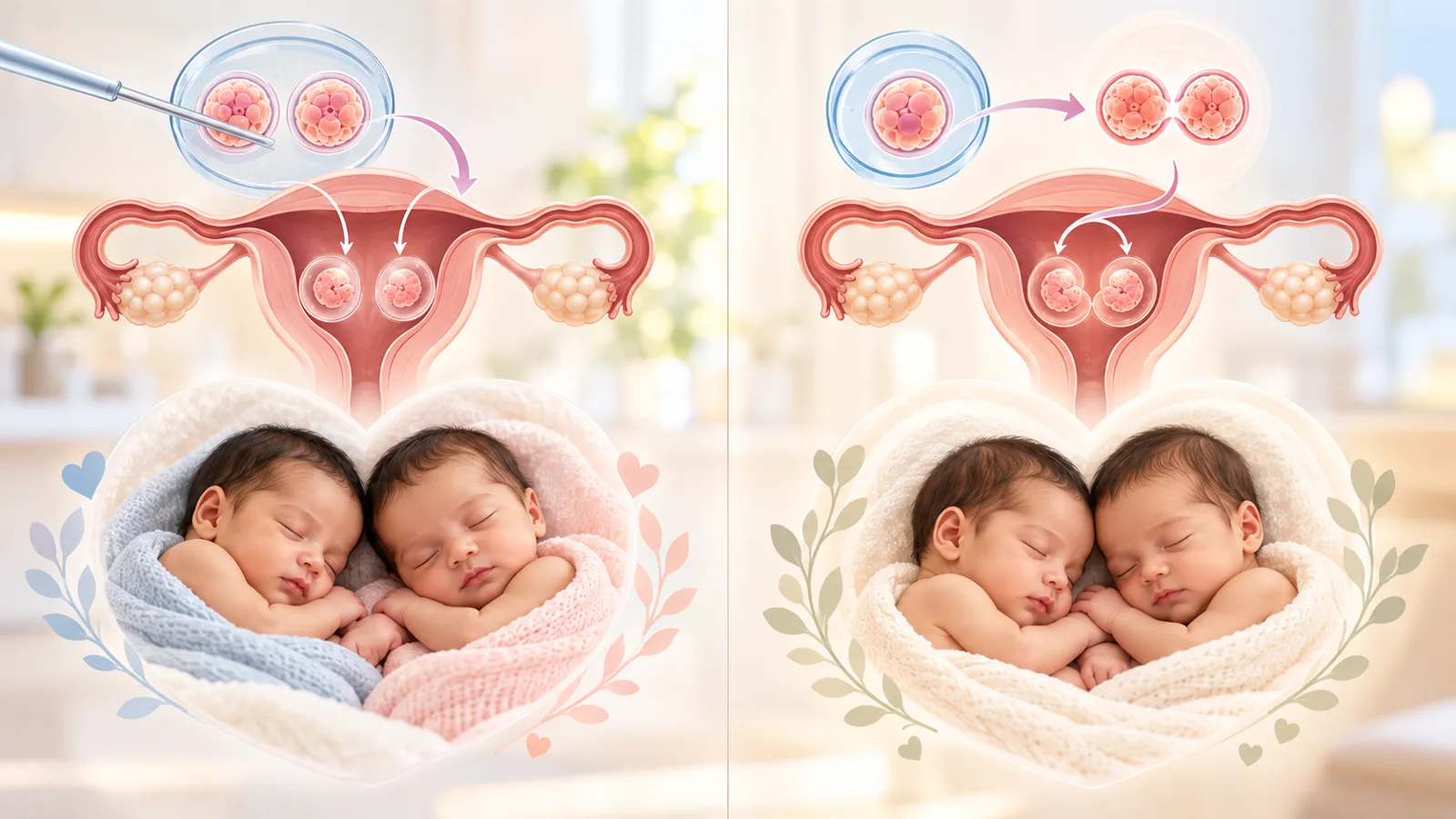
In nature, non-identical twins happen when the ovaries release two eggs in the same month. This is more common as a woman gets older and in some families. Identical twins are more of a chance event, and the rate is similar across the world (Smits and Monden, PLOS One).
The placenta matters. Twins who share one placenta also share its blood vessels. This can cause problems such as one baby getting more blood than the other, a condition called twin-to-twin transfusion syndrome (Human Reproduction, 2025).
Why Does IVF Raise the Chance of Twins? Three Reasons
The science points to three reasons. The first one explains most IVF twins.
1. More than one embryo is placed in the womb
In IVF, eggs are fertilised in the lab and the embryos grow for 3 to 5 days. The doctor then places one or more embryos in the womb. This step is called embryo transfer.
If two embryos are transferred and both attach to the womb lining, you get non-identical twins. It is that simple. UK registry data shows the effect clearly. Women under 35 who had two embryos transferred had a multiple birth rate above 30%. When only one embryo was transferred, multiple births stayed at around 1 to 3% at every age (HFEA, Multiple births in fertility treatment 2019).
Notice who carries the highest twin risk: younger women with good-quality embryos. Their embryos are more likely to implant, so two embryos often means two babies.
2. A single embryo can split into identical twins
This surprises many couples. Even with one embryo transferred, identical twins can happen. Studies report identical twinning after assisted reproduction at roughly 1 to 2.4 in 100 pregnancies, compared with about 0.4 in 100 in natural conception (Human Reproduction, 2025).
The largest study so far looked at 154,671 births from single embryo transfer in Australia and New Zealand. It found identical twins in 1.5% of births. Embryos transferred at the blastocyst stage (day 5 or 6) had about double the odds of splitting compared with day 2 or 3 embryos. Fresh transfers carried a higher risk, while embryos frozen by vitrification did not show a raised risk (Human Reproduction, 2025).
Why does this happen? Honestly, science does not have a full answer yet. Researchers suspect that the longer time embryos spend in the lab, and changes to the embryo’s outer shell, may make splitting a little more likely. Some studies link very good-quality blastocysts with a higher chance of splitting (Fertility and Sterility, 2024). Results on other lab steps, such as ICSI or assisted hatching, are mixed.
The important point: identical twins after one embryo are rare, and no doctor can plan them or fully prevent them.
3. Fertility medicines outside IVF
Many couples mix up IVF with simpler treatments such as ovulation tablets or injections, with or without IUI. These medicines can make the ovaries release two or more eggs at once. Once released, nobody controls how many are fertilised.
A large US trial compared three medicines used before IUI. Among pregnancies, twins or more occurred in 32% with injections (gonadotropins), 13% with letrozole and 9% with clomiphene. Only the injection group had triplets (AMIGOS trial, NEJM 2015; Medscape summary).
This is why careful scan monitoring matters in every stimulated cycle. It also shows something many people do not expect: IVF with a single embryo gives the doctor more control over twins than stimulated IUI does.
How Big Is the Chance? The Numbers in One Place
The chance of twins depends mostly on how many embryos are transferred. These figures come from national registries and published studies, not from any single clinic.
| Situation | Chance of twins (or more) | Source |
|---|---|---|
| Natural pregnancy in India | About 1 in 100 births (9 to 16 per 1,000) | PLOS One |
| IVF, two embryos, woman under 35 | Above 30% of births | HFEA |
| IVF, one embryo, any age | About 1 to 3% of births | HFEA |
| Identical twins after one embryo | About 1.5% of births | Human Reproduction, 2025 |
| Randomised trial: two embryos vs one | 33.1% vs 0.8% of births | NEJM, 2004 |
| All UK IVF births, 1990s vs 2021 | 28% fell to 5% | HFEA |
| IVF twin pregnancies in Europe, 2010 vs 2018 | 25.7% fell to 12.4% | ESHRE guideline |
The drop in the UK and Europe did not come from any new medicine. It came from clinics choosing to transfer fewer embryos. In the UK, one embryo was transferred in 75% of IVF cycles by 2019, compared with just 13% in 1991 (HFEA, 2019).
If Twins Sound Lovely, Why Do Doctors Try to Avoid Them?
Because a twin pregnancy is a high-risk pregnancy, for the mother and for both babies. The UK fertility regulator calls multiple births the biggest single health risk of IVF (HFEA). Here is what the evidence shows.

Risks for the babies
- Early birth. Preterm birth is the most common problem. More than half of all twins are born before 37 weeks (ACOG). On average, twins arrive at about 36 weeks, compared with 39 weeks for a single baby (European Journal of Obstetrics, 2025).
- Problems linked to early birth. Babies born early can struggle with breathing, feeding and keeping warm. Some face learning or behaviour problems later, and preterm twins have a higher risk of cerebral palsy (ACOG).
- Low birth weight and NICU stays. Two babies share the space and nutrition meant for one, so twins are often smaller at birth.
- Shared-placenta problems. Identical twins who share one placenta can develop twin-to-twin transfusion syndrome and unequal growth (Human Reproduction, 2025).
Risks for the mother
- High blood pressure and preeclampsia. Preeclampsia affects around 1 in 10 twin pregnancies, about two to three times the rate in a single pregnancy. It also tends to come earlier and be more severe (BMC Pregnancy and Childbirth).
- Pregnancy diabetes. Gestational diabetes is more common with twins (ACOG Practice Bulletin 231).
- Blood clots, heavy bleeding after delivery and caesarean birth are all more likely (StatPearls). Read more in our guide to caesarean births in IVF pregnancies.
For a couple who has waited years, these risks are real and worth taking seriously. The goal of IVF is not just a positive pregnancy test. It is a healthy mother holding a healthy baby at the end of a full-term pregnancy.
One Embryo at a Time: Does It Lower My Chance of a Baby?
In a single attempt, transferring one embryo gives a slightly lower chance than transferring two. Over the full treatment, the difference largely disappears. This is the most important fact in this article.
The Cochrane review, which pools the best trials, found this. With one fresh transfer of two embryos, a woman with a 46% chance of a live birth would have about a 27 to 35% chance with one embryo. But when one embryo was transferred, followed by a second frozen embryo if needed, the overall chance of a baby was not clearly different from one transfer of two embryos. Twin pregnancies were far fewer (Cochrane).
This works because good freezing (vitrification) now lets us keep the spare embryos safely for a later transfer. You are not throwing away a chance. You are taking it one step at a time.
The world’s leading fertility societies agree:
- Europe (ESHRE, 2024): no clinical or embryo factor, on its own, justifies transferring two embryos instead of one (ESHRE guideline).
- USA (ASRM, 2021): a genetically tested normal embryo should be transferred alone, whatever the woman’s age (ASRM).
You can read how the procedure works in our guide to single embryo transfer.
What Indian law says
India has clear rules on this. Under the Assisted Reproductive Technology (Regulation) Act, 2021, no clinic may place more than three eggs or embryos in a woman’s womb in one treatment cycle (ART Act, Section 24).
The ART Regulations, 2023 go further. Doctors should normally transfer one or two embryos. Three are allowed only in special situations: an older mother, repeated miscarriages, or repeated failure of embryos to implant (SCC Online summary of the ART Regulations, 2023).
The Act also bans splitting embryos to create twins in the lab (ART Act, Section 24). So if a clinic ever promises twins, that is a warning sign, not a service.
“Can We Ask for Twins?” An Honest Answer
You can always ask, and we will always discuss it openly. But no honest doctor can promise twins, and asking for two embryos is a medical decision, not a wish list.
Many couples ask for twins for practical reasons: the cost of another cycle, age, or the hope of completing the family in one go. These feelings are real. Our job is to weigh them against your safety and your baby’s safety.
When we plan an embryo transfer at Shradha IVF, Dr. Shradha Chakhaiyar looks at:
- Your age at the time the eggs were collected.
- The quality and stage of your embryos, and how many are frozen for later.
- Your past treatment: earlier pregnancies, miscarriages, or transfers that did not work.
- Your health: blood pressure, sugar levels, body weight, the shape of the womb, and any previous caesarean.
- What you want, once you understand the risks on both sides.
In most cases, a single good-quality embryo gives the best balance of safety and success. Where there is a good medical reason to consider two, we explain the added twin risk clearly and record your consent in writing, as the law expects.
IVF is science, not magic. It works best when decisions are made carefully, one step at a time. If you are planning IVF in Patna or anywhere in Bihar and want to talk this through, you can book a consultation with our team.
Frequently Asked Questions
Does IVF always give twins?
No. Most IVF pregnancies today are single babies, especially when one embryo is transferred. With a single embryo, the chance of twins is about 1 to 3 in 100.
Can one embryo become twins?
Yes, but rarely. A single embryo can split into identical twins in about 1 to 2 of every 100 pregnancies after single embryo transfer. Nobody can plan or fully prevent this.
Does a frozen embryo transfer increase the chance of twins?
Not by itself. The number of embryos transferred matters most. A large 2025 study found that single embryos frozen by vitrification did not show the raised splitting risk seen with fresh day-5 transfers.
Does ICSI cause twins?
ICSI is a way of fertilising the egg in the lab. It does not add embryos, so it does not add twins in the way a second embryo does. Studies on whether it slightly changes the splitting risk give mixed results.
Can IUI or fertility tablets cause twins?
Yes. Medicines that make the ovaries release more than one egg can lead to twins, and injections can occasionally lead to triplets. This is why every stimulated cycle needs scan monitoring.
How many embryos can be transferred in India?
By law, no more than three in one cycle. The ART Regulations, 2023 say doctors should normally transfer one or two, and three only in special cases such as older age, repeated miscarriage or repeated implantation failure.
When will we know if it is twins?
An early ultrasound, usually a few weeks after a positive pregnancy test, shows how many pregnancy sacs and heartbeats there are. A first-trimester scan also shows whether twins share a placenta, which changes how the pregnancy is monitored.
Is a twin IVF pregnancy looked after differently?
Yes. It needs more frequent scans, closer checks of blood pressure and sugar, and planning for an earlier delivery, ideally in a hospital with newborn intensive care.
References
- HFEA. Multiple births in fertility treatment 2019.
- HFEA. Fertility treatment 2019: trends and figures.
- HFEA. Fertility Treatment 2021: preliminary trends and figures.
- Cochrane. Number of embryos for transfer in women undergoing ART.
- ESHRE Guideline Group. ESHRE guideline: number of embryos to transfer during IVF/ICSI, Hum Reprod 2024.
- ASRM and SART. Guidance on the limits to the number of embryos to transfer, Fertil Steril 2021.
- Thurin A, et al. Elective single-embryo transfer versus double-embryo transfer, NEJM 2004.
- Incidence and risk factors of monozygotic twinning following ART, Hum Reprod 2025.
- Risk factors for monozygotic twinning after single frozen blastocyst transfer, Fertil Steril 2024.
- Diamond MP, et al. Letrozole, gonadotropin, or clomiphene for unexplained infertility (AMIGOS), NEJM 2015.
- Smits J, Monden C. Twinning across the developing world, PLOS One 2011.
- ACOG. Multiple pregnancy and Practice Bulletin 231: Multifetal gestations.
- Clinical risk factors for preeclampsia in twin pregnancies, BMC Pregnancy Childbirth.
- Preeclampsia in twin pregnancies: time for differential approaches?, 2025.
- StatPearls. Twin births.
- Government of India. Assisted Reproductive Technology (Regulation) Act, 2021.
- SCC Online. ART Regulations, 2023: manner of placing embryos.
This article is for general information and does not replace a consultation with your doctor. Medically reviewed by Dr. Shradha Chakhaiyar, MRCOG (London).