

Medically reviewed by Dr. Shradha Chakhaiyar, MBBS, DGO, MRCOG (London) — IVF Specialist & Reproductive Surgeon, Shradha IVF & Maternity, Patna
A woman who has spent four years and two cycles getting pregnant arrives at 36 weeks and says, almost apologetically, “Doctor, we should just do a caesarean, no? After everything, why take a chance.”
It is an entirely understandable thing to feel. It is also, in most cases, not what the medicine says.
This article sets out how the decision between a normal delivery and a caesarean section is actually made after IVF — what genuinely requires surgery, what does not, and something that almost never gets mentioned: what an unnecessary caesarean can cost you if you want another child.
Is Normal Delivery Possible After IVF? The Short Answer
Yes. An uncomplicated single pregnancy conceived through IVF, reaching term with the baby head-down and no other complication, can be delivered vaginally exactly as any other pregnancy would be. Conceiving through IVF is not, by itself, a medical indication for a caesarean section. Caesarean rates are higher after IVF, but that is largely because of conditions that occur more often in this group — twins, placental problems, older maternal age with other risk factors — and partly because of anxiety rather than indication. The decision should be made on obstetric findings at the time, not on how the pregnancy began.
Why Caesarean Rates Are Higher After IVF
The rate genuinely is higher, and the reasons split into two groups that are worth separating clearly, because they lead to different conclusions.
Medical reasons — real and specific
- Multiple pregnancy. Twins and triplets are far more common after IVF when more than one embryo is transferred, and multiple pregnancies more often need surgical delivery.
- Placenta praevia and other placental problems, which occur somewhat more often in IVF pregnancies, particularly after frozen embryo transfer.
- Older maternal age combined with other factors — not age alone, but age together with hypertension, diabetes or a difficult labour pattern.
- Pregnancy complications such as pre-eclampsia or growth restriction, which are somewhat more frequent in this group.
- Previous uterine surgery, including myomectomy, which may be part of the history that led to IVF in the first place.
Non-medical reasons — and these matter more than people admit
A population study looked at first-time mothers aged 35 and over, all with a single baby at term, head-down, with no complication — in other words, women for whom there was no obstetric reason for surgery. It found a higher rate of planned pre-labour caesarean among those who had conceived through IVF or ICSI than among those who conceived spontaneously.
The researchers were candid about the likely reasons: mothers requesting a caesarean because they believed it safer for the baby, and doctors reluctant to risk labour in a pregnancy that had been so difficult to achieve. They called the paper “Too Precious to Push?”
That is worth sitting with. A meaningful share of caesareans after IVF happen not because of the pregnancy but because of how much it cost to get there.
Is an IVF Pregnancy High Risk?
Not automatically, and the phrase does more harm than good when applied loosely.
An IVF pregnancy carries a modestly increased rate of certain complications — including preterm birth, low birth weight, placental problems and pre-eclampsia. Much of that increase historically came from twin pregnancies, and a good part of the remainder appears related to the underlying infertility and to maternal age rather than to the IVF procedure itself. The single-embryo transfer approach that most good clinics now follow has removed a large part of the risk that used to exist — how safe IVF actually is covers that in detail, and what a blastocyst transfer involves explains the transfer decision that determines it.
What an IVF pregnancy does warrant is attentive monitoring — regular growth scans, blood pressure checks, and a low threshold for investigating anything unusual. Careful monitoring is not the same as planned surgery, and conflating the two is how a great many unnecessary caesareans are justified. Our notes on whether ultrasound is safe in pregnancy and common mistakes around pregnancy ultrasound may reassure anyone anxious about frequent scanning.
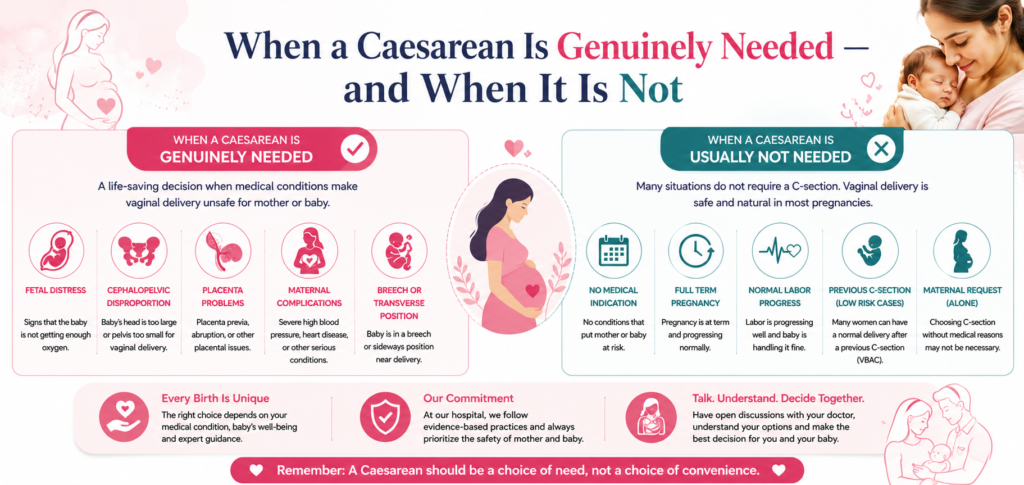
When a Caesarean Is Genuinely Needed — and When It Is Not
This is the table to keep. It applies whether or not you conceived through IVF.
| Genuine indications for caesarean | Not indications on their own |
|---|---|
| Placenta praevia covering the cervix | Having conceived by IVF |
| Breech or transverse lie at term where external version is unsuitable or unsuccessful | Maternal age alone, without any other factor |
| Twins where the first baby is not head-down, or monoamniotic twins; triplets or more | “Precious baby” or a long journey to conception |
| Previous classical (vertical) uterine incision, or certain previous uterine surgery | Twins where the first baby is head-down — vaginal birth is often possible |
| Obstructed labour or failure to progress despite adequate management | A scheduled or auspicious date |
| Fetal distress requiring immediate delivery | Doctor’s or family’s convenience |
| Severe pre-eclampsia or other maternal condition where labour is unsafe | Anxiety alone — real, but managed with support and monitoring, not surgery |
| Cord prolapse, placental abruption and other emergencies | A single previous caesarean in many cases — see the section on VBAC below |
The left column is not negotiable and a caesarean in those situations is a good and often life-saving decision. The right column is where the conversation should happen.
The “Precious Baby” Problem
In obstetric practice, there is a recognised category of non-absolute indications — situations where a caesarean might reasonably be considered but where vaginal birth remains a genuine option. “Precious pregnancy” sits in that list, alongside maternal request.
The instinct behind it is completely human. After years of treatment, injections, waiting and disappointment, the idea of anything going wrong in the final hours is unbearable. Surgery feels controlled. Labour feels like a gamble.
But labour is not a gamble in the way it feels. A monitored labour in a properly equipped unit, with a clear plan for moving to caesarean if the situation changes, is a safe process — and the option of surgery remains available at any point if it becomes necessary. Choosing a planned caesarean in advance does not remove risk; it exchanges one set of risks for another, and adds consequences for any future pregnancy.
None of which means a woman’s fears should be waved away. They should be taken seriously and addressed — with information, with a birth plan, with monitoring, and with someone senior present. Our notes on staying calm through a difficult journey and structured stress reduction such as meditation may help through the last weeks.
How a Caesarean Affects Future Pregnancies and IVF
This section exists because it is the part almost nobody tells IVF patients, and because a fertility clinic is exactly the place it should be said.
A first caesarean usually commits you to more. In one large cohort, women whose first birth was by caesarean had a repeat caesarean rate of about 97% in the next pregnancy, compared with about 13% among women whose first birth was vaginal.
The next pregnancy carries more risk. The same research found higher rates of placenta praevia, placenta accreta, pregnancy-induced hypertension and gestational diabetes in pregnancies following a caesarean — with the associations strongest where the first caesarean had no clear medical indication.
The scar itself can matter for fertility. A caesarean can leave a defect in the uterine wall known as a niche, which is detectable in a substantial proportion of women on transvaginal scanning afterwards. Evidence on whether this reduces implantation in later IVF is mixed — some studies show lower implantation and pregnancy rates, others show no difference. What is more consistently reported is that a history of caesarean is associated with roughly a 9% lower chance of a subsequent pregnancy compared with a vaginal delivery.
For most couples this changes nothing, because their caesarean was needed. But for a couple with frozen embryos and hopes of a second child, agreeing to an unnecessary caesarean is not a neutral decision — it is a decision that may make the next attempt harder. If a second pregnancy is in your plans, that belongs in the conversation now rather than later, and a full preconception consultation before trying again is the place to review it.
Caesarean Rates in India and Bihar
Some context, because the decision you are being offered is shaped by where you are standing.
India’s caesarean rate has risen from about 17% to around 21.5% over recent survey rounds. But the national figure hides the real pattern: roughly 47% of babies in private facilities are delivered by caesarean, against about 14% in public facilities. The WHO reference range often cited is 10–15%.
Bihar shows both failures at the same time, which is worth stating honestly rather than selectively:
| Setting | Approximate caesarean rate | What it suggests |
|---|---|---|
| India — overall | ~21.5% | Above the commonly cited reference range |
| India — private facilities | ~47% | Substantial over-use in the private sector |
| India — public facilities | ~14% | Broadly within range nationally |
| Bihar — overall | Roughly 10–13% and rising | Approaching the range from below |
| Bihar — public facilities | Under 5% | Too low — a rate this low suggests women who genuinely need emergency surgery are not reaching it |
| Bihar — private facilities | Several times higher than public | The over-use pattern, in the same state |
Both numbers describe a failure. A woman in a rural block who needs an emergency caesarean and cannot get one is in danger. A woman in a private hospital in Patna having surgery she did not need has been let down differently. The answer to both is the same: the decision should follow the clinical findings.
Twins After IVF: How Delivery Is Planned
If you are carrying twins, the delivery conversation is genuinely different — though still not automatically surgical.
Where the first twin is head-down and the pregnancy is otherwise uncomplicated, a vaginal delivery is frequently possible and is often the recommended plan, in a unit equipped to move quickly if needed. Where the first twin is breech or transverse, where the twins share an amniotic sac, or where there are three or more babies, a caesarean is usually planned.
Twin pregnancies also carry higher rates of preterm birth, pre-eclampsia and low birth weight regardless of how they are delivered — which is the argument for transferring a single embryo in the first place. That decision, taken months earlier in the laboratory, shapes the delivery more than anything decided at 38 weeks.
If You Do Need a Caesarean: Preparing Well
When a caesarean is genuinely indicated, it is a safe, common and often life-saving operation, and going into it well prepared makes a real difference.
- Understand why. Ask for the specific indication in plain language, and write it down — it matters for future pregnancies.
- Discuss anaesthesia. Most planned caesareans use spinal anaesthesia, so you are awake and can hold your baby soon after birth.
- Ask about skin-to-skin contact and early breastfeeding in theatre or recovery, which are usually possible.
- Plan pain relief for the first week rather than improvising it.
- Arrange help at home for at least two to three weeks. You will not be lifting much.
- Prepare for the timing — a planned caesarean is usually done at around 39 weeks unless there is a reason to deliver earlier.
- Get your general health in order beforehand — anaemia correction in particular, and weight where relevant. Our notes on diet and lifestyle for both partners and how excess weight leads to infertility cover the groundwork.
Recovery After a Caesarean: A Realistic Timeline
Recovery is longer than after a vaginal birth, and knowing the shape of it helps.
| When | What to expect |
|---|---|
| First 24 hours | Catheter and drip usually removed; encouraged to sit up and start moving; feeding can begin |
| Days 2–4 | Usual hospital stay; walking short distances; wound checked; regular pain relief |
| Week 1–2 | Wound soreness settling; avoid lifting anything heavier than the baby; help at home needed |
| Week 3–6 | Gradual return to normal activity; no driving until comfortable and able to brake sharply |
| 6 weeks | Postnatal check; most women cleared for normal activity and exercise |
| Beyond | Scar continues to soften over months; numbness around it is common and usually improves |
Get medical advice promptly for fever, increasing wound pain, redness or discharge from the wound, heavy bleeding, or calf pain and swelling.
Feeding. Breastfeeding after a caesarean is entirely possible, and worth planning for — positions that keep the baby off the wound, such as the side-lying or rugby hold, make the first days much easier. Our page on what breastfeeding actually involves covers the practical side.
Emotionally, a delivery that did not go as hoped can leave a real sense of disappointment, and after a long fertility journey that can feel confusing to admit. It is common, it is not ingratitude, and it is worth saying out loud to someone.
Can You Have a Normal Delivery After a Previous Caesarean?
Often yes. Vaginal birth after caesarean, usually shortened to VBAC, is a reasonable option for many women with one previous lower-segment caesarean, a single baby, head-down, and no new indication for surgery.
It requires delivery in a unit that can perform an emergency caesarean quickly, and continuous monitoring in labour, because there is a small risk of the previous scar giving way. The chance of success is higher where the first caesarean was for a non-recurring reason such as breech presentation, and where there has been a previous vaginal birth.
It is not right for everyone, and a planned repeat caesarean is a perfectly sound choice. But it should be a choice, discussed properly — not an assumption that “once a caesarean, always a caesarean.” That belief is one of the reasons India’s rate keeps climbing.
Questions to Ask Before Agreeing to a Caesarean
- What exactly is the medical indication in my case?
- Is this an absolute indication, or one where vaginal birth is still an option?
- If I wanted to try for a normal delivery, what would that involve and what are the risks?
- Is my baby head-down? If breech, can external version be attempted?
- If I have twins, is the first baby head-down?
- How will labour be monitored, and at what point would you recommend moving to surgery?
- We would like another child — how would a caesarean affect that?
- Can this decision wait until labour begins, or does it have to be made now?
A good obstetrician will welcome all of these. If the answers are vague, that is information too.
Delivery Planning at Shradha IVF & Maternity, Patna
We should be direct about the position we are in. We are a private clinic that performs deliveries, in a country where private facilities carry out roughly 47% of births by caesarean. That is precisely why this needs saying plainly.
At Shradha IVF & Maternity in Patna, under Dr. Shradha Chakhaiyar, MBBS, DGO, MRCOG (London), the mode of delivery is decided on obstetric findings — presentation, placental position, the number of babies, the mother’s condition and how labour progresses. Conceiving through IVF is not treated as an indication in itself. Where a caesarean is needed we recommend it clearly and explain why. Where it is not, we say that too, and we support a monitored labour with the option of surgery available at any point.
We also raise the question of future children before delivery rather than afterwards, because for couples who have been through IVF that is rarely a settled matter. If you are thinking about a second pregnancy, when to see a fertility specialist and preparing properly for an IVF cycle are useful starting points, and how age affects your chances covers the timing question.
If you are still earlier in the process, whether IVF is really a last resort and the myths worth putting down may be more useful, and how to prepare for a first consultation lists what to bring.
The findings should.
Caesarean and IVF Pregnancy FAQs
Is normal delivery possible after IVF?
Yes. An uncomplicated single pregnancy conceived through IVF, reaching term with the baby head-down and no other complication, can be delivered vaginally like any other pregnancy. Conceiving through IVF is not by itself a medical indication for caesarean section. The decision should be based on obstetric findings rather than on how the pregnancy was achieved.
Why are caesarean rates higher after IVF?
Partly for medical reasons — twins are more common, as are placental problems, older maternal age with other risk factors, and complications such as pre-eclampsia. Partly for non-medical reasons: research on uncomplicated term singleton pregnancies found higher planned caesarean rates after IVF, driven by maternal request and clinician caution about a hard-won pregnancy.
Is an IVF pregnancy high risk?
Not automatically. IVF pregnancies carry modestly higher rates of preterm birth, low birth weight and placental problems, much of which historically came from twin pregnancies and from underlying infertility and maternal age rather than the procedure. What an IVF pregnancy warrants is attentive monitoring, which is not the same as planned surgery.
When is a caesarean actually necessary?
Genuine indications include placenta praevia covering the cervix, breech or transverse lie at term, twins where the first baby is not head-down, triplets, previous classical uterine incision, obstructed labour, fetal distress and obstetric emergencies. Having conceived by IVF, maternal age alone, a “precious” pregnancy and a scheduled date are not indications on their own.
Does a caesarean affect future fertility or IVF?
It can. A caesarean may leave a defect in the uterine wall called a niche, and a history of caesarean has been associated with roughly a 9% lower chance of a subsequent pregnancy compared with vaginal delivery. Evidence on implantation in later IVF is mixed. A first caesarean also makes a repeat caesarean far more likely next time.
How long is recovery after a caesarean?
Hospital stay is usually two to four days. Wound soreness settles over the first two weeks, during which lifting should be avoided and help at home is needed. Most women return to normal activity gradually between weeks three and six, with a postnatal check at around six weeks. The scar continues to soften over several months.
Can you have a normal delivery after a previous caesarean?
Often yes. Vaginal birth after caesarean is a reasonable option for many women with one previous lower-segment caesarean, a single baby, head-down and no new indication for surgery. It requires continuous monitoring and a unit able to perform emergency surgery quickly. Success is more likely where the first caesarean was for a non-recurring reason.
Can you breastfeed normally after a caesarean?
Yes. Breastfeeding after a caesarean is entirely possible and can usually begin within hours of birth. Positions that keep the baby’s weight off the wound, such as the side-lying or rugby hold, make the first days considerably more comfortable. Milk may take slightly longer to come in after a caesarean, which is normal and temporary.
Ask What the Indication Is. Every Time.
An IVF pregnancy deserves careful monitoring — not automatic surgery. We decide on obstetric findings, explain the reasoning, and take your plans for a second child into account before delivery, not after. First consultations at Shradha IVF & Maternity are free.
Book an Appointment → 💬 WhatsApp Us