

Medically Reviewed by Dr. Shradha Chakhaiyar, MBBS, DGO, MRCOG (London) · IVF Specialist, Shradha IVF & Maternity, Patna ·
Quick Answer
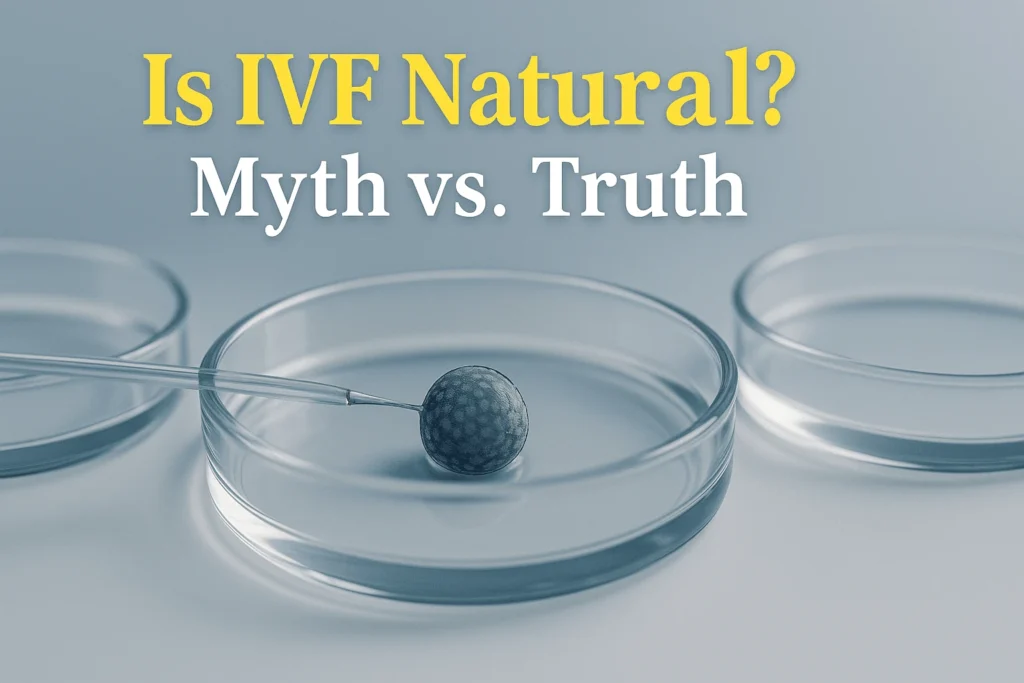
Is IVF natural? IVF is not artificial — it uses your own eggs and sperm, your own hormones (just balanced with medication), and the pregnancy grows naturally in the mother’s womb for nine months exactly like any other pregnancy. The only difference is that the first step — fertilisation — happens in a lab instead of inside the body. Almost everything else about IVF follows the body’s own natural process.
Why Do So Many IVF Myths Exist?
In vitro fertilisation (IVF) has helped millions of couples around the world become parents, and it has been practised safely for more than 40 years. Yet in India — and especially in smaller towns and cities — IVF is still surrounded by fear, rumour, and misinformation. Many couples who could easily become parents delay or avoid treatment because of myths they heard from neighbours, social media, or well-meaning relatives.
At Shradha IVF & Maternity in Patna, the most common questions we hear are not medical — they are emotional, rooted in misunderstanding. So let’s separate myth from fact, clearly and honestly.
Myth 1: “IVF babies are made by a machine”
The truth: In IVF, the egg and sperm are brought together in a laboratory, but that is the only step that happens outside the body. The embryo is then placed into the mother’s uterus, where the pregnancy develops completely naturally over nine months — the same as any other pregnancy. IVF simply gives a small helping hand at the point of fertilisation. There is no “machine” growing a baby.
Myth 2: “IVF babies are weak, abnormal, or different”
The truth: Children born through IVF are just as healthy, intelligent, and active as naturally conceived children. The World Health Organisation and decades of research confirm there is no inherent difference in physical or mental health. IVF babies go to school, play sports, and grow up like everyone else. In fact, when genetic testing (PGT) is used, embryos can be screened before transfer, which can actually reduce the risk of certain genetic conditions. (More on this in the truth behind IVF children.)
Myth 3: “IVF always results in twins or triplets”
The truth: Multiple pregnancies used to be more common in the early days of IVF, when several embryos were transferred at once. Today, Single Embryo Transfer (SET) is the recommended standard for most patients, especially younger women. The number of embryos transferred is a careful medical decision based on your age and health — not a guarantee of twins. A single embryo can occasionally split into identical twins, but this is rare (around 1–2% of cases).
Myth 4: “IVF is only for the rich”
The truth: IVF is more affordable and accessible than ever. While it is an investment, the cost is comparable to many other common medical procedures, and centres like Shradha IVF offer EMI options and transparent pricing. The goal is to bring parenthood within reach of every family — not just a privileged few.
Myth 5: “IVF is unbearably painful”
The truth: Most women describe IVF as uncomfortable rather than painful. The treatment involves hormone injections, blood tests, and ultrasound scans — manageable for the vast majority of patients. The egg retrieval, the most invasive step, is done under light sedation, so there is no pain during the procedure. Mild bloating or cramping afterwards usually settles within a few days. The embryo transfer itself is quick and painless, similar to a routine internal examination. (See how painful is the IVF process for a step-by-step breakdown.)
Myth 6: “IVF uses up all your eggs and causes early menopause”
The truth: This is one of the most common fears — and it is biologically incorrect. Every month, your ovaries naturally begin developing a batch of eggs, but usually only one matures, and the rest are absorbed by the body and lost. IVF medication simply rescues more of that same month’s batch so they can mature together and be collected. It does not dip into your future egg supply and does not bring on early menopause. If you’re worried about your egg count, the real measure is your ovarian reserve.
Myth 7: “Infertility is always the woman’s problem”
The truth: Male factors contribute to roughly 40–50% of all infertility cases. Low sperm count, poor motility, abnormal shape, or DNA fragmentation are common and often treatable. This is why semen analysis is an essential part of any fertility evaluation. In cases of severe male-factor infertility, ICSI (where a single healthy sperm is injected directly into an egg) dramatically improves the chance of fertilisation. Infertility is a couple’s issue, not a woman’s burden.
Myth 8: “IVF is the only treatment for infertility”
The truth: IVF is one of several fertility treatments — and often not the first one recommended. Depending on the cause, your doctor may first suggest lifestyle changes, ovulation-inducing medication, or IUI (Intrauterine Insemination). IVF is recommended when these simpler options are unlikely to work or have already failed — we explain this fully in is IVF the only treatment for infertility.
Myth 9: “IVF guarantees a baby on the first try”
The truth: IVF significantly improves your chances, but no honest clinic can guarantee success in a single cycle. Outcomes depend on age, egg and sperm quality, uterine health, and the underlying cause of infertility. Many couples conceive within the first or second cycle; others need a few attempts. The first cycle is often partly diagnostic — it helps the doctor understand how your body responds, so the protocol can be fine-tuned. Cumulative success across a few cycles is much higher than any single cycle alone.
Myth 10: “IVF requires a long hospital stay and complete bed rest”
The truth: IVF is an outpatient process. Egg retrieval and embryo transfer are both day procedures — you go home the same day, usually within a few hours. Most visits are short, just for monitoring hormone levels and follicle growth. After embryo transfer, no evidence that lying flat or strict bed rest improves success. Gentle, normal daily activity is perfectly fine and often better for you.
Myth 11: “IVF causes cancer”
The truth: Large-scale studies have found no significant link between IVF or the fertility medications used and an increased risk of cancer. The hormone medications used in IVF are safe when prescribed and monitored by a fertility specialist — we reviewed the evidence in detail in ” Do IVF injections increase cancer risk. This is a fear worth letting go of.
Myth 12: “IVF is unnatural and against nature”
The truth: IVF works with your body’s natural biology, not against it. It uses your own eggs and your own sperm. The hormones involved are the same ones your body already produces — IVF simply brings them into balance. The embryo follows the exact same developmental process as in a natural pregnancy; only the very first step happens in the lab. As Dr. Shradha Chakhaiyar puts it: “IVF is not an artificial process. It is a branch of science that gives a small support to overcome a barrier in natural conception. Everything else follows nature’s own course.”
When Should You Actually Consider IVF?
Now that the myths are cleared, here is the honest picture. IVF may genuinely be the right step if you have:
- Blocked or damaged fallopian tubes — IVF bypasses the tubes entirely
- Severe male-factor infertility — often combined with ICSI
- Low ovarian reserve (low AMH) — to make the best use of remaining eggs
- Endometriosis or PCOS that hasn’t responded to simpler treatment
- Unexplained infertility after 12 months of trying (or 6 months if you’re over 35)
The biggest mistake is not “trying IVF too early” — it’s delaying it for years when it’s clearly needed, while egg quantity and quality quietly decline with age. The right approach is never fear; it’s a diagnosis. A proper fertility evaluation tells you exactly where you stand.
Talk to a Specialist — Not to Rumours
If misconceptions have been holding you back, the best thing you can do is replace fear with facts. At Shradha IVF & Maternity in Patna, Dr. Shradha Chakhaiyar (MBBS, DGO, MRCOG London) personally evaluates each couple and explains your real options in plain language — no pressure, no jargon. For families coming from across Bihar, this clarity often turns years of confusion into a clear, hopeful path forward.
📞 Have a question about IVF you’ve been afraid to ask? Book a consultation with Dr. Shradha Chakhaiyar at Shradha IVF & Maternity, Patna.