


Medically Reviewed by Dr. Shradha Chakhaiyar, MBBS, DGO, MRCOG (London) — Fertility Specialist & Reproductive Surgeon, Shradha IVF & Maternity, Patna
20+ Years of Experience · www.shradhaivf.com
Yes, you can become a mother through IVF at 40. Using your own eggs, the live birth rate is roughly 7–12% per cycle at 40–42, falling below 5% at 43+, mainly because more embryos become chromosomally abnormal with age (around 60% at 40, 90% by 44). More than one cycle is usually needed. Importantly, donor eggs are a highly effective option — around 50%+ success per cycle, and that rate barely changes through your 40s, because it depends on the donor’s age, not yours. A chromosomally normal embryo implants about as well at 42 as at 32 — so at 40, the goal is finding a normal embryo, which is why starting promptly matters most.
📋 What This Guide Covers
- Is it really possible to have a baby with IVF at 40?
- What happens to fertility at 40?
- What are the real success rates at 40, 42, and 43+?
- Why do the odds drop — and what it doesn’t mean
- Natural conception vs IVF at 40
- What is the IVF process like at 40?
- What actually improves your chances?
- How many cycles will you likely need?
- Does the husband’s age matter too?
- Own eggs or donor eggs — the honest conversation
- Is pregnancy at 40+ safe?
- Why starting now matters more than anything
- A note from Dr. Shradha, Patna
- FAQs
Is It Really Possible to Have a Baby with IVF at 40?
Yes. Let me say that plainly before anything else, because the internet may have left you doubting it. Women become mothers through IVF at 40, at 42, and beyond — I have delivered their babies myself. It is harder than it would have been at 30, and I won’t pretend otherwise. But “harder” is not “impossible,” and the gap between those two words is where a great deal of unnecessary despair lives.
What changes at 40 is not whether it can happen, but the odds and the strategy. And once you understand both honestly, you can make a clear-eyed decision instead of a frightened one. This page is about your specific decade; for the complete picture across every age, our pillar guide on how age affects IVF walks through the whole curve.
What Happens to Fertility at 40?
To make sense of the numbers, it helps to understand the biology, because it is gentler and more logical than the scary headlines suggest.
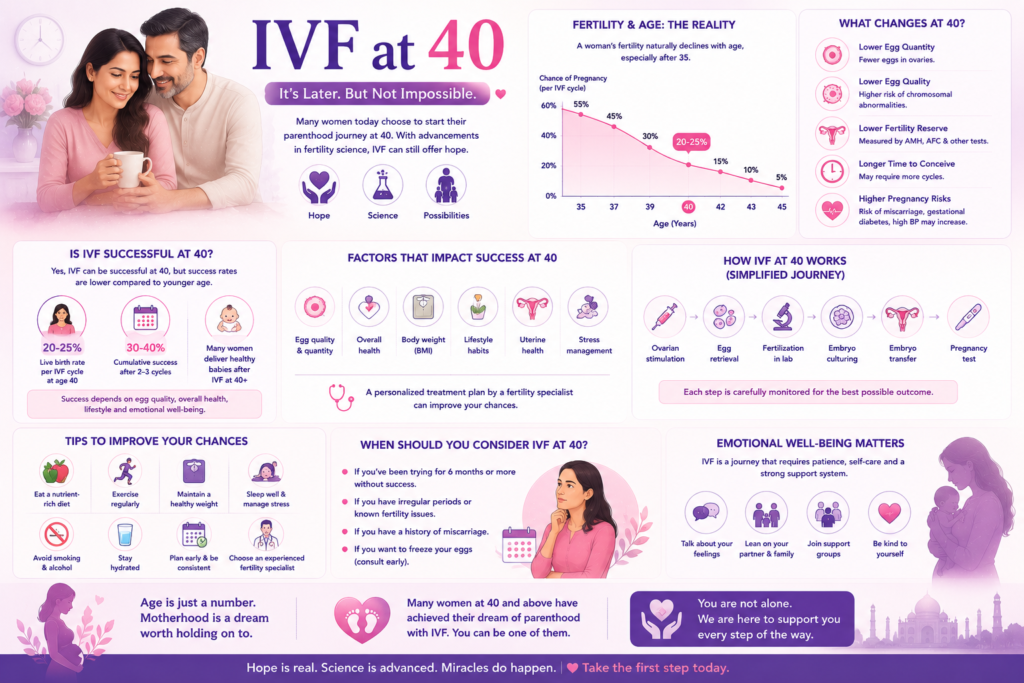
A woman is born with all the eggs she will ever have — she never makes a new one. Two things change with age. First, the number of eggs falls: by 40 the ovarian reserve is much smaller than it was at 30, which means fewer eggs can be collected in an IVF cycle. Second, and more importantly, the quality of eggs declines: the cellular machinery that sorts chromosomes correctly becomes less reliable, so a higher proportion of eggs — and the embryos made from them — carry the wrong number of chromosomes.
Both of these are natural, neither is anyone’s fault, and understanding them is the key to the whole strategy. If you want to know where your own reserve stands, that is measured with an AMH blood test and an ultrasound follicle count — our guides on low ovarian reserve and AMH and egg count explain what those numbers mean.
What Are the Real Success Rates at 40, 42, and 43+?
Here is the honesty other pages skip: “over 40” is not a single number. A woman of exactly 40 has meaningfully better odds than one of 44. These are registry averages (SART, CDC) for IVF using your own eggs — population figures, not a prediction about you:
| Age | Live birth per cycle (own eggs) | What’s happening |
|---|---|---|
| 40 | ~10–12% | Still a real chance; more eggs per cycle helps |
| 41–42 | ~7–10% | Declining; cumulative cycles matter most here |
| 43+ | Under 5% | Own-egg success is limited; donor eggs usually discussed |
| Any 40s — donor eggs | ~50%+ | Driven by the donor’s age, so barely declines through your 40s |
Across several cycles, the picture is a little kinder than any single cycle suggests: SART data indicates women aged 40–42 can reach around 20% cumulatively across multiple transfers with their own eggs. I show you the low per-cycle numbers not to discourage you, but because you cannot make a good decision on a comfortable half-truth — and because the next sections are where the real hope is. It also helps to understand what a “success rate” actually measures, which our guide on the real IVF success rate unpacks, since clinics quote these figures in very different ways.
Why Is It Difficult to Conceive after 40?
The reason is almost entirely about chromosomes, and understanding it changes how the numbers feel.
As eggs age, more of them end up with the wrong number of chromosomes. By 40, roughly 60% of embryos are chromosomally abnormal; by 44, around 90%. Abnormal embryos usually fail to implant or miscarry early. That, not some vague “weakness,” is what the falling numbers measure — and it is why an embryo that looks perfect on the screen can still fail, as our guide on why a perfect-looking embryo fails explains.
Natural Conception vs IVF at 40
Some couples at 40 ask, reasonably, whether they should keep trying naturally rather than moving to IVF. It is an honest question and deserves an honest answer.
Natural conception at 40 is possible, but the monthly chance is low — around 5% per month — and it falls with each passing year. For a woman of exactly 40 with regular ovulation, open tubes, and a partner with reasonable sperm, a few months of well-timed trying is not unreasonable. But the same clock that lowers IVF odds lowers natural odds too, and more steeply. The safe approach is not “natural instead of IVF” but getting evaluated promptly, so you understand your real position before you spend months you may not have to spare. At 40, the cost of waiting is simply higher than at any earlier age.
What Is the IVF Process Like at 40?
The steps of IVF at 40 are the same as at any age, but the emphasis shifts. In brief, a cycle involves stimulating the ovaries with medication to grow multiple eggs, collecting those eggs in a short procedure, fertilising them in the laboratory (often with ICSI, where a single sperm is injected into each egg), growing the resulting embryos for a few days, and transferring an embryo to the uterus.
At 40, three things are handled with particular care. First, the stimulation protocol is chosen to collect as many good eggs as safely possible, because numbers matter more now. Second, we often grow embryos to the blastocyst stage and consider testing them, to identify the strongest embryo to transfer. Third, we frequently use a freeze-all approach — freezing the embryos and transferring in a later, carefully prepared cycle — which separates the job of making good embryos from the job of preparing a receptive uterus, and often improves outcomes.
What Actually Improves Your Chances at 40?
You can’t make your eggs younger — anyone promising that is misleading you. But several things genuinely tilt the odds, and they all follow from that “finding a normal embryo” idea:
- Aim for more eggs per cycle. Since a smaller fraction will be normal, collecting more eggs means more chances of finding a good one. The stimulation protocol matters more at 40 than at any other age.
- Consider PGT-A (embryo genetic testing). It doesn’t make embryos normal — it helps us identify the normal one, so we transfer the embryo most likely to work rather than discovering a problem through a miscarriage. Particularly worth discussing at 40+.
- Use freeze-all and prepare the uterus carefully — see our guide on frozen versus fresh transfer.
- Optimise egg quality where you can. It won’t reverse age, but it removes avoidable obstacles — our guide on how to improve egg quality is honest about what helps and what doesn’t.
- Know your ovarian reserve so the plan is realistic — see low ovarian reserve and what your AMH means.
How Many Cycles Will You Likely Need?
Honestly? Usually more than one. At 40+, because a normal embryo is harder to find, most women need two or three cycles to succeed with their own eggs — and that is normal, not failure. This is why I always ask women at this age to plan, emotionally and financially, for a journey rather than staking everything on a single attempt.
A first cycle also teaches us a great deal about how your body responds, which we use to make the next one smarter — our guide on what to change after a failed first cycle covers exactly this. The women who do best are usually the ones who went in expecting a process, not a lottery ticket.
If Husband Turns 40, Does it Affect Fertility?
It does, though less dramatically than the woman’s age, and it is almost always overlooked. Sperm quality declines gradually with age — motility falls and DNA fragmentation rises — which can affect fertilisation and embryo development. The effect is real but smaller than the effect of egg age, and techniques like ICSI overcome many male-factor problems. The practical point is simple: the husband should always be assessed too, with a semen analysis at the very start, not as an afterthought. Our guide on male infertility explains what that involves.
Own Eggs or Donor Eggs — the Honest Conversation
This is the conversation most articles avoid, and I’d rather have it with you gently and directly than let you find it nowhere.
First: trying with your own eggs is completely reasonable at 40, and often the right place to start if your ovarian reserve allows. Many women in their early forties conceive with their own eggs, and wanting to try is natural and valid.
Second, and just as important: donor eggs are not a failure, and they are not a last resort. They are a valid, safe, and remarkably effective path to motherhood — and I want to remove the shame that too often surrounds them. Here is the fact that reframes everything: with donor eggs, success depends on the donor’s age, not yours. That’s why donor-egg success stays around 50%+ per cycle and barely declines through your 40s. A woman of 41 carrying a donor-egg pregnancy has broadly the same chance as a woman of 30. The pregnancy is carried by you, born to you, and yours in every way that matters.
When is it worth seriously considering donor eggs? Usually when ovarian reserve is significantly diminished, when several own-egg cycles haven’t succeeded, or from about 43+ where own-egg odds become low. But this is a deeply personal decision, shaped by your values and your circumstances — and in our community, sometimes your family’s involvement too. There is no single right answer, and no one should rush you toward it or away from it.
Is Pregnancy at 40+ Safe?
Most women over 40 have healthy pregnancies and healthy babies — that’s the headline, and it’s true. It’s also honest to say the risks are somewhat higher: gestational diabetes, high blood pressure and pre-eclampsia, and a higher chance of caesarean delivery. This is a reason for closer monitoring, not for fear. A pregnancy at 40 is one we watch a little more attentively, and that attentiveness is exactly what keeps mother and baby well. With good antenatal care, age 40 is a perfectly reasonable time to have a baby.
Why Starting Now Matters More Than Anything
If there is one sentence I want to reach you, it’s this: at 40, the single most powerful thing in your control is how soon you begin.
Every month counts now in a way it didn’t at 30. A woman who starts at 40 has meaningfully better odds than the same woman who starts at 42 — more eggs, a higher proportion of them normal, better prospects with both own and donor eggs. Waiting “just one more year” to try naturally, or to feel ready, is the most expensive decision available to you, because it spends the one thing no treatment can return.
This is not meant to frighten you. It’s meant to free you from the paralysis of “maybe next year.” The kindest thing you can do for your future self is to find out where you actually stand — today, not eventually. You can begin with our IVF success rate calculator for a rough estimate, read how to prepare for your first consultation, or simply come in. And if you are not yet 40 but heading that way and wondering whether to act, our guide for those asking “I’m 35 — is IVF the only option now?” may help you decide sooner rather than later.
A Note from Dr. Shradha, Patna
At Shradha IVF & Maternity, IVF after 40 is planned honestly and compassionately by Dr. Shradha Chakhaiyar, MRCOG (London), with both own-egg and, where appropriate, donor-egg pathways explained without pressure. The first consultation is free — you can book an appointment here.
FAQ Related to IVF at 40
Yes. Using your own eggs, the live birth rate is roughly 7–12% per cycle at 40–42, so more than one cycle is often needed. Donor eggs offer around 50%+ per cycle. Many women become mothers through IVF at 40 — it's harder than at 30, but far from impossible.
Approximately 10–12% live birth per cycle at exactly 40, falling to around 7–10% at 41–42 and under 5% at 43+. Across multiple cycles, women aged 40–42 can reach roughly 20% cumulatively. The decline is due to more chromosomally abnormal embryos with age.
No. 40 is a very common age for IVF, and success with your own eggs is realistic, especially in the early 40s. Odds decline year by year, so starting promptly matters — but 40 is well within the range where IVF regularly succeeds.
Trying with your own eggs is reasonable in your early 40s if your ovarian reserve allows. Donor eggs — which offer around 50%+ success regardless of your age — are worth considering if reserve is very low, after several unsuccessful own-egg cycles, or from about 43+. It's a personal decision made without pressure.
Usually two or three with your own eggs, because a chromosomally normal embryo is harder to find at this age. This is normal, not failure. Planning emotionally and financially for a journey of several cycles — rather than a single attempt — leads to better outcomes.
Most women over 40 have healthy pregnancies, but risks such as gestational diabetes, high blood pressure, pre-eclampsia, and caesarean delivery are somewhat higher. This calls for closer monitoring rather than fear — with good antenatal care, 40 is a reasonable age to have a baby.
40 Is Not Too Late to Walk Through the Door.
Let Dr. Shradha assess your ovarian reserve and give you your real, personal odds — with your own eggs, and honestly about every option, without pressure. You’ll leave with a plan instead of a fear. The first consultation is free.