

Medically Reviewed by Dr. Shradha Chakhaiyar, MBBS, DGO, MRCOG (London) — IVF Specialist & Reproductive Surgeon
Shradha IVF & Maternity, Patna, Bihar · 20+ Years of Experience
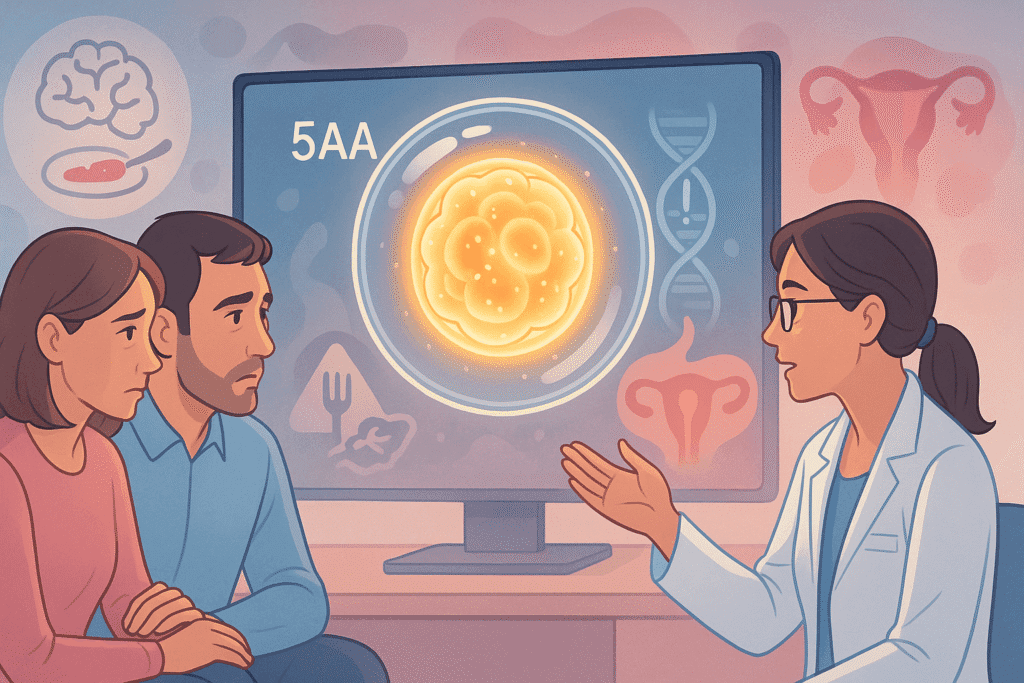
Embryo grading (like “5AA”) only measures visual appearance — how the embryo looks under a microscope. It cannot detect chromosomal abnormalities, assess mitochondrial strength, or predict how the embryo will interact with the uterine lining. Even a chromosomally confirmed (euploid) embryo only implants successfully 50–70% of the time. A failed transfer is almost always due to a combination of factors — embryo genetics, uterine receptivity, timing of transfer, immune environment — most of which can be identified and improved.
📋 What This Guide Covers
- What embryo grading actually measures
- The Gardner grading system explained
- The honest stats: how often do “perfect” embryos succeed?
- Reason 1 — Chromosomal abnormality (the biggest hidden factor)
- Reason 2 — Uterine receptivity and structural issues
- Reason 3 — The Window of Implantation (WOI)
- Reason 4 — Immune and systemic factors
- Reason 5 — Transfer technique and timing
- Preparing your body: what the evidence actually says
- What to do after a failed embryo transfer
- Recurrent implantation failure — when to investigate further
- A note from Dr. Shradha
- FAQs
What Embryo Grading Actually Measures
Before we explain why a “perfect” embryo can fail, it’s important to understand what “perfect” actually means in the context of an IVF lab — because it means less than most patients are told.
Embryo grading is a visual assessment. An embryologist looks at the embryo under a microscope and evaluates it based on:
- How many cells it has
- How even the cells are
- How much fragmentation is visible
- At the blastocyst stage: how expanded it is, how developed the inner cell mass looks, and how the outer cell layer (trophectoderm) appears
What grading cannot see:
- Whether the embryo’s DNA is intact and chromosomally normal
- The strength of mitochondria (the energy powerhouses that drive cell division)
- Genetic mutations that may affect development
- How this specific embryo will interact with this specific woman’s uterine environment
This is the central truth that every IVF patient deserves to know clearly: a top-grade embryo is one that looks excellent. It is not a guarantee that the embryo is chromosomally normal or that it will implant. The visual grade is a meaningful signal — higher-grade embryos generally have better outcomes — but it is one piece of a much larger picture.
The Gardner Grading System — What 5AA Actually Means
The most widely used grading system for blastocysts (day-5 embryos) is the Gardner scale. It gives three pieces of information:
| Component | What It Grades | Scale | Best Score |
|---|---|---|---|
| Expansion stage (number) | How expanded/hatched the blastocyst cavity is | 1 (early) → 6 (fully hatched) | 5 or 6 |
| Inner Cell Mass / ICM (first letter) | The cells that become the baby | A (many, tightly packed) → C (very few) | A |
| Trophectoderm / TE (second letter) | The cells that become the placenta | A (many, cohesive) → C (very few/scattered) | A |
So a “5AA” embryo is a fully expanded blastocyst with excellent inner cell mass and excellent trophectoderm — the highest visual score. A “4BB” would be a slightly less expanded blastocyst with good (but not excellent) scores on both cell populations. Both are considered “good quality.” A 5AA embryo is not genetically tested — it is only visually assessed.
The Honest Stats — How Often Do “Perfect” Embryos Actually Work?
The most important number on this page: even after chromosomal testing (PGT-A) confirms an embryo is chromosomally normal, that embryo only implants successfully in about 50–70% of transfers. The remaining 30–50% of failures in those “confirmed perfect” embryos are due to other factors — uterine environment, the implantation window, immune factors, and more.
This means: a first failed IVF transfer — even with a top-grade embryo — is not evidence that something is catastrophically wrong with you or your embryos. It is statistically expected to happen. Understanding this doesn’t make the emotional pain smaller, but it means there is every reason to keep going with the right next steps.
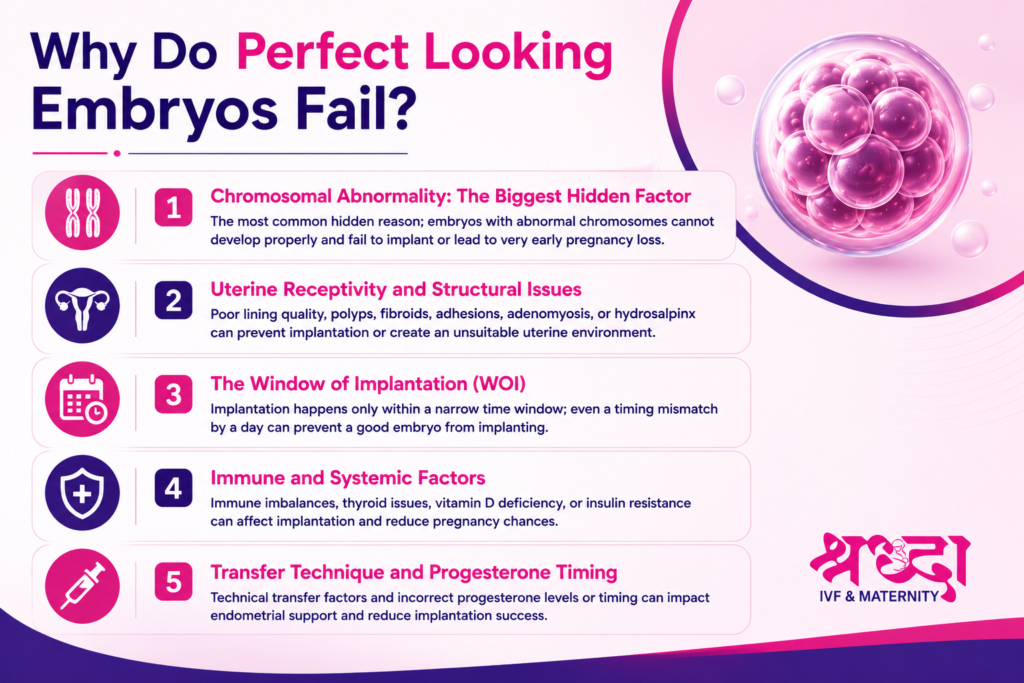
Why Do Perfect Looking Embryos Fail?
Reason 1 — Chromosomal Abnormality: The Biggest Hidden Factor
The most common reason a visually perfect embryo fails to implant is one that no amount of looking can reveal: the embryo has abnormal chromosomes (aneuploidy).
Chromosomal abnormalities occur when an embryo has too many or too few chromosomes during the early cell division process. These are almost always random events — not hereditary, not caused by lifestyle, and not preventable. A cell with the wrong number of chromosomes usually cannot develop into a viable pregnancy, and the embryo fails to implant or implants briefly before a very early pregnancy loss (sometimes called a “chemical pregnancy”).
The rate of chromosomal abnormality in embryos rises significantly with age:
- Under 35: roughly 30–40% of embryos may be chromosomally abnormal
- 35–40: 40–60%
- Over 40: 60%+ and rising
This is why a 42-year-old undergoing IVF may need to retrieve and test many embryos to find one that is chromosomally normal. It is also why the development of PGT-A (Preimplantation Genetic Testing for Aneuploidies) has been a significant advance — it allows the lab to test each embryo’s chromosomes before transfer, so that only confirmed chromosomally normal (euploid) embryos are transferred. Even then, as the statistics above show, 30–50% of euploid transfers don’t result in a pregnancy — which is why chromosomal testing is important but not the complete answer.
Reason 2 — Uterine Receptivity and Structural Issues
Even a chromosomally perfect embryo needs a receptive uterus to implant. Several uterine factors can prevent or hinder this:
Thin or poor-quality endometrial lining
The ideal endometrial thickness on transfer day is typically 7–10 mm or more. Below 7 mm, implantation rates drop meaningfully. Beyond thickness, the lining’s “texture” (triple-line pattern on ultrasound) and blood flow also matter. Causes of suboptimal lining include low estrogen, poor uterine blood flow, previous uterine procedures, and inflammation.
Structural problems: polyps, fibroids, adhesions, adenomyosis
Endometrial polyps (small benign growths inside the uterus) can physically block implantation. Submucosal fibroids (growing into the uterine cavity) distort the environment. Intrauterine adhesions (scar tissue from previous infection or surgery) and adenomyosis (endometrial tissue growing into the muscle wall) also impair receptivity. Most are identified by ultrasound or hysteroscopy, and most are treatable.
Hydrosalpinx
If a fallopian tube is blocked and fluid-filled (hydrosalpinx), that fluid can be embryotoxic if it refluxes into the uterus — reducing implantation rates significantly. This is why we manage hydrosalpinx surgically before an IVF cycle.
Reason 3 — The Window of Implantation (WOI)
This is one of the most clinically significant — and least-explained — reasons for embryo failure, and it’s almost entirely absent from most patient-facing resources in India.
The endometrium is receptive to implantation only during a narrow biological window — typically around 6–10 days after ovulation (or, in a frozen embryo transfer cycle, a specific number of days after progesterone administration). In natural cycles, this window may be 4–5 days wide. In medicated IVF cycles, it can be as narrow as 12–48 hours.
If an embryo is transferred outside this window — even by a day — implantation may not happen, regardless of how good the embryo is. This is not rare. What’s more, individual women’s windows vary: some women have a “displaced window of implantation” that is earlier or later than the standard protocol assumes.
The ERA (Endometrial Receptivity Analysis) test takes a small biopsy of the endometrial lining during a mock cycle and analyses gene expression to identify when exactly the lining is receptive for that specific patient. If a shifted window is found, the transfer date in the next cycle can be adjusted. ERA is typically recommended after recurrent implantation failure (two or more failed transfers with good-quality embryos). It’s not for everyone — but for some patients, a timing shift of even 12 hours has been the difference between repeated failure and a successful pregnancy.
Reason 4 — Immune and Systemic Factors
A small but significant proportion of implantation failures involves the immune system. Normally, a successful pregnancy requires the body to “tolerate” the embryo (which carries the father’s genetic material and would otherwise be seen as a foreign entity). In some women, this immune tolerance is disrupted:
- Antiphospholipid syndrome (APS): A clotting disorder that can reduce blood flow to the developing embryo. Treatable with aspirin and heparin.
- Thyroid disorders: Both hypothyroid and hyperthyroid (even subclinical levels) can affect implantation. TSH should be optimised between 1–2.5 for IVF cycles.
- Elevated natural killer (NK) cells: Some research suggests elevated NK cell activity in the uterus may impair implantation, though evidence for testing and treatment is still evolving.
- Vitamin D deficiency: Active vitamin D is secreted by the endometrium and appears to influence genes important for implantation. Worth checking and correcting.
- Insulin resistance / PCOS: Hormonal environments associated with PCOS and insulin resistance can affect endometrial receptivity.
Reason 5 — Transfer Technique and Progesterone Timing
The embryo transfer itself is a technical procedure, and technique matters. The catheter must reach the right location in the uterine cavity with minimal trauma. A technically difficult transfer (due to cervical anatomy, for example) can reduce implantation rates. This is one reason experienced embryologists and reproductive surgeons matter.
Progesterone support after transfer is equally important. Progesterone prepares and maintains the uterine lining for implantation. If progesterone levels are suboptimal — or if the timing of progesterone start doesn’t align precisely with the embryo’s development stage — the WOI can shift, or the lining may not be adequately supported. In some patients, a premature rise in progesterone before egg retrieval can also impair the endometrium for that same cycle, which is one reason many centres now freeze all embryos when this is detected and plan a frozen transfer in a subsequent month.
What “Preparing Your Body” Actually Means — The Evidence-Based Version
You’ve likely read that “a healthy lifestyle” improves IVF success. This is true — but it’s important to be specific about what the evidence supports and what it doesn’t.
What genuinely helps:
- Healthy BMI — Both underweight and overweight status affect endometrial receptivity and hormone response. Meaningful improvements take 2–3 months.
- Folate and prenatal vitamins — Essential for healthy cell division; should be started 3 months before transfer.
- Vitamin D — Deficiency is common and worth correcting given its role in endometrial function.
- Thyroid optimisation — TSH in the 1–2.5 range for IVF. Check and treat before starting a cycle.
- Stopping smoking — Reduces egg quality and endometrial blood flow. One of the highest-impact modifiable factors.
- Stress management — Chronic high stress raises cortisol, which can interfere with LH surges and implantation signals. Yoga, meditation, counselling are reasonable and feel good. However, don’t let “stress caused the failure” become another source of guilt — the evidence for stress as a primary cause of individual cycle failure is not strong.
- Anti-inflammatory diet — A Mediterranean-style diet (vegetables, fruit, lean protein, omega-3 fats, reduced refined sugar and processed food) is broadly supportive of hormone health and reduces systemic inflammation.
What doesn’t have strong evidence for IVF specifically: acupuncture alone, supplements beyond the basics, bed rest after transfer, abstaining from sex indefinitely after transfer, and most herbal protocols. None of these harms if they feel meaningful — but please don’t blame yourself if you “didn’t do enough” of these. A failed transfer is rarely lifestyle-caused.
What to Do After a Failed Embryo Transfer
A failed cycle is not the end of the road — it’s data. Here’s how we think about the next steps at Shradha IVF, and what questions are worth asking your clinic:
- Request a “failure review” consultation. This should include going through the specific details of this cycle — the lining, progesterone levels, transfer conditions, embryo grade, and any developmental notes. Some clinics don’t do this routinely; ask for it specifically.
- Consider PGT-A if embryos haven’t been tested. If your embryos were selected visually and weren’t chromosomally tested, the most likely cause of failure is aneuploidy. PGT-A testing in the next cycle could identify this. Particularly relevant for women over 35.
- Check the uterine cavity. A hysteroscopy before the next transfer is often recommended after a first failure to look for polyps, adhesions, or other structural issues. It’s a short procedure, and it’s actionable: if something is found, it can usually be corrected.
- Review the progesterone protocol. Was progesterone started at the right time? Were levels checked during the luteal phase? These details can usually be adjusted in the next cycle.
- Consider ERA (Endometrial Receptivity Analysis) if you’ve had two or more failures with good-quality embryos. Particularly if you suspect the timing might be the issue.
- Check sperm DNA fragmentation. High DNA fragmentation in sperm can contribute to poor embryo development even when fertilisation has occurred. This is checked with a separate test from the standard semen analysis.
- Review the basic panel: TSH, vitamin D, blood glucose, AMH, and uterine blood flow. Small optimisations here are often easier wins than major protocol changes.
Use our IVF Success Rate Calculator to understand how your age, history, and reserve affect your personalised odds — and have an honest conversation with Dr. Shradha about what the most productive next step is for your specific situation.
Recurrent Implantation Failure — When to Investigate Further
The definition of Recurrent Implantation Failure (RIF) varies, but a common working definition is: failure to achieve a clinical pregnancy after at least 3 transfers of good-quality embryos (or 2–3 euploid embryo transfers in women over 37). This is when a more systematic investigation is warranted — including ERA testing, immune workup, thrombophilia screening, and advanced genetics. RIF affects a small proportion of IVF patients, but when it occurs, targeted investigation almost always reveals something manageable. It is not the same as being “unable to get pregnant” — it is a specific pattern that has specific solutions.
A Note from Dr. Shradha, Patna
At Shradha IVF & Maternity, every failed cycle is followed by a personal review consultation with Dr. Shradha. We go through the details, identify what we can learn, and plan the next step with clear eyes. The first consultation after a failed cycle is free. You can also use the IVF Success Rate Calculator to get a personalised sense of your cumulative success odds across multiple cycles.
Your Perfect Embryo Deserves a Perfect Plan
A failed transfer is not the end. It’s information — and with the right investigation, most couples can identify what to adjust and try again with better odds. Dr. Shradha offers a free post-cycle review consultation. Let’s find the answer together.
FAQs Related to Why Perfect Embryos Fails
Most fertility clinics confirm pregnancy using a beta hCG blood test about 10 to 14 days after embryo transfer. This test is more accurate than home pregnancy tests, especially after IVF where fertility medications can interfere with test results. Testing before Day 10 can produce misleading results in either direction.
Possible early signs include light implantation spotting (pink or brown discharge), mild cramping, breast tenderness, fatigue, and increased urination. However, symptoms vary widely — some women with successful pregnancies experience none of these. All of these signs can also be caused by fertility medications, so symptoms alone cannot confirm success.
Avoid heavy exercise, lifting, smoking, alcohol, and hot baths. Follow all medication instructions from your fertility specialist carefully — do not skip progesterone doses. Moderate rest is sensible, but strict bed rest is not required and is not evidence-based. Gentle activity like walking is fine after the first 24 hours.
No. Many women with completely successful IVF pregnancies report no implantation bleeding, no cramping, no breast tenderness, and no fatigue during the two-week wait. Some pregnancies develop silently with no noticeable symptoms at all. Symptom absence is one of the most common causes of unnecessary anxiety. Wait for the beta hCG test.
Chronic high stress can disrupt hormonal balance, but there is no strong evidence that normal anxiety during the two-week wait causes a transfer to fail. One stressful period does not prevent implantation. Managing stress — through rest, meditation, or talking to supportive people — is worth doing for your wellbeing, but please don't blame yourself if the transfer doesn't succeed. Implantation failure is almost always biological, not emotional.