

Medically reviewed by Dr. Shradha Chakhaiyar, MBBS, DGO, MRCOG (London) — IVF Specialist & Reproductive Surgeon, Shradha IVF & Maternity, Patna
Two sentences come up again and again in our consultations in Patna. “I had the test done at three places and got three different answers.” And, more recently, “Doctor, is there a machine that can tell us properly?”
The first frustration is entirely justified. The second question is a good one, and it deserves a straight answer rather than a brochure.
Artificial intelligence is genuinely changing parts of fertility treatment, and in one area — the consistency of laboratory measurement — it is already better than a tired human at the end of a long day. In another area, choosing which embryo to transfer, the picture is far less settled than the marketing suggests. This article goes through both honestly.
How Is AI Used in IVF? The Short Answer
AI is used in fertility treatment mainly for four things: analysing semen samples with automated motility and morphology tracking, grading and ranking embryos from time-lapse images, predicting how a woman will respond to ovarian stimulation, and estimating the likelihood of success from clinical data. Its clearest and best-established benefit is consistency — the same sample or embryo assessed the same way every time, without the variation that occurs between technicians and laboratories. What AI has not yet been shown to do, in large randomised trials, is increase live birth rates. It is a decision-support tool that assists embryologists and doctors rather than replacing them.
Where AI Is Actually Being Used in Fertility Treatment
| Application | What it does | How established |
|---|---|---|
| Automated semen analysis | Tracks individual sperm to measure concentration, motility, trajectory and morphology objectively | Well established for consistency; widely used |
| Embryo grading from time-lapse imaging | Scores and ranks embryos from continuous images without removing them from the incubator | Widely used; benefit to live birth not demonstrated |
| Ovarian stimulation prediction | Suggests starting doses and protocols from AMH, antral follicle count, age and prior response | Promising, mostly research and early clinical use |
| Follicle tracking on ultrasound | Automates counting and measuring follicles during monitoring scans | Emerging; reduces manual measurement time |
| Outcome prediction models | Estimates the chance of a live birth from clinical and laboratory data | Useful for counselling; accuracy varies widely between models |
| Laboratory workflow and witnessing | Sample identification, tracking and documentation | Practical and low-risk; genuinely reduces error |
Notice that the applications with the strongest case are the unglamorous ones — measurement, tracking, documentation. That pattern holds across medicine generally, and it is worth keeping in mind when a clinic leads with the glamorous ones.
AI in Semen Analysis: The Clearest Win
This is where automation makes the most defensible difference, and it is worth explaining why.
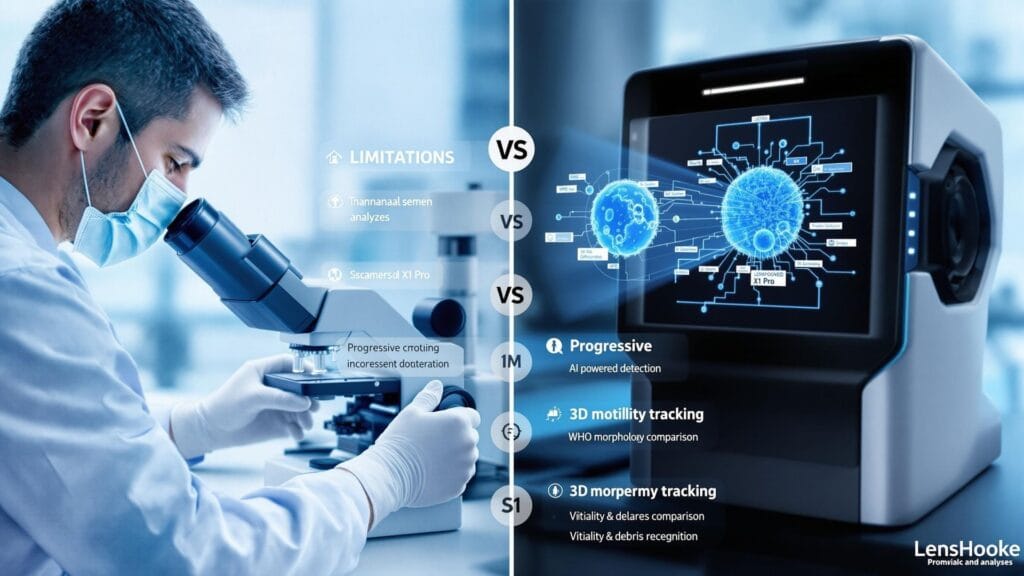
A conventional semen analysis is performed by a human looking down a microscope and counting. That person is estimating motility by eye, judging shape against reference criteria, and distinguishing sperm from debris and round cells. It is skilled work, and it varies — between technicians in the same lab, between labs, and for the same technician at different times of day.
That variation is not a small technical detail. It is why a man can have three tests and three different answers, and why treatment decisions sometimes get made on a number that would have been different elsewhere.
Automated systems address this specifically. They track individual sperm across successive frames, so motility is measured from actual movement rather than estimated; they assess morphology against defined criteria consistently; they distinguish debris and round cells algorithmically rather than by judgement; and they produce a standardised report in a format any doctor can read the same way.
What this genuinely gives you: reproducibility, objectivity, speed, and a report that means the same thing in Patna as it does anywhere else.
What it does not give you: perfect accuracy. Automated systems have their own limitations — very low-concentration samples are harder for them, debris can still confuse them, and results depend on sample preparation and on the operator loading the sample properly. Any claim of complete accuracy from any diagnostic device should be treated with suspicion, ours included. This is why a trained andrologist reviews the output rather than simply printing it.
Reference values should also follow the current standard: the WHO laboratory manual, sixth edition (2021). If a report quotes the fifth edition, the thresholds being used are out of date.
If you are trying to make sense of a report you already have, what abnormal sperm results actually mean explains the parameters, what causes male infertility and how it is treated covers the wider picture, and if yours showed no sperm at all, what a zero sperm count actually means explains why that is not the end of the road.
One more thing worth knowing: not all variation between reports is laboratory error. Semen quality genuinely fluctuates with illness, fever, sleep, alcohol and stress — how chronic stress affects sperm count and motility covers that, and it is why two samples several weeks apart are standard regardless of how they are analysed.
AI in Embryo Selection and Time-Lapse Imaging
This is the application people have heard most about, and the one where the honest answer is most different from the marketing.
In a conventional laboratory, embryos are removed from the incubator at intervals and assessed under a microscope. A time-lapse incubator instead photographs each embryo continuously without disturbing it, producing a complete record of how it developed. AI software can then analyse thousands of these image sequences, learn which developmental patterns are associated with pregnancy, and score or rank the embryos in a cycle.
The technology is real and the analysis is genuinely more consistent than human grading. Reported prediction accuracy for AI models sits substantially above morphology-based assessment.
But better prediction has not translated into more babies. A large randomised trial across the UK and Hong Kong, with around 1,600 participants, compared time-lapse imaging with standard care and found live birth rates of 33.7% versus 33.0% — a negligible difference. A Cochrane review had already concluded there was insufficient evidence that time-lapse improves live birth. And a randomised, double-blind trial comparing deep-learning embryo selection with standard manual morphology did not demonstrate non-inferiority.
Reviews of the field are consistent on this point: AI should be considered an adjunct for decision support, intended to aid rather than replace the embryologist, and large trials have not yet shown a statistically significant increase in live births per transfer compared with expert human selection.
There is also a subtlety worth knowing. Where time-lapse systems do appear to help, part of the benefit may come simply from leaving embryos undisturbed in a stable incubator rather than from the algorithm doing the ranking. Disentangling the two is an open question.
None of this makes the technology useless. Ranking is most useful when there are several embryos to choose between; with one embryo, there is nothing to rank. If you want to understand the stage at which this decision is made, what a blastocyst transfer involves explains it.
Does AI Improve IVF Success Rates? What the Trials Show
Short answer: not yet, on the evidence available.
| What was tested | Result |
|---|---|
| Time-lapse imaging vs standard care (large multicentre randomised trial, ~1,600 participants) | Live birth 33.7% vs 33.0% — negligible difference |
| Deep-learning embryo selection vs manual morphology (randomised, double-blind) | Did not demonstrate non-inferiority |
| Time-lapse systems (Cochrane review) | Insufficient evidence of improved live birth |
| AI prediction accuracy vs morphology (systematic review, 29 studies, 18,500+ cycles) | AI clearly better at prediction — but no consistent live birth benefit |
| Overall position of recent reviews | Adjunct for decision support; aids rather than replaces the embryologist |
It is worth being precise about what this does and does not mean. It does not mean AI is a gimmick — better, more consistent measurement is a real good in itself, and the prediction models are genuinely impressive. It means that as of now, no clinic can honestly promise you a better chance of a baby because it uses AI. If one does, ask to see the evidence for that specific system.
If success rates are the question actually on your mind, why a 60% success rate is still worth it and how age affects your chances are more useful than any technology page, because age and diagnosis still matter far more than equipment.
What AI Does Well Done in IVF?
| AI reliably improves | AI does not (yet) do |
|---|---|
| Reproducibility — the same result on the same sample every time | Increase live birth rates, on current trial evidence |
| Objectivity — removing variation between technicians and labs | Assess an embryo’s chromosomes; that needs genetic testing |
| Speed — semen results in minutes rather than hours | Diagnose why a couple is infertile |
| Standardised reporting any doctor can interpret identically | Replace the embryologist’s or clinician’s judgement |
| Documentation, sample tracking and error reduction in the lab | Assess the uterus or the receptivity of the endometrium |
| Handling large datasets for counselling and prediction | Guarantee any outcome |
Can AI Replace the Embryologist?
No, and nobody serious in the field is claiming it will soon.
An embryologist does a great deal that no current system does: handling gametes and embryos physically, judging when a sample or culture is behaving unusually, performing ICSI, making decisions when the situation departs from the pattern the algorithm was trained on, and taking responsibility for the outcome. AI models are also trained on particular populations and particular laboratories, and they do not necessarily transfer cleanly to a different setting — which is a real limitation in India, where most systems were developed elsewhere.
The realistic model, and the one the literature supports, is hybrid: the algorithm provides a consistent second reading, the human makes the decision. That is how it works in radiology, and it is how it should work here.
Is AI in IVF Regulated in India?
Partly, and the gaps are worth understanding.
Fertility clinics and laboratories themselves are regulated under the Assisted Reproductive Technology (Regulation) Act, 2021, which requires registration with the National ART and Surrogacy Board and mandates record-keeping standards. Medical devices are separately regulated under India’s medical device rules, and diagnostic equipment used in a laboratory should be appropriately approved.
What is much less clearly regulated is software that scores or ranks — embryo grading algorithms in particular sit in an area where oversight is still developing internationally, not only in India. In practice this means the burden of asking sensible questions falls on the patient, which is what the next section is for.
Questions to Ask Before Paying Extra for AI
Many clinics offer AI-related services as a paid add-on. Some are worth it, some are not, and these questions separate them:
- Is this system approved as a diagnostic device, and by whom?
- Does a human embryologist or andrologist review every result, or is the report issued automatically?
- Is there published evidence for this specific system — not for AI in general?
- Will this change my treatment, or only my report? A more precise number that leads to exactly the same plan has limited value to you.
- What does it cost, and is it included or extra? Ask for it in writing alongside what IVF costs overall.
- If I have only one embryo, does ranking help me at all? Usually not.
- What would you do if the AI and the embryologist disagree? The answer tells you how the clinic actually uses it.
A clinic confident in its technology will answer all of these plainly. Our note on choosing a fertility specialist properly covers the wider set of questions, and the myths worth putting down deals with the other claims you will encounter.
AI-Assisted Semen Analysis at Shradha IVF, Patna
We use automated, AI-assisted semen analysis at Shradha IVF & Maternity in Patna, and it is worth describing accurately rather than dramatically.
The system tracks individual sperm to measure concentration, progressive motility with actual trajectory and velocity, morphology and vitality, and separates debris and round cells from sperm. Results are available within minutes, in a standardised report format, assessed against WHO 2021 reference values. Our andrology team reviews every report before it is issued.
In practice, this changes the reliability of the starting point. When a man’s report is consistent and objective, the decision between medical management, IUI, IVF and ICSI can be made once, properly, rather than revisited after every conflicting result. That saves time, repeat tests and money — which is a real benefit, and a more modest claim than the one we would make if we were selling.
What it does not do is improve your sperm, guarantee a result, or make the underlying cause disappear. If the report shows a genuine problem, the useful next steps are the ones in which foods actually improve sperm count and a proper clinical evaluation — not another test.
What This Means for Your IVF Treatment
If you take three things from this page, take these.
A more accurate test is worth having. Consistent measurement means fewer repeat tests and a treatment decision made on something reliable. That is genuinely useful, and it is where the technology has earned its place.
A more accurate test is not a better treatment. Knowing your numbers precisely does not change what those numbers are. The things that most affect your chances remain age, diagnosis, ovarian reserve and sperm quality — not the equipment used to measure them.
Be sceptical of outcome promises. Any clinic claiming that AI raises your chance of a baby is ahead of the evidence. Ask what the technology measures, who reviews it, and what it costs. Then judge the clinic by whether it answers.
If you are earlier in this than any of it, when to see a fertility specialist and whether IVF is really a last resort matter more than any machine, and common questions about test tube babies covers the basics. If you are already planning a cycle, preparing properly for an IVF cycle and how safe IVF actually is are the useful reading, along with what a good AMH level actually means for the stimulation conversation. When you come in, how to prepare for a first consultation lists what to bring.
It is not the same as a better chance — and you deserve to be told the difference.
AI in IVF FAQs
How is AI used in IVF?
AI is used in fertility treatment for automated semen analysis, embryo grading from time-lapse imaging, predicting response to ovarian stimulation, automating follicle measurement on scans, estimating success probability from clinical data, and laboratory workflow and sample tracking. Its most established benefit is consistency of measurement rather than improved treatment outcomes.
Does AI improve IVF success rates?
Not on current evidence. A large randomised trial of time-lapse imaging found live birth rates of 33.7% with it compared with 33.0% without, and a randomised double-blind trial of deep-learning embryo selection did not demonstrate non-inferiority to manual assessment. AI predicts outcomes more accurately than morphology alone, but that has not translated into more live births.
What is AI embryo selection?
Embryos are photographed continuously inside a time-lapse incubator, and software trained on thousands of image sequences scores and ranks them by how closely their development matches patterns associated with pregnancy. It is more consistent than human grading and most useful when several embryos are available, but it cannot assess chromosomes and has not been shown to increase live births.
What is AI sperm analysis?
An automated system tracks individual sperm across successive images to measure concentration, progressive motility with actual trajectory and speed, morphology and vitality, and separates debris and round cells from sperm. Results are produced within minutes in a standardised report format, which removes much of the variation seen between technicians and laboratories.
Is AI semen analysis more accurate than manual testing?
It is more consistent and more objective, which is not the same as being perfect. Automated systems remove variation between technicians and produce reproducible measurements, but they have their own limitations with very low-concentration samples, debris and sample preparation. No diagnostic device is completely accurate, which is why results should be reviewed by a trained andrologist.
Can AI replace the embryologist?
No. Embryologists handle gametes and embryos physically, perform procedures such as ICSI, recognise when a situation departs from the expected pattern, and take clinical responsibility. AI models are also trained on specific populations and laboratories and may not transfer well to other settings. The realistic model is hybrid, with the algorithm providing a consistent second reading.
Is AI in IVF regulated in India?
Partly. Fertility clinics and laboratories are regulated under the Assisted Reproductive Technology (Regulation) Act, 2021, and diagnostic devices fall under India’s medical device rules. Software that scores or ranks embryos sits in an area where regulatory oversight is still developing internationally, so patients should ask clinics directly about approval and human review.
Should I pay extra for AI in my IVF cycle?
Only after asking specific questions. Find out whether the system is an approved device, whether a human reviews every result, whether published evidence exists for that specific system rather than AI generally, and whether it will change your treatment or only your report. A more precise number that leads to the same treatment plan has limited value.
A Reliable Pregnancy Report Is Where Best IVF Treatment Starts.
If you have had semen tests at different places and got different answers, a single standardised analysis reviewed by our andrology team will settle it — so the treatment decision gets made once, properly. First consultations at Shradha IVF & Maternity are free.