Reviewed by Dr. Shradha Chakhaiyar, MBBS, MRCOG (London) — IVF Specialist, Shradha IVF & Maternity, Patna
Every festival in India carries a message. Diwali teaches us to move from darkness to light; Holi, that good triumphs over evil. Chhath — the great four-day festival of Bihar — teaches that a mother’s faith, devotion and love for her child are eternal, and that the divine never leaves a devotee in despair. For a couple longing for a child, Chhath holds a particularly tender meaning: the story of Chhathi Maiya, worshipped across the Purvanchal as the goddess who grants and protects children. This is that story — told with love, and with honesty about where faith ends and medicine begins.
Who Is Chhathi Maiya?
Chhathi Maiya is the presiding deity of Chhath. In scripture she is identified with Devi Shashthi — the sixth form of Prakriti (Nature) and, by tradition, the sister of Surya, the Sun God. It is no accident that she is honoured on the sixth day of the lunar fortnight of Kartik, which is why the festival is also called Surya Shashthi Vrata. In Hindu custom, Shashthi is invoked on the sixth day after a child’s birth — the chhathi ceremony — as the goddess who gives children long life and shields them from harm. She is, in the simplest terms, the goddess of childbirth and of the wellbeing of children. In one beloved legend she declares that she protects the children of the whole world and grants children to the childless — which is exactly why couples without a child have turned to her for centuries.
The Story of Chhathi Maiya and the Blessing of Motherhood
An ancient tale, retold across generations in Bihar, captures why Chhathi Maiya became the goddess of motherhood. King Priyavrata and his queen, Malini, performed penance for years in the longing for a child, yet remained childless. In their grief they turned to the sage Kashyapa, who counselled them: “Worship Goddess Shashthi — Chhathi Maiya.” The queen prayed with all her heart, and by the goddess’s grace she was at last blessed with a child. The infant, however, was born lifeless. As the royal couple wept, the goddess appeared and said, “Priyavrata, your faith has not died.” With her divine touch the child was restored to life. From that day, Chhathi Maiya has been revered as the goddess who gives children to the childless and guards every mother’s womb. It is a story not about magic, but about faith that refuses to give up — and that refusal to give up is the quiet heart of every fertility journey.
The Four Days of Chhath
Chhath is among the most disciplined and demanding of all Hindu festivals — a vrat of extraordinary devotion, kept mostly by women (the vrati), with the whole family in support. It unfolds over four days of fasting, purity and worship of the Sun:
| Day | Name | What happens |
|---|---|---|
| Day 1 | Nahay Khay | The vrati bathes in a river or pond, cleans the home, and eats a simple sattvik meal (traditionally lauki-bhaat) — the last food before the fast deepens |
| Day 2 | Kharna (Lohanda) | A day-long waterless fast, broken only in the evening with gur ki kheer and roti; after this, a fast without food or water begins |
| Day 3 | Sandhya Arghya | At the ghat, the family offers arghya (water and fruit in a soop) to the setting sun; kosi is lit at home |
| Day 4 | Usha Arghya (Paran) | Before dawn, arghya is offered to the rising sun, and the 36-hour fast is finally broken (paran) |
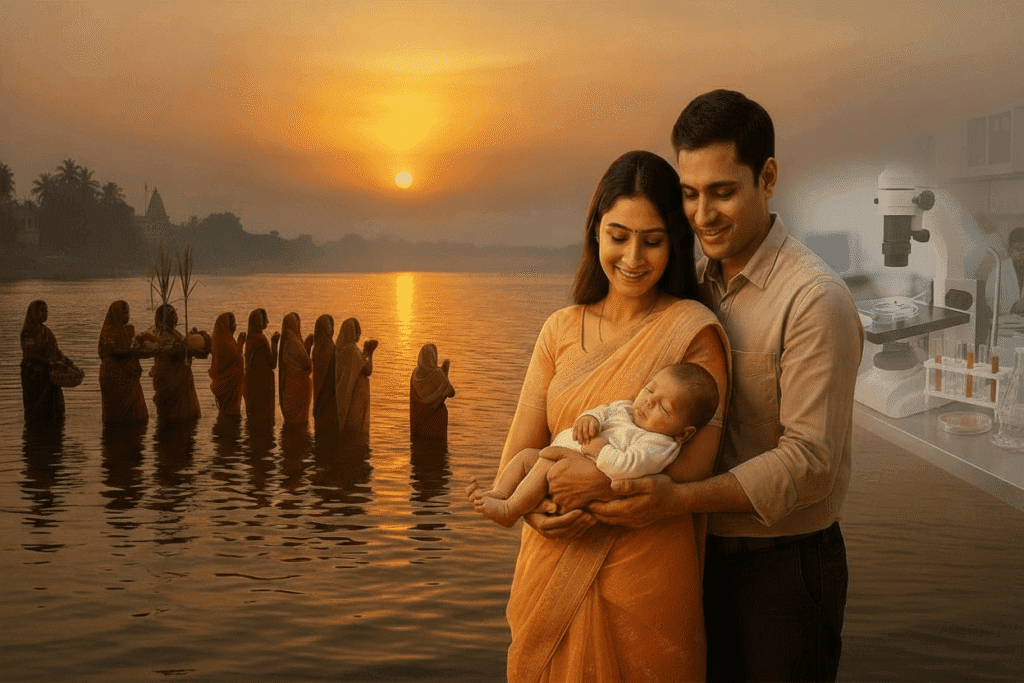
The offering to both the setting and the rising sun is the festival’s most moving image — a reminder that the divine is honoured not only at its height but in its decline, and that after every sunset a sunrise is promised. For a couple who have known the sunset of disappointment, it is a promise worth holding onto.
Why Couples Pray at Chhath for a Child
Across Bihar, Jharkhand, eastern Uttar Pradesh and the Nepal Terai, Chhath is kept for the wellbeing of the family — and, very often, for santan prapti, the blessing of a child. Mothers keep the vrat for their children’s long life; the childless keep it in hope. This is faith at its most sincere and beautiful, and it deserves respect, not dismissal. At the same time, honesty is its own form of devotion: a festival does not diagnose a blocked fallopian tube, restore ovulation, or correct a low sperm count. Faith can carry a couple’s heart through a hard journey — but the practical problem of infertility is a medical one, with real, identifiable causes in most couples and effective treatment for many.
An honest word, in the spirit of Chhath. Nothing in this article claims that any ritual, fast or prayer treats infertility. Chhathi Maiya is worshipped for faith, strength and hope — and those matter. But if conception has not happened, the kindest next step alongside your faith is a proper medical evaluation. Keeping both — shraddha and vigyan, faith and science — is not a contradiction. It is wisdom.
When Faith Meets Science
In the age of the Puranas, the divine worked through sages and miracles. Today, many believe, that same grace can reach us through other channels — a kind stranger who points the way, a doctor, a treatment that opens a door that seemed shut. When a couple has tried for years without success, it may be read not as abandonment but as a gentle turning of direction: a sign to also seek the help that science now offers. The scriptures themselves honour buddhi — the God-given intellect — and medicine is one of its finest fruits. This is why so many faiths, including the Hindu tradition, see no conflict between prayer and treatment; our article on whether IVF is accepted in every religion explores this in depth, and IVF: myth versus truth gently dismantles the fear that IVF is somehow “unnatural.”
What Modern Medicine Can Actually Do
Where a festival offers hope, medicine offers a cause and a plan. Infertility is rarely a mystery once it is properly investigated — in the great majority of couples a specific, treatable reason is found. Understanding what IVF actually involves removes most of the fear that surrounds it.
| Common cause | What modern treatment offers |
|---|---|
| Blocked fallopian tubes | IVF bypasses the tubes entirely, fertilising the egg in the lab |
| Ovulation disorders (e.g. PCOS) | Medication to restore ovulation; IUI or IVF where needed |
| Male-factor infertility | ICSI can inject a single healthy sperm directly into an egg |
| Unexplained infertility | A structured ladder from timed intercourse to IUI to IVF |
| Repeated loss or failed cycles | Investigation and a revised plan — a failed first cycle is not the end |
None of this diminishes faith. It simply means that the prayer offered at the ghat and the plan made in the clinic can walk together.
When to Add Medical Help to Your Prayers
Faith has no timetable, but fertility does. The simplest medical guidance is this: see a specialist if you have been trying to conceive for a year — or six months if the woman is over 35 — and sooner if there are irregular periods, known PCOS or endometriosis, previous pelvic surgery, or a history of cancer treatment. Our guide on when to see an IVF specialist sets out the timing clearly, and good preconception health gives any pregnancy its best start. Seeking help is not a failure of faith — it is faith in action.
Carrying the Festival’s Strength Through the Journey
Chhath is, above all, a festival of endurance — the long fast, the cold water at dawn, the standing in the river. That same quiet strength is what a fertility journey asks for. Protect it: lean on the support of family and society, learn how loved ones can truly help, and look after your own heart through the waiting — staying calm and hopeful and simple practices like meditation genuinely help, and because the burden is shared, so does managing stress for the husband too. This festive season, our companion pieces on the message of Diwali and Dussehra and IVF carry the same message of hope.
Shradha IVF — Where Faith Meets Fertility
At Shradha IVF & Maternity, Patna, our philosophy is simple: where science reaches its limit, faith continues — and where faith seeks a path, science can provide one. Under Dr. Shradha Chakhaiyar, MRCOG (London), every couple is met with both clinical skill and genuine warmth — because a fertility journey asks for both. As one of the leading fertility centres in Bihar and a trusted test-tube-baby centre in Patna, we offer the full range of care, from the first gentle step to advanced IVF and ICSI, with honesty at every turn.
A Message for Every Couple
When the darkness of despair deepens on the path of life, light a lamp — in your heart, and in your faith. Keep your Chhath, offer your arghya to the rising sun, and hold on to hope. And when you are ready, let that same hope carry you through a clinic door as well. Karma is yours; guidance is the divine’s. Faith may bring you to the threshold; science can help you walk through it. This Chhath, may both fill your lap with the joy you have prayed for.
Science can help you walk through it. This Chhath, may both fill your lap with joy.
This Chhath, pair your faith with a plan
If the prayer for a child has gone unanswered for a year or more, one honest consultation can tell you why — and what can be done. At Shradha IVF & Maternity, Patna, we meet every couple with both science and sensitivity.
Book an Appointment → 💬 WhatsAppFrequently Asked Questions
Who is Chhathi Maiya and why is she worshipped?
Chhathi Maiya is the goddess worshipped during Chhath, identified in scripture with Devi Shashthi — the sixth form of Prakriti and, by tradition, the sister of Surya the Sun God. She is the goddess of childbirth and the wellbeing of children, invoked on the sixth day after a baby’s birth (the chhathi ceremony). Couples pray to her for the blessing and protection of children, which is why Chhath is so closely tied to motherhood and family.
What is the story behind Chhathi Maiya and childless couples?
A beloved legend tells of King Priyavrata and Queen Malini, who remained childless despite years of penance. On the sage Kashyapa’s advice they worshipped Goddess Shashthi (Chhathi Maiya), and the queen was blessed with a child. When the baby was born lifeless, the goddess restored it to life, saying their faith had not died. From then, Chhathi Maiya has been revered as the goddess who grants children to the childless and protects every mother’s womb.
What are the four days of Chhath Puja?
Chhath unfolds over four days. Day 1 is Nahay Khay — a holy bath and a simple sattvik meal. Day 2 is Kharna, a day-long fast broken in the evening with gur ki kheer, after which a waterless fast begins. Day 3 is Sandhya Arghya, offering water and fruit to the setting sun at the ghat. Day 4 is Usha Arghya, offering arghya to the rising sun and finally breaking the roughly 36-hour fast (paran).
Can Chhath puja or any ritual cure infertility?
No ritual, fast or prayer treats infertility, and it would be wrong to suggest otherwise. Chhath is worshipped for faith, strength and hope, and those genuinely help a couple endure a hard journey. But infertility is a medical condition with identifiable causes in most couples and effective treatment for many. The wisest path keeps both faith and science together — prayer for the heart, and a proper medical evaluation for the cause.
Is it against Hindu faith to do IVF if we are praying for a child?
No. The Hindu tradition honours buddhi — the God-given intellect — and medicine is one of its finest fruits, so there is no conflict between prayer and treatment. Many devout couples keep their vrats and also pursue IVF, viewing the doctor and the treatment as another channel of the same grace. Seeking medical help is not a lack of faith; it is faith expressed through action.
When should a praying couple also see a fertility specialist?
See a specialist if you have been trying to conceive for a year, or six months if the woman is over 35 — and sooner if there are irregular periods, known PCOS or endometriosis, previous pelvic surgery, or a history of cancer treatment. Faith has no timetable, but fertility does: acting in good time gives both simpler treatments and IVF the best chance of success.
What does modern treatment offer for infertility?
Once infertility is properly investigated, a specific and treatable cause is found in most couples. IVF bypasses blocked fallopian tubes, ICSI overcomes severe male-factor problems, medication restores ovulation in conditions like PCOS, and a structured ladder of timed intercourse, IUI and IVF addresses unexplained infertility. Even a failed first cycle is information that guides a better next attempt, not the end of the road.
How can we keep hope and faith strong during a fertility journey?
Lean on the support of family and friends, protect your emotional wellbeing, and don’t carry the burden in silence. Simple practices such as staying calm, meditation and shared support for both partners genuinely ease the stress of waiting. Festivals like Chhath are a source of real strength — endurance, discipline and hope — and carrying that strength into a medical journey, rather than setting faith aside, is what helps most couples through.