

Medically Reviewed by Dr. Shradha Chakhaiyar, MBBS, DGO, MRCOG (London) — Fertility Specialist & Reproductive Surgeon, Shradha IVF & Maternity, Patna
20+ Years of Experience · www.shradhaivf.com
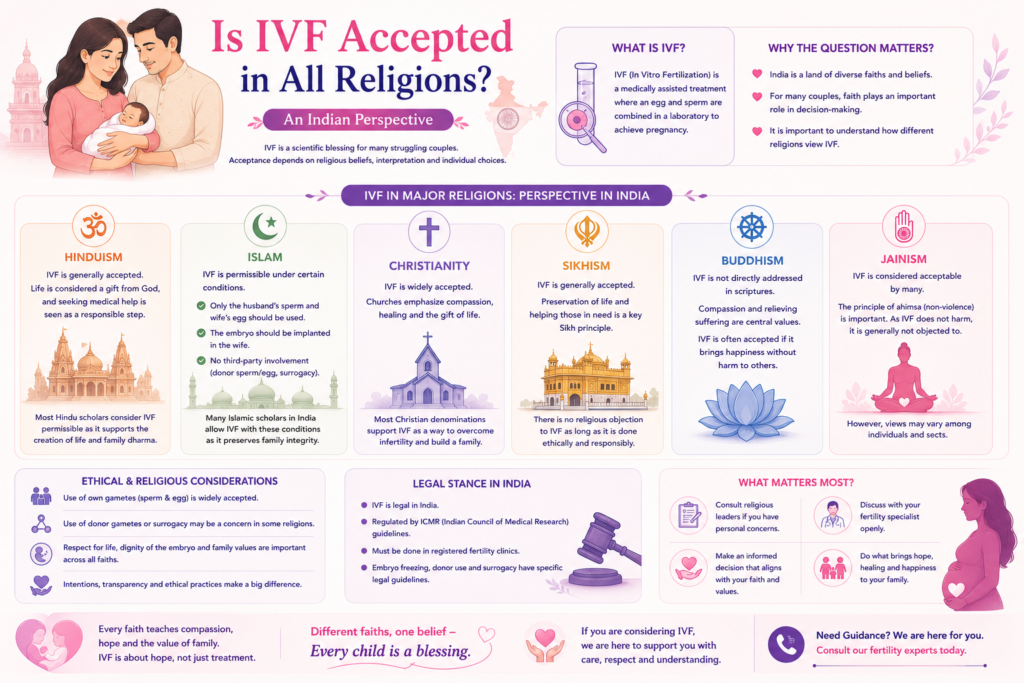
Most major religions — including Islam, Hinduism, Judaism, Sikhism, Buddhism, and most Protestant Christian denominations — generally permit IVF when a married couple uses their own egg and sperm. The Roman Catholic Church is the main exception, opposing IVF. The real divergence between faiths is over donor eggs, donor sperm, and surrogacy: Sunni Islam and Orthodox Christianity generally do not permit third-party involvement, while Hinduism, Buddhism and some other traditions are more permissive. Positions vary between scholars, so couples should consult their own religious leader for personal guidance.
📋 What This Guide Covers
- Is IVF allowed in most religions?
- What do faiths actually disagree about?
- Which religions allow IVF? (comparison table)
- Is IVF halal? What does Islam say?
- Is IVF allowed in Hinduism?
- What does Christianity say about IVF?
- What do Judaism, Sikhism & Buddhism say?
- What does your faith mean for your treatment plan?
- A note from Dr. Shradha, Patna
- FAQs
Is IVF Allowed in Most Religions?
For most couples reading this, the honest answer is yes — with an important condition.
Islam, Hinduism, Judaism, Sikhism, Buddhism, and most Protestant and Anglican Christian denominations generally accept IVF when a married husband and wife use their own egg and sperm. The reasoning is broadly similar across traditions: the desire for a child is a legitimate and often blessed one, and medicine that helps a married couple have their own biological child is treated as healing, not as interference.
The clearest exception among major faiths is the Roman Catholic Church, which opposes IVF on doctrinal grounds. It is worth being straightforward about that rather than glossing over it — but it is also worth knowing that it is the exception, not the rule, and that for the overwhelming majority of couples in Bihar it is not the relevant tradition.
What Do Faiths Actually Disagree About?
Here is the insight that most articles on this subject miss entirely, and it reframes the whole question.
The real dividing line between religions is not IVF. It is third-party involvement. Once you introduce a donor egg, donor sperm, or a surrogate, a third person enters what many faiths regard as the exclusive relationship between husband and wife — and that is where traditions diverge sharply.
So the more useful question is not “does my religion allow IVF?” but “does my religion allow the specific form of IVF I might need?” For most couples, standard IVF using their own egg and sperm is not in dispute at all. It’s worth knowing that before you spend a night worrying.
Which Religions Allow IVF? A Comparison
This table summarises positions that religious authorities and scholars have generally held. Views differ within every tradition, and this is a summary, not a ruling — please treat it as a starting point for a conversation with your own religious leader.
| Faith | IVF (own egg & sperm) | Donor egg / sperm | Surrogacy |
|---|---|---|---|
| Islam (Sunni) | Generally permitted | Generally not permitted | Generally not permitted |
| Islam (Shia) | Generally permitted | Many scholars permit it | Views vary |
| Hinduism | Broadly accepted | Views vary | Among the more permissive |
| Judaism | Generally supported | Orthodox stricter; liberal branches permit | Varies by branch |
| Sikhism | No prohibition; generally accepted | Personal/family decision | No formal doctrine |
| Buddhism | Generally accepted | Generally permissive | Generally permissive |
| Protestant / Anglican | Generally supportive | Varies by denomination | Varies |
| Eastern Orthodox | Cautious, not prohibited | Generally refused | Generally refused |
| Roman Catholic | Opposed | Opposed | Opposed |
Is IVF Halal? What Does Islam Say?
This is the version of the question I am asked most often in Patna, so let me answer it as precisely and respectfully as I can.
IVF is generally considered permissible in Islam when it takes place within a valid marriage and uses the husband’s sperm and the wife’s egg. Scholars have broadly reasoned that seeking treatment for illness is encouraged, that infertility is an affliction rather than a sin, and that helping a married couple conceive their own biological child preserves — rather than violates — the integrity of the marriage and of lineage (nasab).
The firm limit in mainstream Sunni jurisprudence is third-party involvement. Donor sperm, donor eggs, and surrogacy are generally not permitted because they introduce genetic material from outside the marriage and confuse lineage, which Islamic law treats as a serious matter. Many scholars have also held that the treatment should not continue after the marriage ends.
An important nuance: Sunni and Shia scholarship differ on donation
Most articles on this topic treat “Islam” as a single position. In reality, on the specific question of gamete donation, Sunni and Shia jurisprudence diverge. While Sunni scholarship broadly rejects donor gametes, a significant body of Shia scholarship has permitted gamete donation, with some authorities making formal provisions for it. If this question is relevant to your treatment, it genuinely matters which school of thought you follow — and it is worth raising with a scholar you trust rather than relying on a general article, including this one.
Is IVF Allowed in Hinduism?
Hinduism is broadly accepting of IVF, and for reasons that run deep rather than being merely permissive.
Having children and continuing the family line is treated as an important part of dharma — a duty and a natural, blessed aspiration. Because Hinduism is a pluralistic tradition without a single central authority issuing binding rulings, there is no doctrinal prohibition on assisted reproduction. Medicine that helps a couple fulfil the desire for a child is generally seen as compatible with dharma, not opposed to it. Indeed, Hindu scholarship is often described as among the most permissive of the major traditions on assisted reproduction.
Where Hindu opinion varies is, again, on donors — some scholars and families prefer the couple’s own gametes out of concern for lineage (gotra) and inheritance. This tends to be a family and personal decision rather than a religious prohibition.
I’ll add one observation from twenty years of practice. Hindu tradition is full of stories in which children arrive by extraordinary means — sages, boons, unusual conceptions. Whatever one makes of them theologically, they suggest a tradition that has never insisted there is only one acceptable path to a child. If you are Hindu and worried that IVF is somehow against your faith, that fear is, in my experience, far more social than scriptural.
What Does Christianity Say About IVF?
Christianity does not speak with one voice here, and the differences are significant:
- Roman Catholicism opposes IVF. The Church’s position rests on the belief that conception should occur through the marital act, and on concerns about the moral status and destruction of embryos. This is the clearest prohibition among the major world faiths, and Catholic couples are generally encouraged to seek guidance from their priest.
- Protestant and Anglican denominations are generally supportive of IVF for married couples, with individual conscience and denominational guidance shaping views on embryo freezing and donors.
- Eastern Orthodox churches are cautious but stop short of outright prohibition, and generally refuse third-party involvement.
What Do Judaism, Sikhism, and Buddhism Say?
- Judaism is generally supportive of IVF, often understood in light of the obligation to “be fruitful and multiply.” Orthodox authorities tend to be stricter on donor gametes, while more liberal branches are more permissive. Rabbinic guidance is customary.
- Sikhism has no specific doctrinal prohibition on IVF, and it is generally accepted as a legitimate way to help a couple have a child. Decisions on donors are typically personal and familial.
- Buddhism generally accepts IVF, with an emphasis on ethical reflection, intention, and compassion, and is among the more permissive traditions on donation and surrogacy.
What Does Your Faith Mean for Your IVF Treatment Plan?
This is where a doctor, rather than an article, becomes useful — because your beliefs genuinely shape what we recommend, and they should.
- If your faith permits IVF with your own gametes but not donors — which covers most Muslim couples and many others — then our job is to maximise what can be achieved with your own egg and sperm. That often means techniques like ICSI, which can overcome even severe male-factor problems using the husband’s own sperm, and careful attention to egg quality and the uterine environment.
- If donor options are acceptable to you, that opens additional paths where they’re medically indicated.
- If you are unsure, tell us. We would far rather build a plan around your beliefs from day one than discover a boundary halfway through a cycle.
You should never feel you have to choose between your faith and your treatment, and you should never feel embarrassed to raise it. In my clinic, it is a normal part of the first conversation. (If it helps, here’s how to prepare for your first consultation, and what IVF actually involves.)
A Note from Dr. Shradha, Patna
At Shradha IVF & Maternity, treatment plans are built with respect for each family’s beliefs, under the personal care of Dr. Shradha Chakhaiyar, MRCOG (London). The first consultation is free — bring your questions, all of them.
FAQs Related to Is IVF Accepted in All Religion or Not
Generally, yes. Most Islamic scholars permit IVF when it takes place within a valid marriage using the husband's sperm and the wife's egg, reasoning that seeking treatment is encouraged and that lineage is preserved. Third-party donation and surrogacy are the main restrictions. Consult a scholar you trust for personal guidance.
In mainstream Sunni jurisprudence, generally no — donor gametes and surrogacy are typically not permitted, as they introduce genetic material from outside the marriage and affect lineage (nasab). Notably, a significant body of Shia scholarship takes a different view and permits gamete donation. Views differ, so consult your own scholar.
Broadly, yes. Hinduism treats having children as an important part of dharma, and there is no doctrinal prohibition on assisted reproduction — it is often described as among the more permissive traditions. Views on donor gametes vary, usually as a family and lineage consideration rather than a religious ban.
The Roman Catholic Church is the main major faith that opposes IVF, on grounds relating to conception occurring through the marital act and the moral status of embryos. Most other major religions — Islam, Hinduism, Judaism, Sikhism, Buddhism, and most Protestant denominations — generally permit IVF using the couple's own gametes.
In most cases, yes. Standard IVF and ICSI use the couple's own egg and sperm and are permitted by most faiths. ICSI in particular can overcome even severe male-factor infertility using the husband's own sperm — so a restriction on donors very often does not close the door to treatment.
Bring Your Faith With You. It’s Welcome Here.
Dr. Shradha will build a treatment plan that respects your beliefs — and explain honestly what’s possible within them. No judgment, no pressure, and no question is too awkward to ask. The first consultation is free.