

Reviewed by Dr. Shradha Chakhaiyar, MBBS, DGO, MRCOG (London), IVF Specialist & Reproductive Surgeon
Shradha IVF & Maternity, Patna, Bihar · 20+ Years Clinical Experience
📋 Table of Contents
- Perimenopause Is Everywhere — But Something’s Wrong
- What Perimenopause Actually Is (And Isn’t)
- Perimenopause vs Fertility Decline
- Symptoms by Category
- “But My Blood Test Was Normal” — Diagnosis
- What Else Could It Be?
- The Fertility Trap: How a Wrong Label Costs Time
- Can You Still Get Pregnant in Perimenopause?
- Perimenopause in India & When to Get Evaluated
- The Emotional Side No One Talks About
- What You Should Actually Do
- Frequently Asked Questions
Perimenopause Is Everywhere Right Now — But Something Is Wrong
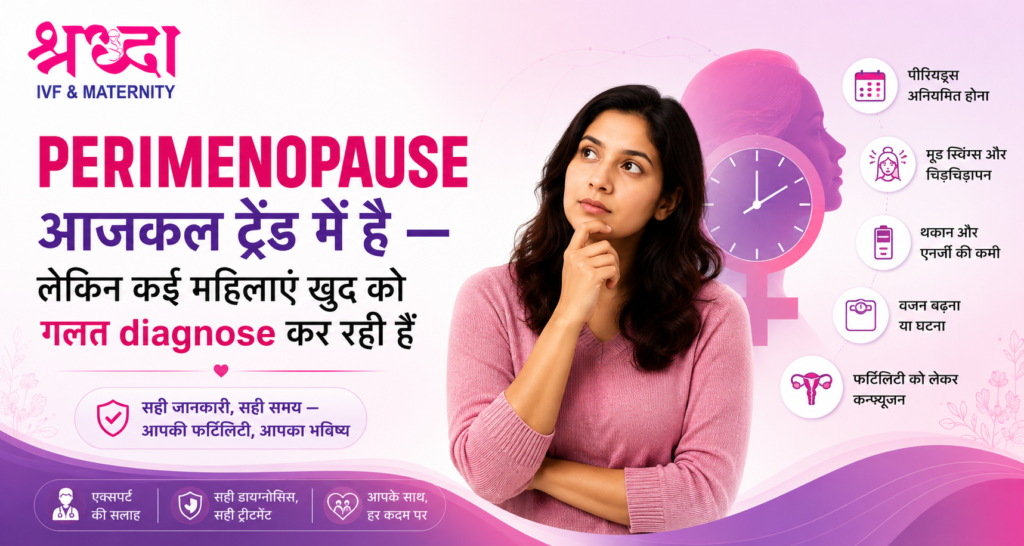
Perimenopause is the natural transition phase before menopause, when hormone levels fluctuate and periods gradually become irregular. It usually begins in the early-to-mid 40s (sometimes the late 30s) and lasts several years until menopause. It is diagnosed mainly from your age and changing menstrual pattern over time — not from a single blood test — because perimenopausal hormones rise and fall unpredictably.
A few years ago, the problem with perimenopause was silence — no one talked about it. Today the problem is the opposite. Women now walk into clinics already convinced they have perimenopause, carrying a self-diagnosis, a supplement list, and a treatment expectation — all shaped by reels, podcasts, and trending health content. The awareness is welcome. The accuracy is not always there.
The data shows the scale of the confusion. In a 2025 national survey of over 1,000 women, nearly 40% felt they had been misdiagnosed when seeking care for perimenopause symptoms. Other research found that only about 52% of women can accurately define perimenopause — even though 71% are experiencing or have experienced it. And as a STAT investigation noted in May 2026, the booming “perimenopause movement” online has become fertile ground for unproven supplements and hormone products sold as one-size-fits-all fixes. Awareness has outrun accuracy — and that gap is where harm happens.
NoSingle blood test can diagnose it
What Perimenopause Actually Is (And What It Is Not)
Perimenopause is a natural transition phase — the years during which the body gradually moves toward menopause (defined as 12 consecutive months with no period). During this time, ovarian hormone production becomes erratic rather than simply “low.”
What it is:
- A transition that typically begins in the early-to-mid 40s (occasionally the late 30s)
- A phase where periods become irregular — shorter, longer, heavier, lighter, or skipped
- A time of fluctuating hormones that can affect mood, sleep, energy, and temperature regulation
- A process that lasts on average around 4 years, but can range from a few months to a decade
What it is not:
- It is not diagnosed by a single test. Because hormones fluctuate, one blood test on one day cannot confirm or rule it out.
- It is not every hormonal symptom you experience. Many symptoms blamed on perimenopause have other, very treatable causes.
- It is not the same as fertility decline — and confusing the two is the single most consequential mistake covered in this guide.
Perimenopause vs Fertility Decline — The Difference That Matters
This is the heart of the confusion, so let’s make it concrete. Perimenopause and fertility decline are related but different processes, on different timelines, measured by different markers, with very different stakes.
| Fertility Decline | Perimenopause | |
|---|---|---|
| What it is | Gradual drop in egg quantity and quality (ovarian reserve) | Hormonal transition phase toward menopause |
| Typical age | Begins gradually after ~30; accelerates after 35 | Usually early-to-mid 40s |
| Main marker | AMH + antral follicle count (egg supply) | Changing cycle pattern over time; fluctuating FSH/estradiol |
| Key symptom | Often none — difficulty conceiving is the main sign | Irregular periods, hot flushes, sleep/mood changes |
| Stakes | Time-sensitive — affects your window to conceive | Inevitable transition — will happen eventually |
| Can overlap? | Yes — a woman in her 40s can have both at once, which is exactly why precise evaluation matters | |
The crucial takeaway: fertility decline starts earlier and is time-sensitive, while perimenopause is a later, inevitable transition. A woman can be experiencing declining ovarian reserve years before any true perimenopause — and if she mislabels that as “perimenopause” and waits, she may lose her most fertile years to the wrong diagnosis.

What are the Symptoms of Perimenopause — by Category
Perimenopause symptoms span several systems, which is part of why they’re so easily confused with other conditions:
- Menstrual: irregular cycles, changes in flow, skipped periods
- Vasomotor: hot flushes, night sweats
- Sleep & mood: insomnia, anxiety, irritability, low mood, “brain fog”
- Physical: fatigue, joint aches, weight changes (especially around the abdomen), palpitations
- Urogenital: vaginal dryness, reduced libido, urinary changes
Notice how many of these overlap with thyroid disease, stress, anaemia, vitamin D deficiency, PCOS, and even early pregnancy. That overlap is precisely why self-diagnosis is so unreliable.
“But My Blood Test Was Normal” — How Perimenopause Is Actually Diagnosed
This is the most misunderstood part of the entire topic, and understanding it will save you a great deal of confusion.
Why a Single Hormone Test Can Mislead
Perimenopause is defined by hormonal fluctuation, not by consistently low hormones — especially in the early stages. That means a blood test drawn on a hormonally “stable” day will often come back completely within the normal range. A normal FSH or estradiol result does not rule out perimenopause, and a single high reading does not confirm it. This is why so many women are told “your hormones are fine” while still clearly in transition — or are wrongly labelled on one misleading reading.
This is why specialists use the STRAW+10 framework — the international standard for staging reproductive ageing. Rather than relying on one blood test, it combines your menstrual cycle pattern over time with hormone trends and symptoms. In other words, the pattern of your cycles across months tells the story far better than a single snapshot.
What AMH, FSH and Estradiol Actually Tell You
- AMH (Anti-Müllerian Hormone) reflects your ovarian reserve — your remaining egg supply. It’s the key fertility marker and is more stable across the cycle, but it cannot predict the exact date of your menopause. A very low AMH (for example, under about 0.5 ng/mL) can be supporting evidence of late-stage transition, and a very low level under 40 can flag primary ovarian insufficiency.
- FSH and estradiol reflect how hard the brain is signalling the ovaries on a given day. They fluctuate significantly in perimenopause, so they’re interpreted as trends, ideally on day 2–3 of the cycle — not as one-off verdicts.
- Thyroid (TSH), prolactin, and a pregnancy test are often checked too, because thyroid disorders, raised prolactin, and pregnancy can all mimic perimenopausal symptoms.
What Else Could It Be? — Conditions Mistaken for Perimenopause
Before accepting “it’s perimenopause,” a proper evaluation rules out the conditions that produce overlapping symptoms — many of which are highly treatable:
| Condition | Overlapping Symptoms |
|---|---|
| Thyroid disorders (hypo/hyper) | Fatigue, weight change, mood changes, irregular periods, hair changes |
| PCOS / PMOS | Irregular periods, weight gain, mood changes, acne (often from the 20s–30s) |
| Chronic stress/cortisol imbalance | Cycle changes, sleep disturbance, anxiety, fatigue |
| Anaemia/vitamin D deficiency | Fatigue, low mood, poor concentration (very common in Indian women) |
| Depression/anxiety disorders | Mood changes, sleep problems, brain fog, low energy |
| Pregnancy | Missed period, nausea, fatigue, mood changes — yes, even in the 40s |
The Fertility Trap: How a Wrong Self-Diagnosis Costs You Time?
Here is where the confusion becomes genuinely costly — and where a fertility specialist’s perspective matters most. When a woman in her early-to-mid 30s decides “I think I’m entering perimenopause,” one of two harmful things usually follows:
- She panics unnecessarily — “I’m running out of time” — and makes rushed, fear-driven decisions based on a condition she likely doesn’t have.
- Or she waits — “it’s just perimenopause, it’s normal, I’ll deal with it later” — while the real, time-sensitive issue goes unchecked.
In both cases, the focus shifts to hormones, supplements, and trend-based treatments — and away from what actually should be evaluated if pregnancy is a goal: ovarian reserve (AMH), ovulation patterns, and partner factors. The danger is simple but serious: a woman can spend her most fertile years managing a label that doesn’t even apply to her, while her actual ovarian reserve quietly declines. Perimenopause will happen eventually, no matter what. Fertility decisions cannot be postponed blindly.
Can You Still Get Pregnant During Perimenopause?
Yes — pregnancy is still possible during perimenopause. Ovulation still occurs during the transition, just unpredictably. This has two important implications, depending on what you want:
- If you are trying to avoid pregnancy: you still need contraception until you have reached menopause (12 months with no period). “Irregular” does not mean “infertile.”
- If you are hoping to conceive: it is possible, but fertility is reduced, and the window is narrower. This is exactly when timely evaluation matters most — options such as IVF, and in some cases donor eggs, can help, and earlier action meaningfully improves outcomes.
Perimenopause in India — Earlier Onset & When to Get Evaluated
One locally important point: Indian women tend to reach menopause earlier than the Western average of around 51 — several Indian studies report average menopause in the mid-to-late 40s, which means perimenopause can begin correspondingly earlier. Combined with the high rates of thyroid disorders, PCOS, anaemia, and vitamin D deficiency among Indian women, this makes proper evaluation (rather than social-media self-diagnosis) especially important here.
A simple guide for when to stop guessing and get evaluated:
- Under 40 with menopausal-type symptoms (hot flushes, missed periods) → see a doctor promptly; this could be primary ovarian insufficiency, which needs proper assessment
- Trying to conceive at any age with cycle changes → don’t wait — get ovarian reserve and ovulation checked
- Persistent symptoms affecting daily life → get evaluated rather than self-treating with supplements
- Any significant change in your cycle pattern → worth a proper check, especially over 40
The Emotional Side No One Talks About
This is where the real impact is happening. Women aren’t just arriving with symptoms anymore — they’re arriving with fear. “Am I losing my chance to become a mother?” “Is it too late for me?” Social media amplifies this anxiety, often deliberately, because fear drives engagement and sales.
But here’s the truth: the body is not failing suddenly. Most of these conditions are manageable. The key is timing and correct diagnosis — not panic, and not denial. Being told clearly what is and isn’t happening in your body is itself a form of care.
What You Should Actually Do — Practical Guidance
Instead of guessing, get clarity. Don’t label every symptom as perimenopause, and don’t rely on social media for a diagnosis. Do this instead:
- If your cycle has changed → get evaluated rather than assuming
- If you’re planning pregnancy → don’t delay; check ovarian reserve and ovulation
- If symptoms persist → seek proper medical advice before starting any hormone or supplement regimen
- Ask for the right work-up → cycle history over time, plus thyroid, AMH, and other markers as indicated — not one isolated test
How Shradha IVF Helps You Get Clarity in Patna
At Shradha IVF & Maternity, getting clarity starts with a proper evaluation rather than a guess: a careful cycle and symptom history, and the right tests — ovarian reserve / AMH, thyroid, and hormone trends — interpreted in context. From there, whether the answer is reassurance, treatment for a missed condition, or a time-sensitive fertility plan, you’ll know where you actually stand. Led personally by Dr. Shradha Chakhaiyar, MRCOG (London).
FAQs Related to Perimenopause
One of the earliest signs of perimenopause is a change in menstrual cycle patterns. Periods may become shorter or longer, heavier or lighter, or arrive earlier or later than usual. These changes happen because estrogen and progesterone levels start fluctuating. Some women may also notice mood changes, sleep disturbances, or occasional hot flashes during the early stage.
Perimenopause and menopause are commonly described in four stages:
- Early Perimenopause – Hormone levels begin fluctuating and menstrual cycles may become slightly irregular. Symptoms are often mild.
- Late Perimenopause – Periods become increasingly unpredictable, and symptoms such as hot flashes, night sweats, sleep problems, and mood changes may become more noticeable.
- Menopause – Menopause is officially reached after going 12 consecutive months without a menstrual period.
- Postmenopause – The stage after menopause, when periods stop permanently and symptoms may gradually reduce, although some women continue experiencing certain effects.
Common signs of perimenopause include:
Irregular menstrual cycles
Hot flashes
Night sweats
Mood swings or irritability
Sleep disturbances or insomnia
Vaginal dryness
Reduced libido or changes in sexual desire
Some women may also experience headaches, brain fog, weight changes, fatigue, or difficulty concentrating.
Most women begin perimenopause between 40 and 45 years of age, but it can start earlier or later. Some women may notice symptoms in their mid-to-late 30s, while others may not experience changes until their late 40s. The transition can last anywhere from a few years to around ten years before menopause occurs.
Don’t Guess it Perimenopause. Get Clarity.
If you’re confused about your symptoms or your fertility timeline, the answer isn’t a trending label or a supplement — it’s the right evaluation. Consult Dr. Shradha Chakhaiyar at Shradha IVF & Maternity, Patna, and find out what’s actually happening in your body.