


Medically Reviewed by Dr. Shradha Chakhaiyar, MBBS, MRCOG (London) — Fertility Specialist & Reproductive Surgeon, Shradha IVF & Maternity, Patna
20+ Years of Experience · www.shradhaivf.com
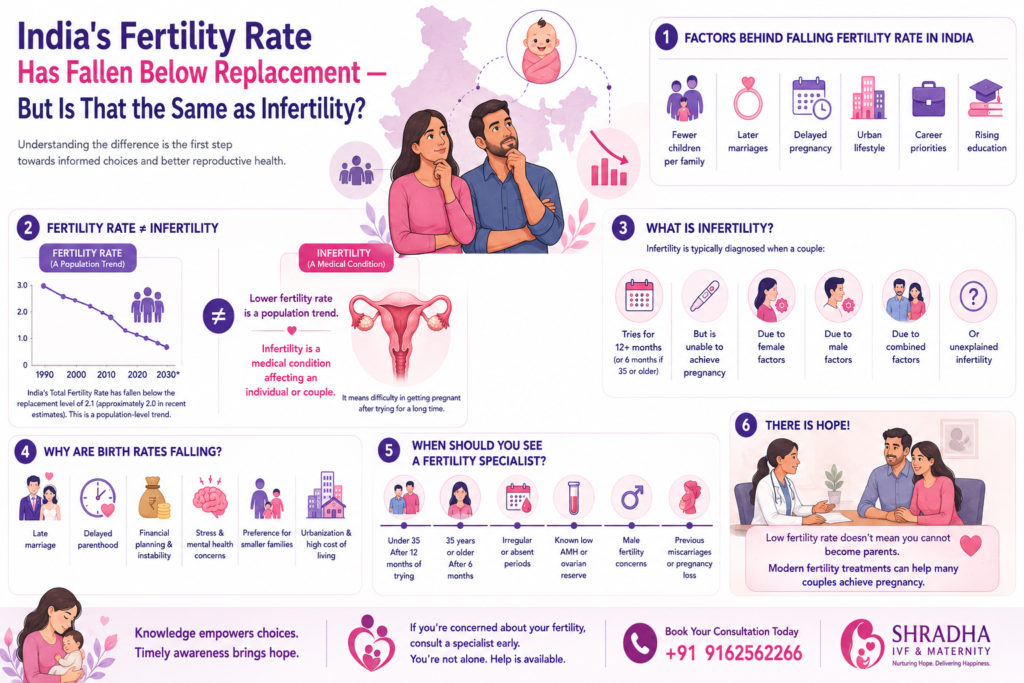
India’s total fertility rate has dropped to 1.9 children per woman, below the replacement level of 2.1 — but that is not the same as rising infertility. Fertility rate is a population-wide average of how many children are being born, driven largely by choice, education, and delayed marriage. Infertility is a clinical measure of couples who want children but can’t conceive — estimated separately at 15–20% of Indian couples (around 27.5–30 million people). Both trends are real, they measure different things, and delayed childbearing quietly links them.
📋 What This Article Covers
What Did Elon Musk’s Tweet Actually Say?
In June 2026, Elon Musk shared data showing India’s total fertility rate had fallen below replacement level for the first time in the country’s history — declining from around 2.3 to 1.9 in roughly a decade — and noted that among India’s most educated groups, this had already been true for years. He was pointing to a data source rather than presenting his own research. The figures trace back to the United Nations Population Fund’s State of World Population Report 2025, which put India’s TFR at 1.9 against the replacement threshold of 2.1, with Delhi specifically down to about 1.2 — lower than several developed countries.
This isn’t a fringe claim or a sudden shock. It reflects a demographic shift that population researchers have tracked for over a decade, especially in urban and southern India. What made it feel new was simply the size of the audience it suddenly reached.
What’s the Difference Between Fertility Rate and Infertility?
This is where most of the coverage got muddled — and where the real story for couples actually sits. They sound similar, but they measure completely different things:
| Total Fertility Rate (TFR) | Infertility | |
|---|---|---|
| What it measures | The average number of children a woman would have in her lifetime at current birth patterns | The share of couples who try to conceive and can’t (usually after 12 months of trying) |
| What drives it | Choice — delayed marriage, education, urban life, economics, family planning | Biology — medical and physical factors preventing conception |
| Voluntary or not | Largely voluntary at the population level | Involuntary — a problem couples don’t choose |
| The number | 1.9 (below 2.1 replacement) | 15–20% of couples affected |
In short: a falling TFR mostly reflects people choosing to have fewer children, later. Infertility is a separate, involuntary, and growing clinical problem. Both are happening in India at once — and some of the drop in TFR is deliberate family planning, while some of it is couples who genuinely want children and are struggling to have them.
What Are the Real Infertility Numbers in India?
While the tweet was about birth rate, the infertility side of the story has its own hard data — and it’s substantial:
- An estimated 15–20% of Indian couples — close to 27.5–30 million people — currently deal with infertility.
- Urban infertility runs as high as 15–20%, compared with roughly 8–10% in rural areas.
- Male factors now account for 40–50% of infertility cases — a rise linked to declining sperm quality from stress and environmental exposure. (More in our guide on male infertility and on stress and sperm quality.)
- Female factors account for a roughly equal share — driven largely by PCOS, endometriosis, and age-related decline.
- Secondary infertility — difficulty conceiving again after a first child — rose from 19.5% (1992–93) to 28.6% (2015–16) in national survey data, concentrated in the southern states where TFR fell fastest. (See our guide on secondary infertility.)
- India carries a substantial share of the world’s overall infertility burden.
Why Are the Two Trends Connected, Not Separate?
The link between a falling birth rate and rising infertility isn’t a coincidence — the same forces drive both. Delayed marriage, delayed first pregnancy, urban lifestyles, and work stress push the national TFR down and push individual infertility up. A woman who has her first child at 32 instead of 24 is contributing to a lower national birth rate by choice — but she’s also statistically more likely to face age-related fertility decline if she wants a second child, or if conception simply takes longer than she expected.
This is exactly why the conversation the tweet triggered matters for real patients, not just economists. India’s declining birth rate isn’t only a workforce-and-pension story. For a meaningful share of couples, it’s also a fertility problem they didn’t choose — hidden inside a statistic that gets discussed as though it were purely about choice.
Where Does Bihar Fit — the Highest-Fertility State?
Here’s a detail that rarely makes the headlines but matters a great deal where we practise. While India’s national TFR has fallen to 1.9 and Delhi’s to around 1.2, Bihar has the highest fertility rate in the country — close to 3. From inside Bihar, “India’s population is about to fall” can feel like a story about somewhere else.
But the infertility picture doesn’t spare high-birth-rate states — and this is the point I most want couples here to understand. A state can have plenty of babies being born overall and have individual couples who are struggling to conceive. A high state-wide TFR says nothing about whether you, personally, will conceive easily. Infertility is a couple-level reality, not a state-level average — and it deserves the same attention in Patna as it gets in Bangalore or Delhi.
What Does This Mean in Our Clinic in Patna?
Numbers like these match what we see in the clinic in Patna, every week, and they’ve genuinely shaped how we approach a first consultation.
We stopped treating infertility evaluation as “start with the woman” a long time ago. If male factors account for close to half of all cases, a semen analysis should happen in week one, not after a wife has already been through three cycles of unexplained testing. We ask both partners to come to the first visit together for exactly this reason. It saves time and money, and it quietly removes the unfair assumption that the problem must sit with one person. (If you’re preparing for a first visit, our guide on how to prepare for your first IVF consultation may help.)
We also don’t treat a couple’s chart as only a fertility problem. Stress, sleep, weight, and thyroid function show up in our workups constantly, and they’re rarely addressed before a couple is pushed toward IVF. Age is the one factor none of us can change, so we’re honest about it early rather than letting six more months slip by on hope alone.
And the data on rising secondary infertility matches something we see often in Bihar specifically: couples who conceived the first time easily and assumed a second child would follow the same way, only to find that two or three years, a job change, or a delayed decision quietly changed the picture. Our advice for anyone planning a second child is the same as for a first: if a year has passed without success, get evaluated together before assuming more time will fix it.
FAQs Related to India Fertility Rate
Yes. India's total fertility rate stood at 1.9 in the UNFPA data cited in June 2026, below the replacement level of 2.1 needed to keep the population stable across generations. Urban areas are lower still, while some states, including Bihar, remain well above replacement.
Not directly. A falling fertility rate mostly reflects choice and delayed childbearing, while infertility is a separate clinical measure of couples unable to conceive despite trying. However, delayed childbearing — a key driver of the falling rate — is also a leading cause of age-related infertility, so the two trends overlap.
Estimates place it at 15–20% of couples — roughly 27.5 to 30 million people nationally — with urban rates (around 15–20%) running higher than rural rates (around 8–10%). It affects both first pregnancies and couples trying to conceive again.
Fertility rate (TFR) is a population average of how many children are being born, driven largely by choice and lifestyle. Infertility is the share of couples who want children but can't conceive, driven by biology. One is largely voluntary; the other is not.
Yes. Male factors now contribute to an estimated 40–50% of infertility cases in India — a rise linked to declining sperm quality, lifestyle stress, and environmental exposure. This is why both partners should be evaluated together, and a semen analysis done early.
Bihar has the highest total fertility rate in India, at close to 3 children per woman — well above the national average of 1.9 and far above Delhi's roughly 1.2. A high state birth rate, however, doesn't mean individual couples there don't face infertility.
Indian fertility rate is declining mainly because of choice and changing circumstances: later marriage, higher education, urban living, economic pressure, and family planning. These lead many couples to have fewer children, later. Some of the decline, though, also reflects couples who want children but are struggling to conceive.
Wondering Why Indian Fertility Rate is Declining?
If you’ve been trying to conceive without success — a first child or a second — the most useful step is a proper evaluation of both partners together. Dr. Shradha will look at the whole picture honestly, right here in Patna. The first consultation is free.