
If you have ever wondered, “Are IVF babies different from normal babies?” — you are not alone. This is one of the most common questions asked by couples considering fertility treatment, and by families and friends trying to understand what IVF actually means for a child.
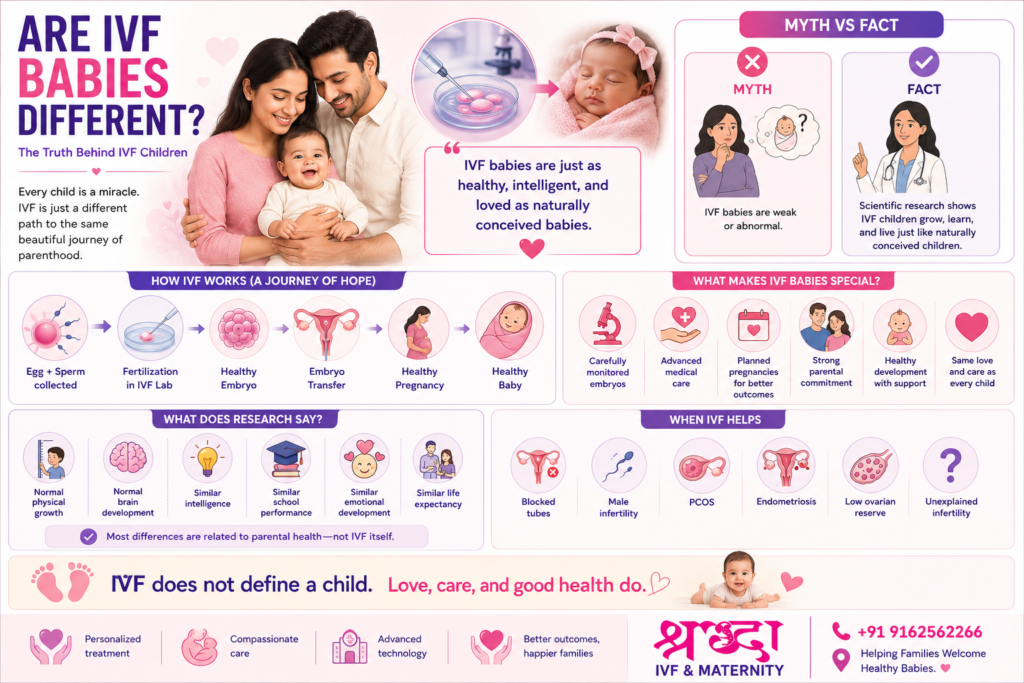
The short answer is: No, IVF babies are not medically different from naturally conceived babies. Once the embryo is transferred to the mother’s womb, the pregnancy follows the same natural process as any other. The baby grows in the same way, develops the same way, and is born the same way.
What makes IVF babies feel deeply special is not their biology — it is the incredible journey of love, patience, and modern science that brought them into the world. In this guide, we will look at what research tells us about IVF baby health and development, bust the most common myths, and explain why every IVF baby’s story is worth celebrating.
Are IVF Babies Medically the Same as Normal Babies?
From a medical and scientific standpoint, IVF babies are just as healthy and normal as babies conceived naturally. The only difference between IVF and natural conception is where fertilisation takes place — in a laboratory instead of the fallopian tube. After the embryo is transferred to the uterus, everything else is identical: the same nine months of development, the same birth process, and the same child at the end.
Decades of global research support this conclusion. A 2024 large-scale review by the European Society of Human Reproduction and Embryology (ESHRE), which analysed data from over 1.4 million children worldwide, found no significant difference in physical health, cognitive development, or long-term outcomes between IVF-conceived and naturally conceived children. Closer to home, a 2023 study published in the Indian Journal of Medical Research followed 1,200 IVF-born children aged 5 to 18 years across Bangalore and Delhi. When compared with 1,200 naturally conceived children from similar backgrounds, no meaningful difference was found in any area — including motor skills, behaviour, emotional health, or intelligence.
The IVF baby vs normal baby debate, in purely medical terms, has a clear answer: there is no difference in the child. IVF is simply a method of assisted conception — it does not alter the genetic makeup or biological development of the baby in any way.
Are IVF Babies Healthy? What the Research Shows
A common concern parents have is whether IVF babies are as healthy as other children. The overwhelming evidence says yes. Studies have consistently shown that IVF children reach the same developmental milestones — walking, talking, reading, socialising — as their peers. There is no evidence linking IVF to lower intelligence, autism, or behavioural problems. A 2022 study in JAMA Pediatrics that followed over 300,000 children in Sweden found no direct connection between IVF and autism; any minor statistical differences disappeared once researchers accounted for parental age and underlying infertility causes.
It is true that some studies have noted a very slightly higher chance of premature birth or low birth weight in IVF pregnancies. However, modern IVF practice has dramatically reduced these risks. The shift to single embryo transfer (SET) — which is now the standard at responsible clinics including Shradha IVF — has eliminated the risks associated with twin and triplet pregnancies, which were the main source of earlier concerns. Additionally, pre-implantation genetic testing (PGT) allows doctors to screen embryos for known inherited conditions before transfer, giving families an extra layer of assurance.
In short, a healthy IVF pregnancy, managed well by an experienced fertility specialist, produces outcomes that are comparable in every meaningful way to a natural pregnancy.
What is ICSI and How Does It Affect the Baby?
In some IVF cycles, a more advanced technique called ICSI (Intracytoplasmic Sperm Injection) is used. This is particularly recommended in cases of male infertility, where sperm count or quality may be low. In an ICSI procedure, a single carefully selected sperm is injected directly into an egg under a microscope, bypassing the fertilisation barrier.
Many parents who go through ICSI find it remarkable — knowing that the healthiest available sperm was selected to create their embryo. However, it is important to understand that ICSI does not make the resulting baby genetically superior, nor does it create any medical difference in the child. Babies born through ICSI IVF develop in the same way as those conceived naturally or through standard IVF. The technique only improves the chances of successful fertilisation — what follows is entirely natural.
Why IVF Babies Feel So Special? (The Emotional Truth)
While science tells us IVF babies are medically no different, there is something undeniably extraordinary about their story. For many couples in India, the path to parenthood through IVF involves years of trying, multiple cycles of treatment, emotional highs and lows, and a level of hope and perseverance that most people never face. When a baby finally arrives after all of this, they are not just a child — they are the living proof of that entire journey.
Parents who have gone through IVF often describe an unusually deep emotional bond with their child. They have imagined this baby for years. They have prayed, hoped, and fought for this child before conception even happened. The baby is loved before they exist. That emotional foundation — built through the IVF journey itself — becomes part of how these children are raised and cherished throughout their lives.
This is the real reason so many people say IVF babies are special. Not because their biology is different, but because the love behind them is immeasurable.
Also, read: C-section vs normal delivery: Are All IVF Babies Born by C-Section (Operation)?
What are the Common Myths About IVF Babies? — Busted
Myth 1: IVF babies are weak or have poor immunity
Fact: There is no evidence that IVF babies are physically weaker. They grow, play, and thrive just like any other child. The World Health Organisation does not classify IVF children as having any inherent physical or mental deficiency.
Myth 2: IVF always results in twins or triplets
Fact: Multiple births used to be more common when doctors transferred several embryos at once. Today, single embryo transfer (SET) is the preferred practice. A responsible IVF centre will guide you on the safest approach for your situation.
Myth 3: An IVF baby is not “your own” child
Fact: In standard IVF, the baby is created from the couple’s own egg and sperm. The genetic material is entirely yours. Even in cases involving donor eggs or sperm, the child is legally, emotionally, and in every practical sense, your own.
Myth 4: IVF is only for the wealthy
Fact: IVF is becoming increasingly accessible. At Shradha IVF in Patna, affordable treatment plans and flexible payment options are available so that more families can access quality care.
The Bottom Line on IVF Babies
The answer to the question “are IVF babies different from normal babies” is clear: medically, they are not different at all. They are healthy, normal children who grow up to lead full, happy lives — just like anyone else. Louise Brown, the world’s first IVF baby born in 1978, has two naturally conceived children of her own today. Kanupriya Agarwal, India’s first IVF baby, also lives a healthy and fulfilling life.
What sets IVF children apart is not their biology. It is the extraordinary love and determination of the families who fought to bring them into the world. If you are on this journey, know that you are not alone — and that the path to parenthood through IVF is backed by over 45 years of science, millions of healthy births, and the dedicated support of fertility specialists who care deeply about your family.
If you are considering IVF or have questions about fertility treatment, the team at Shradha IVF & Maternity in Patna is here to guide you with personalised care, honest answers, and the latest technology.
FAQs on "Are IVF babies different?"
Are IVF babies different from normal babies?
No, IVF babies are not medically different from naturally conceived babies. They grow, develop, and behave the same way. The only difference is how fertilisation occurred — in a lab rather than the fallopian tube — but the pregnancy and child development that follow are identical.
Are IVF babies as healthy as naturally conceived babies?
Yes. Decades of research, including large-scale studies by ESHRE and the Indian Journal of Medical Research, confirm that IVF babies show no meaningful difference in physical health, cognitive ability, or emotional development compared to naturally conceived children.
Is an ICSI IVF baby different from a normal baby?
No. ICSI is a technique that helps fertilisation happen when sperm quality is low. It does not change the genetic makeup of the baby or affect development. Babies born through ICSI grow and develop exactly like naturally conceived children
Why do people say IVF babies are special?
IVF babies are considered special because of the emotional journey behind them. They are typically the result of years of hope, treatment, and perseverance by their parents, which creates a deep bond even before the baby is born.