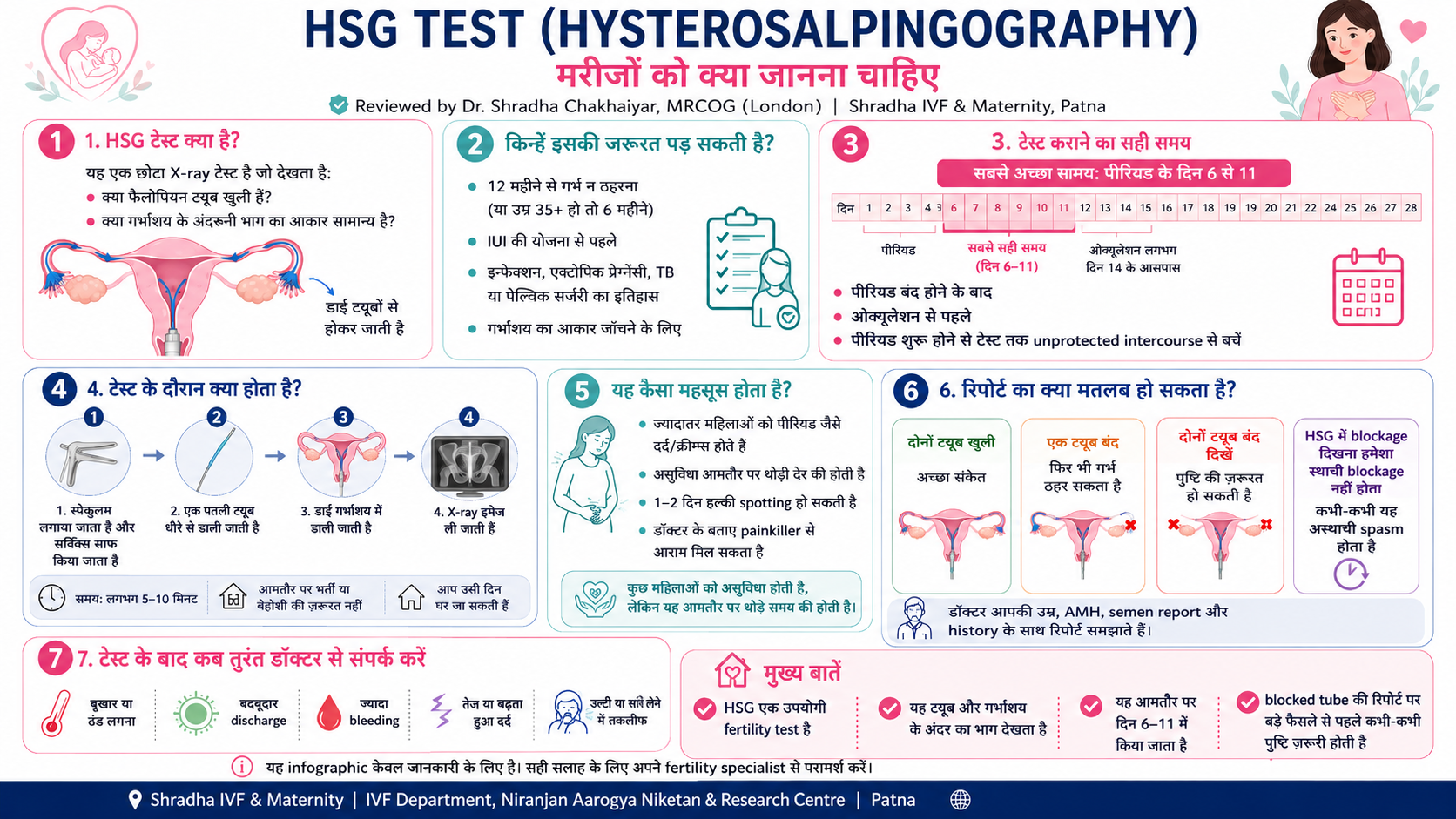
If your doctor has recommended an HSG test, you probably have two worries and one quiet hope. The worries: will it hurt, and what exactly are they going to do? The hope, whispered from a cousin or a forum: “I heard some women get pregnant right after it.” Let me answer all three honestly. The HSG is one of the most useful tests we have for finding out why conception isn’t happening — and once you know what to expect, it’s far less frightening than the internet makes it sound.
🎯 Quick Answer
An HSG (hysterosalpingography) is an X-ray test that checks whether your fallopian tubes are open and your uterus is normally shaped, using a dye passed gently through the cervix. It’s done in the first half of your cycle (usually days 6–12), takes about 10–15 minutes, and typically causes short-lived, period-like cramping — discomfort that can be reduced considerably by taking a pain reliever about an hour beforehand. It’s very safe and does not cause miscarriage. As a welcome bonus, a normal HSG is linked to a small, temporary rise in natural conception in the following few months — the “tubal flushing” effect.
HSG stands for hysterosalpingography — a long word for a fairly simple idea. Break the word apart, and it explains itself:hystero= uterus,salpingo= fallopian tubes,graphy= picture. It is an X-ray test that lets us see two things clearly: whether your fallopian tubes are open, and whether the shape of your uterine cavity is normal.
Here’s how it works. A thin, soft tube (a catheter) is passed gently through your cervix, and a special dye (contrast) is slowly injected. On the X-ray, that dye lights up the inside of your uterus and then travels along the fallopian tubes. If a tube is open, the dye spills out of its far end near the ovary. If a tube is blocked, the dye stops. It’s an elegant way to answer a crucial question — can sperm and egg actually meet? — without any surgery at all.
The test answers two specific questions:
Is the inside of the uterus normal in shape and free of growths or adhesions?
Are both fallopian tubes open, and does the dye spill freely out of their far ends into the abdomen?
It matters because blocked fallopian tubes are one of the most common reasons a woman cannot conceive. If the tubes are blocked, the sperm and egg can’t meet naturally, no matter how perfect everything else is. Our guide on blocked fallopian tubes explains that condition in detail.
Why Has My Doctor Recommended an HSG Test?
An HSG is usually suggested when you’ve been trying to conceive without success and we’re systematically looking for the reason. Specifically, it’s recommended to:
Check whether your fallopian tubes are open or blocked — the main purpose.
Look at the shape of your uterine cavity for anything that could interfere with implantation — a septum, polyps, fibroids distorting the cavity, or scar tissue.
Investigate after a history of pelvic infection, previous ectopic pregnancy, miscarriage, or pelvic surgery.
Plan the right treatment — because the result often decides the path. Open tubes may mean IUI is an option; blocked tubes usually point toward IVF, which bypasses the tubes entirely.
It’s typically one of the early tests in a fertility workup, alongside hormone blood tests, an AMH test for egg count, and a semen analysis for your partner. Our guide on preparing for your first consultation lays out the whole sequence.
Why the fallopian tubes matter so much
Many couples are surprised to learn that fertilisation does not happen inside the uterus. The egg released from the ovary is picked up by the outer end of the tube, and it is inside the tube that the sperm meets the egg. The early embryo then travels down the tube and reaches the uterus about five days later.
So the tube is not a passive pipe — it is the meeting hall, and also the road. If that road is blocked, the egg and sperm cannot meet, no matter how healthy both partners are. This is why tubal disease is one of the leading causes of female infertility, reported in roughly one-third of infertile women — and it is even more relevant in our part of the country, where past pelvic infection and genital tuberculosis are common.
When does a doctor advise an HSG?
Inability to conceive after 12 months of trying (or 6 months if the woman is 35 or older)
Before planning IUI — because IUI only works if at least one tube is open
A history suggesting tubal damage: pelvic inflammatory disease, tuberculosis, ruptured appendix, previous pelvic surgery, ectopic pregnancy, or an abortion followed by infection
Recurrent miscarriage, where the shape of the uterine cavity needs checking
Suspected intrauterine adhesions — for example, scanty periods after a D&C
To confirm tubes are closed after a tubal ligation, or open after a recanalisation surgery
A note on judgement: HSG is not compulsory for every couple. If IVF is already clearly indicated — severe male-factor infertility, or tubes already known to be damaged — an HSG may add cost and discomfort without changing the plan. A good fertility specialist orders the test that will change the decision, not every test that exists.
Is the HSG Test Painful? Should You Worry?
Let me answer the question you actually came here for, and answer it truthfully — because you deserve honesty, not a breezy “it’s nothing.”
An HSG usually causes cramping — similar to strong period cramps — for a few minutes, mainly when the dye is being injected. Most women find it uncomfortable rather than severe, and describe it as pressure, pulling, or period-like cramps. It’s typically brief: the genuinely crampy part often lasts only seconds to a few minutes, and eases quickly once the test is done. Many women drive themselves home and return to their day.
I won’t pretend it’s the same for everyone, though. A smaller number of women feel sharper pain, and this is more likely if a tube is actually blocked, because the dye meets resistance. If that’s you, it isn’t that you’re “bad at pain” — it’s information, and your doctor will recognise it as such.
The single most important thing to know is that the discomfort is very manageable with a little preparation — which is exactly what the next section is about. Fear of the unknown makes the pain loom far larger in the imagination than it turns out to be in reality.
How to Make the HSG Much Easier
These simple, evidence-backed steps genuinely reduce the discomfort, and I recommend all of them to my own patients:
Take a pain reliever beforehand. An over-the-counter anti-inflammatory, taken about an hour before the test (as your doctor advises), significantly reduces the cramping. This is the single most effective thing you can do — don’t skip it.
Choose the right timing in your cycle. Done at the correct point (days 6–12), the test is more comfortable and clearer.
Go to experienced hands. An HSG performed calmly by someone who does many of them, with a gentle technique, is a very different experience from a rushed one. This matters more than any tablet.
Breathe and relax your body. Tensing the pelvic muscles makes everything harder. Slow breathing genuinely helps — and a good team will talk you through each step so nothing is a surprise.
Bring someone if you’d like. Most women are fine to go home alone, but if it eases your mind to have someone with you, do bring them.
What Happens on the Day, Step by Step
Fear of the unknown is bigger than the test. So here is exactly what happens, start to finish:
1
A quick pregnancy check. Because the test isn’t done in pregnancy, you’ll usually confirm you’re not pregnant first — often the reason it’s scheduled early in your cycle.
2
You lie down as for a normal pelvic exam. On an X-ray table, comfortably positioned.
3
A speculum is placed and the cervix gently cleaned. Just like a routine gynae examination.
4
A thin catheter is passed through the cervix. You may feel a little pressure here.
5
The dye is slowly injected. This is the crampy moment for most women — a minute or two of period-like cramping as the dye fills the uterus and enters the tubes.
6
X-ray images are taken as the dye moves, showing whether the tubes are open and the cavity is normal.
7
The catheter is removed and you’re done. The whole thing usually takes 10–15 minutes. You may have some spotting and a little dye leakage afterwards — a sanitary pad is handy — and any cramping settles within a day.
When in the Menstrual Cycle Is the HSG Test Done?
An HSG is scheduled in the first half of your menstrual cycle — usually between days 6 and 12, after your period has finished but before you ovulate. There are two good reasons for this window: it makes sure you aren’t unknowingly pregnant when the test is done, and the uterine lining is thin at this point, giving a clearer picture. You’ll usually be asked to avoid intercourse from the start of that cycle until the test, as an extra safeguard against an early pregnancy.
Understanding Your HSG Test Results
Most of the time you’ll get a good sense of the result quite quickly. Here’s what the main findings mean:
Result
What it means
Likely next step
Both tubes open, normal cavity
Reassuring — the tubes aren’t the problem
Look elsewhere; timed intercourse or IUI may be options
One honest caveat: an HSG occasionally suggests a blockage that turns out to be a temporary tubal spasm rather than a true blockage — which is one reason a doctor may sometimes recommend a laparoscopy to confirm an unclear result. A result is read alongside your whole picture, not in isolation.
Can an HSG Help You Get Pregnant? The “Tubal Flushing” Effect
Now the hopeful part — and I’ll give it to you honestly, because false promises help no one.
There is a real, documented phenomenon: some women are a little more likely to conceive naturally in the few months after a normal HSG. The idea is that pushing the dye through the tubes may flush out minor debris or mucus and gently clear the pathway — which is why it’s nicknamed “tubal flushing.” Fertility bodies acknowledge a slight increase in conception lasting roughly three months after a normal HSG, and the effect appears somewhat stronger when an oil-based dye is used rather than a water-based one.
The honest framing matters, though: this is a modest and somewhat debated bonus, not a treatment. An HSG is done to diagnose, not to cure — and no one should undergo it purely hoping for the flushing effect. But if your test comes back normal, it’s a genuine, evidence-based reason for a little extra optimism in the months that follow. Think of it as a welcome side benefit, not the main event.
The Genital TB Connection (Important in India)
Here’s something the international pages won’t tell you, and it matters a great deal here. In India, genital tuberculosis is one of the leading causes of tubal blockage and tubal-factor infertility — often silently, in women with no obvious history of TB. An HSG can sometimes show a characteristic appearance suggestive of tubal TB, such as a “beaded” or irregular tube.
This is precisely why context and experience matter when reading an HSG in our population. A blocked or abnormal-looking tube in Bihar carries a different set of likely causes than the same finding would in London, and genital TB should always be considered. If it’s suspected, further specific testing follows — and treating the underlying TB is part of restoring the best possible fertility.
HSG vs Hysteroscopy vs Laparoscopy
These three tests get confused constantly, so here’s the clean distinction — they look at different things:
The tubes & pelvis from outside; the fullest tubal view
Keyhole surgery under anaesthesia; most definitive
In short: HSG is the first-line, no-surgery tubal test; hysteroscopy inspects (and can fix) the cavity from within; laparoscopy is the more definitive keyhole assessment used when a clearer answer is needed. They’re partners, not rivals — each answers a different question.
Is HSG Test Safe? Side Effects & Risks
An HSG is considered a very safe procedure. Normal, expected after-effects include mild cramping, light spotting for a day or two, and some sticky dye leakage (bring a sanitary pad). The genuinely uncommon risks are a small chance of pelvic infection (which is why a doctor may prescribe an antibiotic if you’ve had past infections), fainting, and a rare allergy to the iodine dye — so do mention any allergy to iodine or contrast dye beforehand.
And to lay one specific fear to rest: an HSG does not cause miscarriage. The pregnancy check beforehand isn’t because the test would harm an existing pregnancy risk you into losing a wanted one — it’s simply that we never image an unknown pregnancy with contrast and X-ray as a matter of caution. Done at the right time in your cycle, that situation doesn’t arise.
Important: a “blocked tube” on HSG is not always a blocked tube
This is the single most important point in this article, and the one we spend the most time explaining in consultation.
When HSG is compared with laparoscopy and dye test — the reference standard — a widely cited meta-analysis found the sensitivity of HSG to be about 65% and its specificity about 85%. In practical language: if HSG says the tubes are open, that is usually reliable. If HSG says a tube is blocked, that finding is right much less often than people assume.
The problem is concentrated at the cornual end, where the tube enters the uterine muscle. Roughly one in five apparent blocks there is nothing more than a temporary spasm of that muscle, and a further substantial proportion is soft mucus or debris that clears on its own. The tube itself is perfectly normal.
What this means for you: a bilateral cornual block on a first HSG should not, by itself, be the reason a couple is told they need IVF. Depending on the situation, the sensible next steps are a repeat study with an antispasmodic, a hysteroscopy with selective tubal cannulation, or a laparoscopy with dye test — which can confirm and often treat in the same sitting.
What an HSG cannot tell you
It cannot detect endometriosis
It cannot reliably show adhesions on the outside of the tubes and ovaries
It says nothing about egg reserve (AMH), ovulation, or sperm quality
It shows that a tube is open, but not that it is functioning
A normal HSG is good news. It is not, by itself, a certificate of fertility.
Can the HSG itself help you conceive?
Doctors have noticed since the 1950s that some women conceive in the months right after an HSG. This is not a village belief — it has been studied properly.
A Cochrane systematic review found higher pregnancy rates in the six months after tubal flushing with oil-based contrast compared with water-based contrast, and a substantially higher rate compared with no flushing at all.
The landmark H2Oil randomised trial in 1,119 women with unexplained infertility found ongoing pregnancy in 39.7% after oil-based contrast versus 29.1% after water-based contrast within six months. At five years, live birth rates were 74.8% versus 67.3%.
A large follow-up cohort of 2,160 women reported that about 45% conceived naturally within two years of their HSG.
The balanced view: the more recent H2Oil2 trial, reported in 2025, studied women who were 39 or older, or had ovulation disorders, or were at high risk of tubal disease — and did not find a significant advantage for oil-based contrast. The flushing benefit therefore appears to be real but limited, seen mainly in younger women with unexplained infertility and healthy-looking tubes.
The honest summary: HSG is a diagnostic test that sometimes comes with a bonus. It is not an infertility treatment, and it should never be sold as one.
HSG and genital tuberculosis: a reality we cannot ignore in Bihar
Genital tuberculosis is one reason tubal infertility is more common in our region than Western data suggests. It is reported across a wide range in infertile women in low- and middle-income countries, and Indian studies from tubal-factor clinics have reported particularly high figures. Most women have never had chest symptoms and are shocked by the diagnosis.
Certain HSG appearances give the first clue: rigid or beaded tubes, calcified shadows, a small or distorted cavity, irregular adhesions. None of these confirm the diagnosis — confirmation needs endometrial sampling for GeneXpert, PCR, culture or histopathology, sometimes with laparoscopy.
Why this matters: diagnosing and treating genital TB early can prevent further damage. But damage already done to the tubes is usually permanent — and in exactly that situation, IVF works by bypassing the tube altogether. There is no shame in this diagnosis; it is an infection, not a fault.
HSG टेस्ट — मरीजों को क्या जानना चाहिए (हिंदी में सारांश)
A Note from Dr. Shradha, Patna
🇮🇳 Dr. Shradha Chakhaiyar, MRCOG (London)“I’ve lost count of the women who arrive for an HSG pale with dread, having read frightening things online, and who leave twenty minutes later slightly amazed that it’s over and that it wasn’t what they feared. My promise to my patients is simple: I’ll tell you honestly that there may be a minute or two of cramping, I’ll make sure you’re prepared so it’s as easy as possible, and I’ll talk you through every step so nothing takes you by surprise. This little test tells us something we genuinely need to know — and sometimes, when the result is normal, it even gives nature a small nudge in the months after. Don’t let fear of it delay the answers you deserve.”
If an HSG has been advised, or you have a report you do not fully understand, bring it to us. A twenty-minute conversation with a specialist often replaces months of uncertainty.
Shradha IVF & Maternity (IVF Department, Niranjan Aarogya Niketan & Research Centre) Behind Devarun Apartment, Bhikna Pahari, Patna – 800004 Appointments: 9334014489 | WhatsApp: 9523748755 Book online: taponn.me/shradhaivf Consultation hours: Monday to Saturday, 10:00 AM – 6:00 PM
Medical disclaimer: This article is for general education and does not replace a personal consultation. Investigations and treatment must be individualised. No fertility treatment can be guaranteed to succeed.
Most women feel period-like cramping for a few minutes, mainly when the dye is injected — uncomfortable rather than severe. Taking a pain reliever about an hour beforehand reduces it considerably. Sharper pain is more likely if a tube is blocked. The crampy part is usually brief and eases quickly.
Yes, and slightly more easily. A normal HSG is linked to a small, temporary rise in natural conception for about three months afterward — the "tubal flushing" effect, where the dye may clear minor debris from the tubes. It's a modest, welcome bonus, not the main purpose of the test.
To check whether the fallopian tubes are open or blocked and whether the uterine cavity is normally shaped. Blocked tubes are a common cause of infertility, so the result guides treatment — open tubes may allow IUI, while blocked tubes usually point toward IVF, which bypasses the tubes.
HSG procedure itself usually takes about 10 to 15 minutes, with the crampy part lasting only a minute or two. Including preparation, expect to be at the clinic around 30 minutes. Most women can drive home and return to normal activity soon afterward.
Common, minor after-effects are mild cramping, light spotting for a day or two, and some sticky dye leakage — bring a sanitary pad. Uncommon risks include pelvic infection, fainting, and a rare allergy to the iodine dye. Mention any iodine or contrast allergy beforehand.
Nervous About an HSG? Let’s Make It Easy.
Dr. Shradha will explain exactly what to expect, keep you comfortable throughout, and talk you through your results and next steps in plain language. One small test can answer a big question. The first consultation is free.