


Medically Reviewed by Dr. Shradha Chakhaiyar, MBBS, DGO, MRCOG (London) — Fertility Specialist & Reproductive Surgeon, Shradha IVF & Maternity, Patna
20+ Years of Experience · www.shradhaivf.com
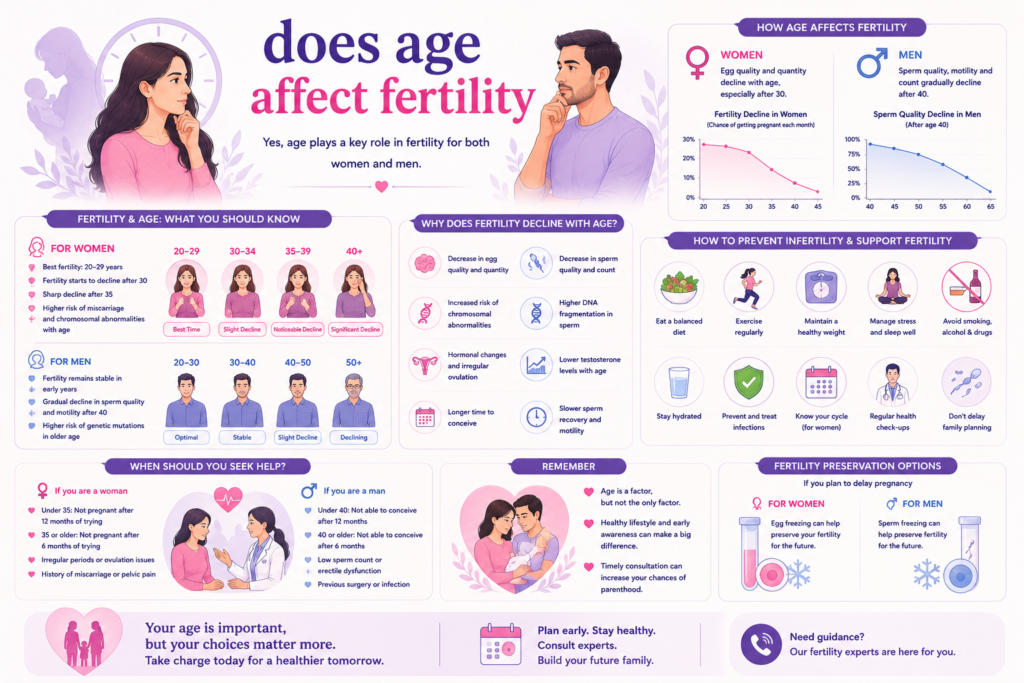
Age is the single strongest predictor of IVF success. Using her own eggs, a woman’s live-birth rate per IVF cycle falls from roughly 40–45% under 35, to about 30% at 35–37, about 20% at 38–40, under 10% at 41–42, and under 5% past 42. The reason is not that older embryos implant less well — research shows a chromosomally normal embryo has a similar chance of success at any age. It’s that with age, fewer eggs are retrieved and a higher proportion of embryos are chromosomally abnormal — so a normal embryo is simply harder to find. That’s why strategy (more eggs, genetic testing where appropriate, multiple cycles) matters — and why starting sooner matters most of all.
📋 What This Guide Covers
- Why does age affect fertility at all?
- What are IVF success rates by age?
- Which “success rate” are you actually being shown?
- What is the age curve really measuring?
- Egg quantity vs egg quality — what’s the difference?
- Does a good AMH mean age doesn’t matter?
- Do your chances improve over multiple cycles?
- Does the man’s age affect IVF too?
- What can you actually do about age?
- Is there an age that’s too late for IVF?
- A note from Dr. Shradha, Patna
- FAQs
Why Does Age Affect Fertility at All?
Here is the biology, as simply as I can put it. A woman is born with every egg she will ever have — around one to two million of them — and she never makes a single new one. From that moment, the supply only falls. By puberty there are a few hundred thousand; by the late thirties, far fewer.
But quantity is only half the story, and it’s the less important half. Your eggs age with you. An egg released at 40 has been sitting in your ovary for forty years, and over that time the delicate machinery that divides its chromosomes correctly becomes less reliable. When that machinery slips, the egg — and any embryo made from it — ends up with the wrong number of chromosomes. We call this aneuploidy, and it is the central fact of age and fertility.
An aneuploid embryo usually does one of two things: it fails to implant, or it implants and then miscarries early. This is why women in their forties can ovulate perfectly regularly, have normal cycles, feel entirely healthy — and still struggle to conceive. Nothing is “wrong” with them. The eggs are simply older.
What Are IVF Success Rates by Age?
These figures come from large national registries (SART, HFEA, CDC) and reflect IVF using a woman’s own eggs. They are population averages across thousands of cycles — not a prediction about you:
| Age (at egg retrieval) | Approx. live birth rate per cycle | What’s happening |
|---|---|---|
| Under 35 | ~40–45% | Peak. Good egg numbers, most embryos chromosomally normal |
| 35–37 | ~30% | Gentle decline. Quality shifts before quantity does |
| 38–40 | ~20% | The decline accelerates — this is the steepest stretch |
| 41–42 | ~10% | Fewer eggs, majority of embryos abnormal |
| 43+ | Under 5% | Own-egg success is limited; donor eggs usually discussed |
I won’t soften those numbers, because you deserve accuracy, and because women who are told comfortable half-truths lose time they cannot get back. But please don’t stop reading here — the next two sections are the ones that actually matter.
Which “Success Rate” Are You Actually Being Shown?
Before you compare any two clinics, understand this, because it is where a great deal of misleading marketing lives. “Success rate” can mean at least three different things:
- Per embryo transfer — the most flattering. It ignores every cycle that never made it to transfer.
- Per egg retrieval — better. But still excludes cancelled cycles.
- Per cycle started — the honest one. It counts everybody who began treatment, including those whose cycle was cancelled or who never got a viable embryo.
The gap between these is not small — it’s the difference between a clinic advertising 55% and the same clinic’s real-world figure being closer to 40%. And the gap widens with age, because older women have more cancelled cycles, which the flattering measures quietly delete.
So when you ask any clinic — including mine — about success rates, ask this exact question: “What is your live birth rate per cycle started, for my age group?” A clinic that answers straight is one you can trust. (See also our page on the real IVF success rate.)
What Is the Age Curve Really Measuring?
Now, the part almost nobody tells you, and the reason I wanted to write this page properly.
Look again at that declining chart. The natural conclusion is: “My embryos are worse, and older embryos don’t implant.” That conclusion is wrong.
When researchers looked specifically at transfers of chromosomally normal (euploid) embryos — embryos tested and confirmed to have the right number of chromosomes — they found no significant difference in pregnancy rates across age groups. A 42-year-old transferring a normal embryo had a statistically comparable chance to a 32-year-old transferring a normal embryo.
Read that again, because it changes everything. A normal embryo is a normal embryo. Your uterus at 41 is not the problem. Your embryo’s ability to implant is not the problem.
So what is the chart measuring? It is measuring attrition — how hard it is to find a normal embryo. Two forces compound:
- The proportion of abnormal embryos rises. Roughly 30% of embryos are chromosomally abnormal at age 30. By 37, it’s around 40%. By 40, over 60%. By 43, it can be 80% or more.
- The number of eggs falls. A 30-year-old might produce 15 eggs in a cycle; a 42-year-old might produce 6.
Fewer eggs, and a smaller share of them are capable of making a normal embryo. That’s the whole story. Age doesn’t make your embryo weaker. It makes a good embryo harder to find.
Egg Quantity vs Egg Quality — What’s the Difference?
These get confused constantly, and the confusion causes real harm:
- Egg quantity (ovarian reserve) — how many eggs you have left. Measured by AMH and antral follicle count. It determines how many eggs we can collect in a cycle. (More in our guide on low ovarian reserve.)
- Egg quality — how likely those eggs are to make a chromosomally normal embryo. This is driven almost entirely by age, and no test measures it directly.
The hard truth: quality is what limits success, and quality follows age. A 42-year-old with a wonderful AMH still has 42-year-old eggs. She may collect plenty of them, but the proportion that are chromosomally normal is set by her age, not her AMH.
That said, quantity is nothing, and lifestyle is nothing. There are real, evidence-informed things worth doing.
Does a Good AMH Mean Age Doesn’t Matter?
No — and this is one of the most common and most costly misunderstandings I encounter in the clinic.
AMH measures egg quantity, not egg quality. A reassuring AMH at 39 tells us we’ll probably collect a decent number of eggs. It tells us nothing about how many of them will make a chromosomally normal embryo — and that is what determines whether you take home a baby.
I have watched women delay treatment for two years because a good AMH made them feel they had time. They did not. Age remains the strongest predictor of IVF success, and no blood test can override it. Equally — and this cuts the other way — a low AMH at 32 is not a catastrophe: fewer eggs, but young, good-quality ones.
Do Your Chances Improve Over Multiple IVF Cycles?
Yes — substantially. And this is the honest counterweight to everything above.
Those per-cycle numbers are for one cycle. Success accumulates. A 38-year-old with roughly a 25% chance in her first cycle can reach a cumulative chance of over 60% across three cycles. For women under 35, cumulative live-birth rates can reach 79–85% over six cycles.
This is why one failed cycle is not an answer — it’s information. And a first cycle teaches us an enormous amount about how your body responds, which we use to make the second one smarter. (See first IVF failed — how to succeed in the second.)
The practical consequence: if you’re going to do IVF, it’s far better to plan for a journey of two or three cycles than to stake everything emotionally and financially on one, and better still to start that journey a year earlier rather than a year later.
Does the Man’s Age Affect IVF Too?
It does, though less dramatically than the woman’s, and it is almost always ignored.
Sperm quality declines with age too: motility falls, DNA fragmentation rises, and the rate of chromosomal abnormalities in sperm increases. The effect on IVF outcomes is real but considerably smaller than the effect of egg age, and techniques like ICSI mitigate many male-factor problems.
But please note what this does not mean. It does not mean the man can be left out of the assessment. Male factors contribute to a large share of infertility overall, and a semen analysis should be part of the very first workup — not something we get around to after two years.
What Can You Actually Do About Age?
You cannot make your eggs younger. Anyone promising otherwise is selling something. But there is a great deal within your control, and it follows directly from understanding the mechanism:
- Start sooner. This is by far the most powerful lever, and the only irreversible one. Starting at 36 rather than 38 changes your odds more than any protocol, lab, or add-on. I would rather you come to me a year early than a year late.
- Maximise eggs per cycle. Since you’re searching for a normal embryo, more eggs means more chances of finding one. Protocol matters here.
- Consider embryo genetic testing (PGT-A) where appropriate — particularly from the late thirties onward. It doesn’t make embryos normal; it helps us identify the normal ones, so we transfer the embryo most likely to work rather than discovering the problem through a miscarriage.
- Plan for more than one cycle. Cumulative success is real. Budget and prepare emotionally for a journey.
- Optimise what’s optimisable — weight, smoking, alcohol, sleep, thyroid, and other health factors. It won’t reverse egg age, but it removes every avoidable obstacle. lifestyle mistakes that damage fertility)
- Consider egg freezing if you’re not ready to conceive now. Eggs frozen at 32 remain 32-year-old eggs, whatever your age when you use them.
Is There an Age That’s Too Late for IVF?
There is no single cut-off, and I’m wary of anyone who states one flatly. What is true is that own-egg IVF becomes very difficult past about 43, because the chance of producing a chromosomally normal embryo becomes small. At that point, an honest doctor will raise the donor-egg conversation — not as giving up, but because with donor eggs, success is driven by the donor’s age, and rates stay high regardless of the recipient’s age.
That is a significant and deeply personal decision, and nobody should be rushed into it. What I will say is this: the woman who has that conversation at 41 has far more options than the woman who has it at 45. Which brings me back to the only advice that really matters on this page — don’t wait for certainty. Come and find out where you actually stand.
(If you’re at a specific decision point, our guides on I’m 35 — is IVF the only option now? and IVF at 40 — is motherhood still possible? go deeper into each.)
A Note from Dr. Shradha, Patna
At Shradha IVF & Maternity, age-related fertility is assessed honestly and completely by Dr. Shradha Chakhaiyar, MRCOG (London). You can also estimate your odds with our IVF success rate calculator. The first consultation is free.
FAQs Related to IVF Success by Age
Age is the strongest predictor of IVF success. As a woman ages, she has fewer eggs, and a higher proportion of her embryos are chromosomally abnormal — so a viable embryo becomes harder to find. Live birth rates fall from around 40–45% under 35 to under 5% past 42 using her own eggs.
Using her own eggs, approximate live birth rates per cycle are: under 35, around 40–45%; ages 35–37, around 30%; ages 38–40, around 20%; ages 41–42, around 10%; and age 43 and over, under 5%. These are registry averages, not individual predictions.
There's no fixed cut-off, but IVF with your own eggs becomes very difficult past about 43, because the chance of producing a chromosomally normal embryo becomes small. At that stage donor eggs are usually discussed, since success then depends on the donor's age rather than the recipient's.
Age: The Only Thing You Can’t Get Back Is Time.
One honest consultation will tell you where you actually stand — your ovarian reserve, your partner’s report, your real options. You may be in a better position than you fear. And if time is short, knowing today is worth far more than knowing in two years. The first consultation is free.