


Reviewed by Dr. Shradha Chakhaiyar, MBBS, MRCOG (London), IVF Specialist
📋 In This Guide
- Fertility Awareness Is Part of Women’s Health
- Age, Biology & the Natural Fertility Timeline
- How Modern Lifestyle Quietly Affects Fertility
- The First 90 Days That Can Shift Your Outlook
- Understanding IVF — Not Something to Fear
- When to Talk to a Fertility Specialist
- Frequently Asked Questions
- Key Takeaways & Next Steps
Many women reach a moment in their journey when they quietly begin to think: “Maybe nothing can help us anymore.” This thought often follows months or years of trying to conceive — through repeated disappointment, social pressure, and the fear of not knowing what is happening inside their own body. The truth is often very different from this fear.
Infertility is not a personal failure. It is not a reflection of a woman’s worth. It is not something to hide. It is a medical condition, and like many other conditions in medicine, it can be understood, evaluated, and managed. This guide is for every woman — and every couple — who has ever felt unsure of what comes next.
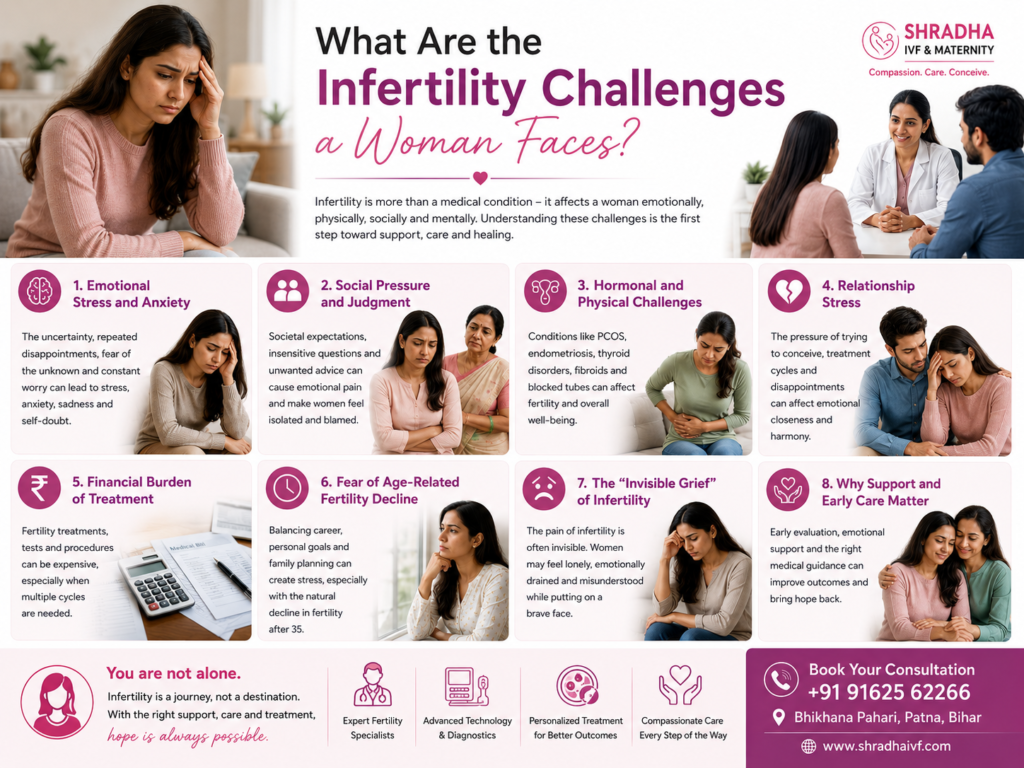
What Are the Infertility Challenges a Woman Faces?
Infertility is not only a medical condition — for many women, it becomes an emotional, physical, social, and psychological journey. While every experience is different, women facing infertility often deal with challenges that affect multiple parts of their lives, sometimes silently.
Emotional Stress and Anxiety
One of the biggest challenges is the emotional pressure that comes with trying to conceive. Repeated negative pregnancy tests, failed treatments, miscarriages, or delayed pregnancy can lead to stress, anxiety, sadness, and self-doubt. Many women silently carry the fear of “why is this happening to me?”
Social Pressure and Judgment
In many families and communities, women are often unfairly blamed for infertility, even when the issue may involve male infertility or combined factors. Questions like “When are you planning a baby?” or constant advice from others can become emotionally exhausting and isolating.
Hormonal and Physical Challenges
Conditions like PCOS, endometriosis, thyroid disorders, fibroids, blocked fallopian tubes, or low ovarian reserve can affect fertility and also cause painful periods, irregular cycles, fatigue, weight changes, and hormonal imbalance. Fertility treatments themselves may also feel physically demanding at times.
Relationship Stress
Infertility can create emotional strain between couples. The pressure of timed intercourse, repeated treatments, financial stress, and disappointment may affect communication and intimacy if emotional support is lacking.
Financial Burden of Treatment
For many couples, fertility treatments like IVF, IUI, fertility testing, or surgeries can become financially stressful, especially when multiple cycles are needed. Delayed diagnosis often increases both emotional and financial burden.
Fear of Age-Related Fertility Decline
Many women today balance careers, marriage, health, and family planning together. As fertility naturally declines with age, especially after 35, women may feel additional pressure regarding timelines and reproductive choices.
The “Invisible Grief” of Infertility
Unlike many visible medical conditions, infertility often remains hidden. Women may appear outwardly normal while struggling emotionally. This invisible grief can lead to loneliness, emotional burnout, and feelings of being misunderstood.
Why Support and Early Care Matter
The right medical guidance, emotional support, and early fertility evaluation can make a significant difference. Women facing infertility deserve compassion, accurate information, and access to supportive fertility care without blame or stigma.
Key Infertility Advocacy Points on International Women’s Day (2026)
Raising Awareness and Breaking the Silence
International Women’s Day is not only about celebrating women’s achievements but also about creating awareness around women’s health challenges, including infertility. Many women silently struggle with fertility issues due to fear, social pressure, or lack of support. This day encourages open conversations, emotional support, and a stigma-free environment where couples feel comfortable seeking fertility guidance and treatment.
Empowering Women Through Fertility Education
Knowledge plays a powerful role in reproductive health. Women’s Day highlights the importance of understanding menstrual health, ovulation, age-related fertility changes, PCOS, endometriosis, thyroid disorders, and fertility preservation. Empowering women with accurate fertility information helps them make informed decisions about pregnancy planning and timely medical care.
Improving Access to Fertility Care
Access to fertility diagnosis and treatment remains a challenge for many families. Long waiting periods, lack of awareness, and financial concerns often delay treatment. Advocacy efforts on Women’s Day emphasize the need for better access to fertility specialists, IVF treatment, diagnostic testing, emotional counseling, and affordable reproductive healthcare for women across all communities.
Recognizing the Emotional Impact of Infertility
Infertility often carries emotional stress, anxiety, and what many describe as “invisible grief.” Women facing repeated treatment failures, delayed pregnancy, or childlessness may feel isolated despite appearing emotionally strong. International Women’s Day acknowledges the emotional resilience of these women and reminds society to offer empathy, understanding, and support rather than judgment.
Encouraging Early Fertility Evaluation
One important message shared during Women’s Day awareness campaigns is the value of early fertility assessment. Timely diagnosis of conditions like PCOS, low ovarian reserve, blocked tubes, or male infertility can improve pregnancy outcomes and provide couples with more treatment options before fertility declines further.
Supporting Every Fertility Journey
Every woman’s reproductive journey is different. Whether someone is trying naturally, considering fertility treatment, preserving fertility, or coping with infertility emotionally, Women’s Day encourages respect, support, and access to compassionate healthcare without stigma or pressure.
1. Fertility Awareness Is Part of Women’s Health
Just as every woman deserves to know about her thyroid, her blood sugar, or her blood pressure, understanding her fertility is a fundamental part of health awareness — not a niche topic for couples in trouble.
Fertility is often treated as a mysterious or embarrassing subject. Misinformation spreads through WhatsApp forwards, social conversations, and old wisdom. But medically, fertility is simply a biological function of the human body — one that follows clear rules, can be measured, and often responds to careful intervention.
When to consider a medical evaluation
Fertility specialists internationally use these widely accepted timelines:
- A couple under 35 trying for 12 months without success should consider an evaluation
- A couple where the woman is 35 or older should seek evaluation after 6 months of trying
- At any age, couples should not wait if there is a known issue — irregular periods, history of pelvic infection or surgery, very low or absent menstrual flow, known PCOS, or known male-factor concerns
Common biological factors in female infertility include hormonal imbalance (such as thyroid or prolactin disorders), Polycystic Ovary Syndrome (PCOS), reduced egg number or quality, blocked fallopian tubes, endometriosis and adhesions, structural issues of the uterus, and age-related fertility decline.
Why “blame the woman” is medically wrong
Many women in Bihar quietly carry the weight of infertility alone — even when the medical reality is shared. Male factors contribute to nearly 40–50% of infertility cases, according to the American Society for Reproductive Medicine. Fertility is a function of two bodies, not one, and meaningful evaluation always begins with both partners — not just the woman.
2. Age, Biology, and the Natural Fertility Timeline
Of all the factors that influence fertility, age is the single most important — and also the most quietly avoided in conversation. The goal here is never to create pressure. The goal is to give women the information they deserve to make decisions that reflect their own life.
Every woman is born with all the eggs she will ever have. Over the years, both the number and the quality of these eggs gradually decline. The decline is slow in the early twenties, more noticeable after thirty, and meaningful after thirty-five. By forty, the rate of decline accelerates.
This does not mean pregnancy after thirty-five is impossible. Many women conceive naturally and through IVF in their thirties and beyond. But understanding the biology helps women plan with clarity rather than later regret.
Where modern life enters the picture
Today, more women are choosing — rightly — to invest in higher education and career growth, financial stability, personal goals and self-discovery, and the right partner at the right time. These priorities deserve respect. The challenge is that biology has not changed at the same pace as women’s lives have. Fertility planning is one way to honour both.
Egg freezing: an option worth knowing about
For women who anticipate delaying pregnancy — for career, partnership, or personal reasons — egg freezing (oocyte cryopreservation) allows healthy eggs to be preserved at a younger age and used later when ready. It is not necessary for everyone, but for some women, it provides reassurance and flexibility that no amount of advice ever could. If you would like to understand whether egg freezing is appropriate for your situation, book a confidential consultation with Dr. Shradha.
How Modern Lifestyle Quietly Affects Fertility
In today’s fast-paced world, women are more educated, more ambitious, and more active than ever before. These changes have brought tremendous opportunity. At the same time, certain aspects of modern life can quietly affect reproductive health — often in ways that go unnoticed for years.
Chronic stress and disturbed sleep
Continuous stress, irregular sleep, and long working hours can disturb the body’s hormonal regulation. Stress hormones such as cortisol may interfere with the brain-hormone signals that regulate ovulation. This can result in irregular cycles, delayed ovulation, or hormonal imbalance.
Weight, insulin resistance, and PCOS
Sedentary work, processed foods, and reduced physical activity contribute to weight imbalance and insulin resistance — both strongly associated with PCOS. The important thing to understand: PCOS does not mean pregnancy is impossible. With proper treatment and lifestyle changes, fertility often improves significantly.
Conditions that hide in plain sight
Several health conditions affect fertility but remain unnoticed for years — thyroid imbalance, vitamin D deficiency, anaemia, and vitamin B12 deficiency. Each is correctable. A simple blood panel often reveals what years of trying could not explain.
Male-side lifestyle matters too
Stress, heat exposure, smoking, alcohol, obesity, and environmental toxins all affect sperm count, motility, and quality. When sperm quality is the issue, options like ICSI treatment make conception possible even with very low sperm parameters. The challenge in many cases is not that couples choose to conceive later. It is that the underlying cause was discovered too late.
4. The First 90 Days That Can Change Your Fertility Outlook
When couples begin planning a pregnancy, the first three months matter more than most realise. Egg development, sperm quality, and hormonal balance all respond to consistent change over a window of approximately 90 days. There is no single pill or quick answer. But the body is remarkably responsive when given the right support.
Sleep — the simplest and most underrated change. Around 7–8 hours of consistent sleep supports the hormonal regulation that underlies ovulation, egg quality, and sperm quality. This single change shifts more than most supplements ever will.
Healthy weight, in either direction. Both excessive weight and very low weight can disturb ovulation. The goal is not a number on a scale — it is metabolic balance.
Movement that suits your body. Moderate exercise — walking, yoga, swimming, light strength training — improves insulin sensitivity, hormonal balance, and stress management. Excessive intense exercise, however, can suppress ovulation; balance matters.
Stop smoking, limit alcohol. Both eggs and sperm are sensitive to toxins. Avoiding tobacco entirely and limiting alcohol significantly improves reproductive outcomes — for both partners.
Track ovulation correctly. Understanding your menstrual cycle and identifying the fertile window is one of the most underused tools in natural conception. Many couples have been “trying for years” without ever timing intercourse to ovulation. A few cycles of accurate tracking can change the outcome.
Don’t delay basic medical tests. A thyroid panel, vitamin D and B12 levels, AMH for ovarian reserve, and a [INTERNAL LINK: semen analysis] for the male partner — together, these are quick, affordable, and often illuminating. If something is wrong, you would rather know in 90 days than in 5 years.
Avoid self-medication. Over-the-counter fertility supplements, hormonal medications without prescription, or “ayurvedic conception kits” advertised online can do real damage. Every couple’s situation is different. Treatment, when needed, must follow proper evaluation.
5. Understanding IVF — A Medical Process, Not Something to Fear
One of the most common misconceptions about infertility treatment is the fear that surrounds IVF (In Vitro Fertilisation). Many believe IVF is unbearably painful, extremely complicated, or only chosen as a last resort. None of these is fully true. In reality, IVF is a carefully controlled medical process designed to assist the body’s natural reproductive function — performed daily, around the world, for over four decades.
What an IVF cycle actually looks like
The process unfolds in clearly defined stages. First, the couple is evaluated through consultation and tests to understand the specific cause of infertility and design a personalised plan. Next, the woman receives medications over 8–12 days to gently stimulate the ovaries to produce mature eggs, with ultrasound monitoring throughout to ensure safety.
The eggs are then collected through a short procedure under light sedation — no surgical incision is required, and most women return home within a few hours. In the embryology laboratory, the eggs and sperm are combined to create embryos in a controlled environment. After three to five days of growth, a healthy embryo is placed gently into the uterus through a thin catheter — a painless procedure called embryo transfer. A pregnancy blood test is performed two weeks later.
When IVF may be the right first step
IVF is sometimes the most appropriate first option — not a last resort — particularly when:
- Both fallopian tubes are blocked or damaged
- Ovarian reserve is significantly reduced
- Severe male-factor infertility is present
- Endometriosis has not responded to other treatments
- The woman is 38 or older with limited time for sequential treatments
In these situations, attempting IUI or natural conception first simply costs months or years that biology cannot afford. The right treatment is the one chosen at the right time, for the right medical reason — guided by a fertility specialist who explains options clearly and respects the couple’s emotional and financial reality.
If you are wondering whether IVF might be relevant to your situation, the cost of IVF treatment in Patna is more affordable than most assume, with EMI plans starting under ₹7,000 per month.
6. When to Talk to a Fertility Specialist
Many women wonder whether their situation “warrants” seeing a specialist. The honest answer: a fertility consultation is not a commitment to any treatment. It is simply a conversation with a doctor who can tell you what is happening — and what your options actually are.
You may want to consider speaking with a fertility specialist if:
- You have been trying to conceive for over 12 months (or 6 months if you are 35+)
- Your menstrual cycles are irregular, very light, very heavy, or absent
- You have known PCOS, endometriosis, or thyroid imbalance
- You have a history of pelvic surgery, infection, or appendicitis with complications
- You have had recurrent miscarriages
- Your partner has had any concern about sperm or fertility evaluation
- You are considering egg freezing before pursuing other life goals
FAQs Related to Women's Day and Infertility
Fertility begins a gradual decline in the late twenties, becomes more noticeable after age 30, and declines more meaningfully after 35. By age 40, the rate of decline is significant. This does not mean pregnancy after 35 is impossible — many women conceive naturally and through IVF in their late thirties — but the chances per month decrease, which is why earlier evaluation is recommended for women 35 and older.
Women are born with around 1–2 million eggs, but this number naturally declines with age. By puberty, the count drops to approximately 300,000–400,000 eggs. Research suggests that by the age of 30, nearly 90% of a woman’s original egg reserve has already declined. Fertility decreases more rapidly after 35 due to both reduced egg quantity and quality.
No. According to the American Society for Reproductive Medicine, male factors contribute to approximately 40–50% of infertility cases. Female factors contribute to a similar share, and around 10–20% of cases involve both partners or remain unexplained. Fertility evaluation always involves both partners — and assigning blame to either is medically incorrect.