


Medically Reviewed by Dr. Shradha Chakhaiyar, MBBS, DGO, MRCOG (London) — Fertility Specialist & Reproductive Surgeon, Shradha IVF & Maternity, Patna
20+ Years of Experience · www.shradhaivf.com
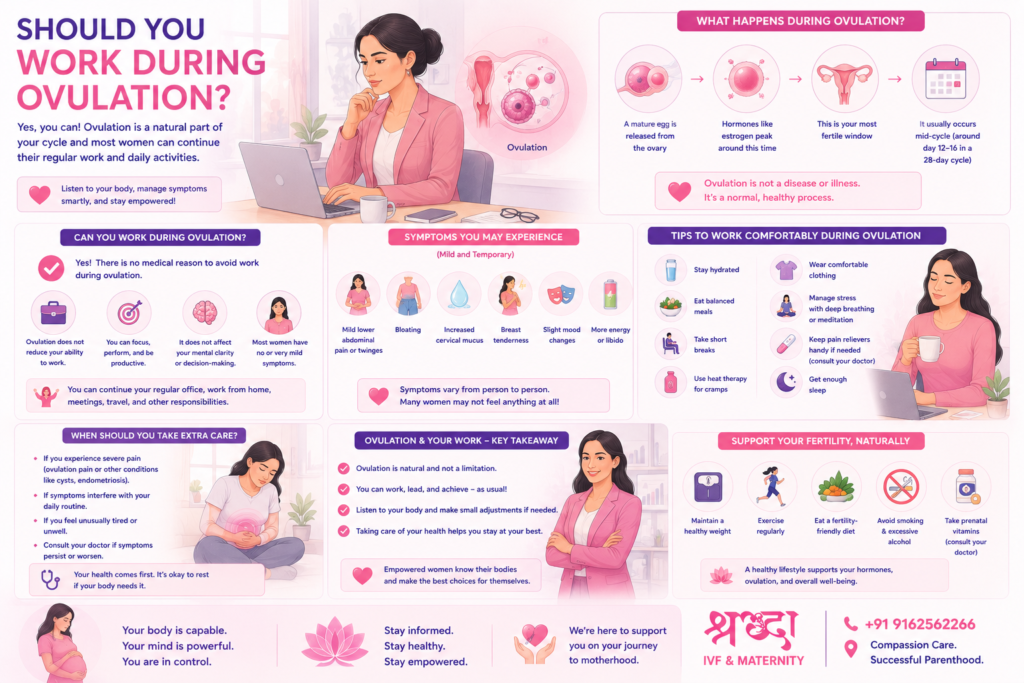
Yes, you can and should continue working during ovulation. Normal work — a job, housework, cooking, walking, moderate exercise — does not reduce your chance of conceiving, and moderate physical activity actually improves fertility and ovulation. The ovulation period is completely safe to stay active during, you do not need bed rest, and you do not need to lie down after intercourse — resting during ovulation is a pregnancy myth, not medical advice. The only genuine concern is excessive, intense exercise (the kind that drives body fat very low and disrupts ovulation). Both during ovulation and in the days after, staying active and living normally is the healthiest thing you can do while trying to conceive.
📋 What This Guide Covers
- The short answer: keep living your life
- Is the ovulation period safe or not?
- Where does the “must rest” belief come from?
- Why moderate activity actually helps
- Where is the line — fine vs too much?
- Does it change across your cycle?
- What to do after ovulation
- The lying-down-after-sex myth
- Resting during ovulation is a pregnancy myth
- Can your job or work stress stop you conceiving?
- If this month didn’t work — it wasn’t the work
- A note from Dr. Shradha, Patna
- FAQs
The Short Answer: Keep Living Your Life
If you take one thing from this article, take this: an ordinary day of work will not stop you from conceiving. Going to your job, doing the housework, cooking for your family, climbing the stairs, walking to the market — none of this harms your chances during ovulation or at any other point in your cycle. Your body is far more robust than the anxiety suggests.
I say this because I meet so many women who have quietly put their lives on hold — taken leave, stopped their exercise, refused to lift so much as a bag — in the sincere belief that stillness will help them conceive. It is a heavy way to live, and the science simply does not support it. So let me first explain where the belief comes from, and then show you what actually matters.
Is the Ovulation Period Safe or Not?
This question gets asked in two very different ways, and it’s worth separating them clearly, because the confusion causes real problems.
Is it safe to work and stay active during ovulation?
Yes — completely. The ovulation period is entirely safe for normal work, housework, walking, and moderate exercise. There is nothing fragile about ovulation that activity can damage. If anything, staying gently active during these days supports the hormonal balance and blood flow that help conception. So if you’re asking whether it’s safe to carry on with your ordinary life during your fertile days, the answer is an unqualified yes.
Is ovulation a “safe period” to avoid pregnancy?
This is the opposite meaning, and here the answer flips — so please read carefully, because getting it wrong leads to unplanned pregnancies. The “safe period” in traditional family planning refers to the days when you are least likely to conceive. The ovulation period is the exact opposite of a safe period — it is your most fertile, highest-risk time if you are trying to avoid pregnancy. Calling ovulation days “safe” is a dangerous mix-up. For a couple trying to conceive, of course, that makes the ovulation window the single best time to try. To know exactly when your fertile days fall, see our guides on the highest-chance days of your cycle and recognising your fertile window from your discharge and body signs.
Where Does the “You Must Rest” Belief Come From?
It’s a deeply rooted idea, especially here in our part of the country: that a woman trying for a baby should be careful, should not exert herself, should avoid heavy work, should rest. It usually comes from a place of love — a mother-in-law or aunt wanting to protect a hoped-for pregnancy — and it borrows its logic from the care we rightly take in a high-risk, already-established pregnancy.
But conceiving is not the same as protecting a fragile late pregnancy. In the trying-to-conceive stage, and in the early days after, a normally active life does not dislodge anything or prevent anything. The embryo, if it forms, is microscopically small and securely held; it is not going to be shaken loose by you sweeping the floor. The belief is well-meant, but it treats a healthy woman as if she were ill, and that isn’t kind to her or true to the biology.
Why Moderate Activity Actually Helps During Ovulation
Here is the part that surprises people: staying active is not merely “allowed” — it is genuinely good for your fertility. The evidence is consistent on this.
- Moderate activity improves ovulation and lowers the risk of infertility. Large reviews of the research find this repeatedly — and the benefit is greatest for women with PCOS, with a higher weight, or with insulin resistance, where movement helps rebalance the hormones that drive ovulation.
- It improves blood flow to the reproductive organs and helps maintain a healthy weight, both of which support conception.
- It reduces stress. Trying to conceive is emotionally exhausting, and gentle regular movement is one of the best natural ways to steady the mind.
- A completely sedentary life is not the “safe” choice. Being entirely inactive can work against reproductive health. Some movement is always better than none.
So the woman doing her normal daily work is very often doing her fertility a quiet favour. If you’d like the fuller picture on this, our guide on the role of diet and lifestyle in enhancing fertility goes into it in detail.
Where Is the Line — Fine vs Too Much?
There is a point at which physical activity can affect fertility — but it is much further out than most people fear. It’s not housework or a job; it’s the extreme end. Here is the honest boundary:
A normal job (desk or standing) · housework & cooking · walking · climbing stairs · carrying normal loads · moderate exercise · yoga · swimming · light jogging
Punishing daily endurance training · very intense workouts driving body fat very low · exercise so heavy that periods become irregular or stop · extreme physical strain far beyond normal daily life
The clue that exercise has tipped into “too much” is your own cycle: if very intense training is making your periods irregular or absent, that’s a sign it may be suppressing ovulation, and easing back is wise. But this describes elite athletes and extreme regimes — not a woman living an ordinary, active life. If your periods are regular and your activity is normal, you are nowhere near this line. (If your periods themselves are irregular, our guide on menstrual health is a good starting point.)
Does It Change Across Your Cycle?
A little, and it’s intuitive rather than restrictive. Around ovulation, oestrogen peaks and most women naturally feel energetic and strong — this is a fine time for normal activity and moderate exercise. In the days after ovulation (the luteal phase), progesterone rises and you may feel a bit more tired, so it’s reasonable to lean toward gentler activity if your body asks for it.
But please note the difference between “lean toward gentler” and “stop and lie down” — they are not the same thing. Easing off intense training in the second half of your cycle is sensible; ceasing all activity and resting in bed is unnecessary and, if anything, unhelpful. Listen to your energy, keep moving, and don’t manufacture restrictions your body isn’t asking for. For when to expect ovulation and how to recognise it, see our guides on the highest-chance days of your cycle and recognising your fertile window.
What to Do After Ovulation
Once ovulation has passed, you enter what’s called the luteal phase — the roughly two weeks between ovulation and your next expected period, often called the “two-week wait.” This is the stretch where anxiety peaks and where the “I must rest” instinct is strongest. Here is what actually helps, and it’s refreshingly simple:
- Carry on as normal. Keep working, keep moving, keep doing your housework. If an embryo is going to implant, it does so securely — your daily activity does not interfere with it. There is no evidence that resting after ovulation improves your chances of pregnancy.
- Lean toward gentler activity if your body asks. Progesterone rises after ovulation and some women feel a little more tired — so gentle exercise like walking or yoga is perfect. But “gentler” does not mean “stop.” Ease off intense training if you were doing it; don’t take to your bed.
- Keep taking folic acid. If you’re trying to conceive, folic acid should already be part of your routine — continue it through this phase and into any pregnancy.
- Eat well and manage stress. A balanced diet and a calm mind help far more than restriction does. Our guide on diet and lifestyle for fertility covers the useful basics.
- Don’t test too early. Testing before your period is due usually produces a false negative and needless heartbreak. Wait until the day your period is due, or just after, for a reliable result.
- Don’t over-analyse every twinge. Early pregnancy symptoms and normal pre-period symptoms overlap almost entirely, so the two-week wait cannot be “read” from how you feel. Try, as far as you can, to let the days pass without decoding them.
If your period arrives, it does not mean you did something wrong after ovulation — it simply means this wasn’t the month. And if you have been doing everything right for several months without success, that’s worth looking into rather than waiting indefinitely; our guide on ovulating but still not getting pregnant explains the common reasons why.
The Lying-Down-After-Sex Myth
This one deserves its own mention, because it’s behind so much of the “I must rest” anxiety. Many women are told to lie flat for twenty minutes, an hour, even to raise their hips, after intercourse — convinced that getting up will let the chance slip away.
It won’t. Sperm reach the cervical canal within minutes — well before you could get up and move — and the ones that are going to make the journey are already on their way regardless of your posture. Studies have not shown that lying down afterwards improves your odds of conceiving. So if you need to get up, get up. You are not spilling your chance of a baby by standing.
Resting During Ovulation Is a Pregnancy Myth
Let me put this one to bed directly, because it’s the belief that sends so many women searching in the first place: resting during ovulation to help you conceive is a myth. It is not medical advice, it has no basis in how conception actually works, and following it costs women their normal lives for no benefit at all.
The idea feels intuitive — if something precious is happening, surely you should be still and careful? But conception isn’t helped by stillness. An egg is released, sperm travel to meet it, and if fertilisation happens the tiny embryo travels to the uterus and implants — all of it internal, protected, and entirely unaffected by whether you spent the day in bed or at work. Rest changes none of it.
This “rest” myth travels in a family of related myths, and it’s worth seeing them side by side, because they all dissolve under the same simple truth — your ordinary activity does not control conception:
| The myth | The truth |
|---|---|
| You must rest during ovulation to conceive | Moderate activity actually helps fertility. Rest offers no benefit. |
| Lie down for an hour after intercourse | Sperm reach the cervix within minutes; posture makes no difference. |
| Avoid all housework when trying | Housework has no effect on conception or early pregnancy. |
| Any exercise reduces your chances | Only extreme, intense training that disrupts ovulation is a concern. |
| Working / a job causes infertility | A normal job does not; only severe chronic stress can affect cycles. |
| Lifting anything will “disturb” conception | Normal lifting is harmless; nothing is dislodged by daily activity. |
If you’re being handed advice like this by well-meaning relatives, it may help to gently share where the real evidence stands — and to read the wider list of genuine ovulation mistakes to avoid, which separates the things that actually matter from the folklore that doesn’t. The mistakes worth caring about are things like mistiming intercourse, not the myths above.
Can Your Job or Work Stress Stop You Conceiving?
This is a real fear for working women, and it deserves an honest, careful answer. A normal job does not cause infertility. Millions of women work demanding jobs and conceive without difficulty. Your career is not the reason you haven’t yet become pregnant.
The one honest caveat is stress — but let me be precise, because this is where guilt sneaks in. Severe, chronic, unrelenting stress can affect the hormones that control ovulation and can disturb the cycle in some women. Ordinary work pressure and everyday worry do not have this effect. And crucially: the stress of trying to conceive does not stop you conceiving — if it did, no anxious couple would ever have a baby, and they do, all the time. So manage stress because you deserve to feel well, not because you’re afraid your worry is sabotaging you. Our guides on staying calm through the fertility journey, on using meditation to support fertility, and — because it’s not only the woman’s stress that matters — on stress and male fertility may all help.
If This Month Didn’t Work — It Wasn’t the Work
I want to end with the sentence I most wish every woman searching this could hear, because it’s the one that lifts the heaviest weight.
If you did not conceive this month, or if you had an early loss, it was not because you worked, lifted something, went to your job, or didn’t rest enough. Conception depends on egg quality, sperm, timing, open tubes, a receptive uterus, and a great deal of biology entirely outside your control — and early losses are almost always due to chromosomal chance, not anything you did. The blame that so often lands on a woman — “she works too hard, that’s why” — is not medicine. It is folklore, and it is cruel, and it is false.
You did not fail by living your life. If conception isn’t happening after a reasonable time of trying — a year, or six months if you’re over 35 — the answer is not more rest; it’s a proper look at what’s actually going on. Our guide on ovulating but still not getting pregnant is a good next read, and the broader list of genuine ovulation mistakes to avoid covers the things that do matter. And if the family pressure around all this is weighing on you, you are not alone in that either — see the role of family and society in supporting a couple.
A Note from Dr. Shradha, Patna
If you’ve been trying for a while and want real answers rather than restrictions, Dr. Shradha Chakhaiyar, MRCOG (London) will look properly and explain clearly. You can book a consultation here — and our note on preparing for your first visit tells you what to bring.
FAQs on Work During Ovulation Period
Yes. Normal work — a job, housework, cooking, walking — does not reduce your chance of conceiving during ovulation. Moderate activity actually supports fertility and ovulation. There's no need to stop working or rest; only extreme, intense exertion that disrupts your cycle is a genuine concern.
Working in ovulation period is completely safe to work, move, and exercise moderately during ovulation. But if "safe period" means safe from pregnancy, ovulation is the opposite — it is your most fertile, highest-risk time to avoid pregnancy, and the best time to try if you want to conceive.
Carry on normally — work, move, and live as usual, leaning toward gentler activity only if you feel tired. Keep taking folic acid, eat well, manage stress, and avoid testing too early. There is no benefit to bed rest after ovulation, and activity does not affect implantation.
No. Resting during ovulation does not improve your chance of conceiving — it is a myth with no medical basis. Conception happens internally regardless of your activity, and moderate movement supports fertility better than rest. You do not need to lie down or avoid work to conceive.
Ordinary physical work does not harm conception — and moderate activity improves fertility by supporting ovulation, blood flow, and a healthy weight. Only extreme, punishing exertion that drives body fat very low and disrupts periods can affect ovulation. A normal working day is nowhere near that threshold.
Stop Resting. Start Finding Out.
You don’t need bed rest — you need answers. If conceiving is taking longer than it should, Dr. Shradha will look at what’s actually going on and give you a real plan, without guilt or folklore. The first consultation is free.