


Medically Reviewed by Dr. Shradha Chakhaiyar, MBBS, DGO, MRCOG (London) — Fertility Specialist & Reproductive Surgeon, Shradha IVF & Maternity, Patna
20+ Years of Experience · www.shradhaivf.com
“Low-lying implantation” means the pregnancy has implanted in the lower part of the uterus, closer to the cervix than usual, rather than near the top. In most cases this is not dangerous: studies of pregnancies with a low-implanted sac found that around 90% of those continuing into the third trimester resulted in a live birth, and the sac often appears to move upward as the uterus grows. The main associated risks are early bleeding and, later, a low-lying placenta. However, a small number of low sacs are actually implanted in a caesarean scar or in the cervix, which is serious — so the position should always be confirmed carefully on ultrasound before any procedure is performed.
📋 What This Guide Covers
- What is low-lying implantation?
- Where is an embryo supposed to implant?
- How to read your scan report
- Is low-lying implantation dangerous?
- The full picture — what “low” can mean
- The one question to ask your doctor
- Can a low-lying sac move up?
- What about bleeding?
- Does this mean I’ll have placenta praevia?
- What causes a pregnancy to implant low?
- If you had IVF: was the embryo placed too low?
- What happens next — monitoring and care
- A note from Dr. Shradha, Patna
- FAQs
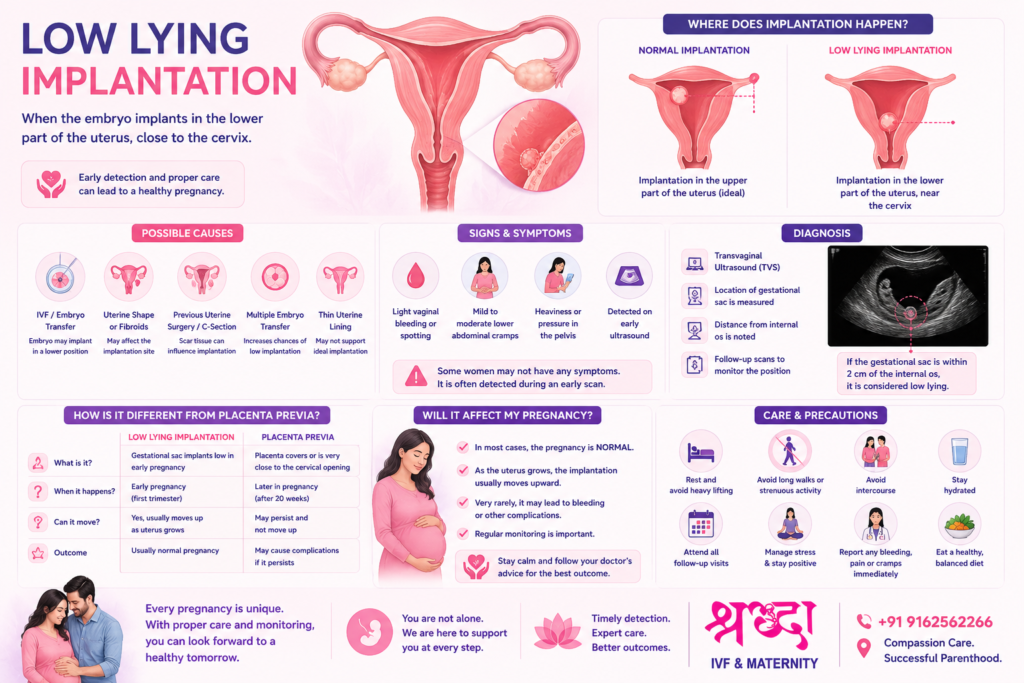
What Is Low-Lying Implantation?
When a pregnancy begins, the embryo attaches itself to the lining of the uterus. Usually it settles high up — near the top of the uterine cavity, most often on the upper back wall. Low-lying implantation simply means it has attached lower down, closer to the cervix, in what we call the lower uterine segment.
It is a description of position, not of health. The embryo itself may be entirely normal, developing exactly as it should, with a good heartbeat. What has changed is the postcode, not the pregnancy.
You may see this written on your report in several ways — “low-lying gestational sac,” “sac implanted in the lower segment,” “low intrauterine implantation,” or a measurement describing how far the sac sits from the internal os (the inner opening of the cervix). All of these are describing the same finding.
Where Is an Embryo Supposed to Implant?
The usual site is the upper portion of the uterus — the fundal region — and most commonly on the posterior, or back, wall. There is a good reason the body prefers this spot. The upper uterus has a rich blood supply, plenty of room to expand as the baby grows, and it is comfortably far from the cervix, which needs to stay closed and undisturbed for the next nine months.
When implantation happens lower down, none of those advantages disappear entirely — but the margins are smaller. The placenta may end up forming close to or over the cervical opening, and the area is more prone to bleeding in early pregnancy. That is the whole of the concern, and it is a manageable one. If you would like to understand the receiving side of this process better, our guide on why the uterine lining matters so much for implantation explains how the lining prepares itself each month.
How to Read Your Scan Report
Most of the fear around this finding comes from not understanding the words. So let me hand you the vocabulary, because a woman who can read her own report is a great deal calmer than one who cannot.
- Gestational sac — the fluid-filled structure containing the very early pregnancy. It becomes visible on ultrasound from around 4.5 to 5 weeks.
- Internal os — the inner opening of the cervix, where the cervical canal meets the uterine cavity. This is the landmark everything is measured from.
- Distance from the internal os — how far the sac sits above that opening, usually in centimetres or millimetres. This is the number that matters most. Research has found that early bleeding is most frequent when the sac lies within about half a centimetre of the internal os, and next most frequent between half a centimetre and one centimetre. The further above the os the sac sits, the more comfortable the picture.
- Lower uterine segment — the lower part of the uterine body, above the cervix. A sac here is low, but still inside the uterine cavity where it belongs.
- Fundus / fundal — the top of the uterus, the usual implantation site.
One thing worth saying plainly, because women worry about it: having a transvaginal scan does not cause a low pregnancy to miscarry, and it does not push the sac downward. Transvaginal ultrasound gives a far clearer picture of the lower uterus than an abdominal scan, which is exactly why it is used here. Our guide on whether ultrasound and TVS are safe during pregnancy addresses this in full.
Is Low-Lying Implantation Dangerous?
For most women, no — and I want to give you the actual evidence rather than a vague reassurance, because vague reassurance rarely calms anybody.
In a prospective two-centre study of 94 women whose scans before 11 weeks showed low implantation, among those whose pregnancies continued into the third trimester, live births occurred in roughly 90%. In a separate cohort of 100 first-time mothers with low-implanted gestational sacs, 74 continued to at least 28 weeks of pregnancy. The researchers in that study concluded that a low-implanted sac may raise the chance of bleeding and may influence where the placenta later develops — but without adding risk to the survival of mother or baby.
That is the honest headline. A low-lying sac is a reason for closer watching, and it is a reason to attend your follow-up scans without fail. It is not, in itself, a reason to assume you will lose this pregnancy.
There is a second half to the honest answer, though, and it is the reason this page is longer than a simple reassurance. “Low-lying” is a description of what the sonographer can see, not a diagnosis in itself — and a small number of low sacs turn out to be something that needs urgent, specialist attention. Let me set that out clearly, and then tell you exactly what to do about it.
The Full Picture — What “Low” Can Mean
Here is the range of things a low-lying sac can represent. I am showing you this not to frighten you — the first row is by far the most common — but because you are entitled to know what your doctor is ruling out when they look carefully and ask you back for another scan.
| What it may be | How common | What it means for you |
|---|---|---|
| Low implantation inside the uterine cavity | The large majority | Usually benign. Monitored with repeat scans; the sac commonly appears to rise as the uterus grows. |
| Cervico-isthmic implantation | Uncommon | Sits right at the junction of uterus and cervix. Needs careful assessment and closer follow-up. |
| Caesarean scar pregnancy | Uncommon, but increasing | Implanted in the scar from a previous C-section. Serious — needs prompt specialist management. |
| Cervical pregnancy | Rare | Implanted within the cervix itself. Serious — needs prompt specialist management. |
| A miscarriage already in progress | Not uncommon | A sac seen low may be one passing through the cervix rather than one implanted there. |
Distinguishing between these is a job for a careful ultrasound in experienced hands, and often more than one scan. It is genuinely straightforward for a doctor who is looking for the distinction — but only if they are looking. Which brings me to the most useful thing on this page.
The One Question to Ask Your Doctor
If you remember nothing else from this article, please remember this.
If you have been told you have a low-lying sac — and especially if any procedure is being suggested, such as a D&C for a suspected miscarriage — ask this:
Here is why that sentence matters. A pregnancy implanted in a caesarean scar or in the cervix sits in tissue with an unusual blood supply, and a procedure performed without recognising it can cause very heavy bleeding. The medical literature is unambiguous on this point: a low-lying sac should not be surgically managed until a cervical or scar pregnancy has been excluded. There are documented cases where the ultrasound appearance of a miscarriage in progress and a cervical pregnancy overlapped closely enough to be confused.
This is not a reason to distrust your doctor. Most will already be checking exactly this. But you are allowed to ask, it takes ten seconds, and no good clinician will mind the question in the slightest. If a previous caesarean is part of your history, mention it explicitly and early — it changes what needs to be ruled out, and it is the single most useful piece of information you can volunteer.
Can a Low-Lying Sac Move Up?
This is the question I am asked most often, and the answer is genuinely encouraging — with one honest caveat.
Yes, in many cases the sac comes to sit higher as pregnancy progresses. Strictly speaking the pregnancy does not detach and travel upward; what happens is that the uterus grows dramatically over the following weeks and months, and the lower segment stretches and lengthens. A sac that looked worryingly close to the cervix at six weeks can be comfortably clear of it by the mid-pregnancy scan. This is the same phenomenon that resolves the large majority of low-lying placentas found at the twenty-week scan.
The honest caveat is this: we confirm that it has happened rather than assume it will. The research also suggests that a sac still sitting low at or after six weeks has a somewhat less favourable outlook than one seen low very early on. That is precisely why your doctor will want you back for a repeat scan rather than simply telling you not to worry — not because something is wrong, but because watching is how we know.
What About Bleeding?
Bleeding is the symptom most associated with a low-lying sac in early pregnancy, and the closer the sac sits to the internal os, the more likely it is. Studies have found early bleeding to be most frequent when the sac lies within roughly half a centimetre of the internal os.
Light bleeding or spotting with a low sac is common and does not, on its own, mean the pregnancy is ending. Many women bleed and go on to have entirely healthy babies. That said, in this specific situation bleeding is always worth reporting rather than waiting out. Contact your doctor promptly if you have bleeding that is heavy or increasing, bleeding with significant pain or cramping, or the passage of clots or tissue.
If you are at a much earlier stage and trying to work out whether what you are seeing is implantation bleeding or the start of a period, that is a different question with its own answers — our guides on telling implantation bleeding from a period and on distinguishing implantation symptoms from PMS cover it properly.
Does This Mean I’ll Have Placenta Praevia?
Not necessarily — and this is where a good deal of unnecessary fear comes from, because women search “low implantation,” find pages about placenta praevia, and assume the diagnosis has already been made.
Here is the relationship. The placenta develops at the site where the pregnancy implanted. So if implantation was low, the placenta may also form low, and if it ends up lying over or very close to the cervical opening, that is placenta praevia. It is a real association, and it is the main reason a low-lying sac is worth following.
But a low sac at six weeks does not equal praevia at term. The uterus grows enormously across pregnancy, and the large majority of low-lying placentas identified at the mid-pregnancy scan have moved comfortably clear of the cervix by delivery. Even when a placenta does remain low, it is a managed situation — it means more monitoring, some restrictions later in pregnancy, and often a planned caesarean delivery, all of which are entirely routine parts of obstetric care.
The practical point: your twenty-week scan will look specifically at where the placenta has settled. That is the scan that actually answers this question. Everything before it is watching, not diagnosing.
What Causes a Pregnancy to Implant Low?
Often there is no identifiable reason at all, and I want to say that first, because women in this situation frequently ask what they did wrong. Nothing you did caused this. Not lifting something, not travelling, not intercourse, not stress, not the fact that you were anxious during the two-week wait. Implantation site is not something a woman can influence by behaviour.
That said, some factors are recognised as making low implantation more likely:
- Previous caesarean section or uterine surgery. Scarring changes the lining and can make the lower segment a more likely landing site — and it is also what makes caesarean scar pregnancy possible. Given how common caesarean delivery has become, this is increasingly relevant, and it is worth understanding the wider picture in our post on whether IVF babies are always born by C-section.
- Previous D&C or uterine instrumentation, which can leave areas of scarring or adhesion.
- Fibroids or structural features of the uterus that alter the shape of the cavity — our guides on fibroids and fertility and on what a bulky uterus means explain how these change the internal landscape.
- Previous uterine infection or inflammation affecting the lining.
- Multiple previous pregnancies, which is a recognised association.
- Sometimes, simply chance. This is the commonest explanation of all.
If the shape of your uterine cavity is in question — before a future pregnancy rather than during this one — a hysteroscopy allows us to look inside directly and correct things like adhesions or polyps.
If You Had IVF: Was the Embryo Placed Too Low?
This is the question my IVF patients ask, almost always with guilt or blame attached to it, and it deserves a proper answer — because the answer is reassuring and very few people ever explain it.
Short answer: almost certainly not, and implantation site is not something the transfer decides.
Here is how embryo transfer actually works. The embryo is deposited through a soft catheter, and in a well-run clinic this is done under ultrasound guidance at a target distance from the top of the uterine cavity. The research on this is reasonably consistent: placing the embryo very close to the fundus — within about a centimetre — is associated with lower pregnancy rates and more uterine contractions, and studies have generally favoured a placement somewhere in the region of one to two centimetres from the fundal surface, around the middle of the cavity. So yes, placement matters, and it is done carefully and deliberately.
But the embryo is not glued where it is placed. This is the part patients are never told. After transfer, the embryo floats freely within the fluid of the uterine cavity for several days before it attaches. It moves. The uterus itself has gentle waves of muscular activity that reposition it. Where an embryo finally implants is determined by that journey and by the receptivity of the lining it settles on — not by the exact millimetre at which the catheter released it.
So if your IVF pregnancy has implanted low, it is not because your doctor misplaced it, and it is certainly not because you got up too quickly afterwards or did not lie still for long enough. It is where this particular embryo chose to settle. Our guides on how to tell whether an embryo transfer has worked, on single embryo transfer, and on blastocyst transfer explain more about what happens in those first days, and our post on why a perfect-looking embryo can still fail covers how much of implantation is outside anybody’s control.
One genuinely useful point for the future: if you are planning a further cycle after a low implantation, this is worth discussing when your treatment is planned. A frozen transfer allows the lining to be prepared unhurriedly in a cycle of its own, which is one of several reasons frozen cycles have become so widely used. It is also the sort of detail worth raising when you review a cycle that did not go as hoped, and your preparation before transfer is one more piece of the same picture.
What Happens Next — Monitoring and Care
Here is what care for a low-lying sac normally looks like, so you know what to expect rather than waiting in the dark:
- A careful ultrasound to confirm the exact position — specifically, that the sac is within the uterine cavity and not in a caesarean scar or the cervix. Transvaginal scanning gives the clearest view.
- A repeat scan after an interval to check the pregnancy is developing normally and to see how the position looks as the uterus grows.
- Attention to any bleeding, with clear instructions on what to report and when.
- A careful look at the placental position at the mid-pregnancy scan, which is the point at which the praevia question is genuinely answered.
- Specialist referral without delay if the assessment suggests a scar or cervical implantation, since these need dedicated management.
What is not usually required is bed rest, and I mention it because so many women are told to lie down for weeks. There is no good evidence that bed rest changes the outcome of a low-lying implantation, and prolonged immobility carries its own risks. Live sensibly, avoid heavy lifting if your doctor advises it, and keep every appointment — that is the plan.
If you are coming for an appointment about this and want to make it as useful as possible, our guide on preparing for a consultation covers what to bring; for this particular situation, bring every scan report you have, including the earliest ones, and a note of any previous caesarean or uterine surgery.
A Note from Dr. Shradha, Patna
At Shradha IVF & Maternity, early pregnancy scans and low-lying implantation are assessed personally by Dr. Shradha Chakhaiyar, MRCOG (London), with the position confirmed carefully before any decision is made. If you have a scan report you are worried about, you can book an appointment here and bring it in.
FAQs Related to Low Lying Implantation
It means the pregnancy has implanted in the lower part of the uterus, closer to the cervix, rather than near the top where implantation usually occurs. It describes position, not health — the embryo itself may be developing entirely normally. It is monitored with repeat ultrasound scans.
Usually not. Studies of low-implanted sacs found around 90% of pregnancies reaching the third trimester resulted in live births. The main associations are early bleeding and a low placenta later. However, the position should always be confirmed to exclude a caesarean scar or cervical pregnancy.
It is associated with a somewhat higher chance of early bleeding, and some low-implanted pregnancies do miscarry — but the majority continue. In one cohort of 100 first-time mothers with low-implanted sacs, 74 continued to at least 28 weeks. A low sac is a reason for monitoring, not an expectation of loss.
Often, yes. The pregnancy does not travel, but the uterus grows and the lower segment stretches, so a sac that looked low early on frequently sits comfortably higher later. This should be confirmed with a repeat scan rather than assumed, particularly if it is still low at six weeks or beyond.
Not necessarily. The placenta forms where implantation occurred, so a low implantation can lead to a low placenta — but most low placentas identified at the mid-pregnancy scan move clear of the cervix as the uterus grows. The twenty-week scan is what genuinely answers this question.
Light bleeding is common, and more likely the closer the sac sits to the cervix — research found bleeding most frequent within about half a centimetre of the internal os. Many women bleed and go on to have healthy babies, but any bleeding in this situation should be reported promptly rather than watched at home.
Worried About a Scan Report? Bring It In.
Dr. Shradha will confirm exactly where the pregnancy has implanted, explain what the measurements actually mean, and set out a clear monitoring plan. Most of the time, the news is better than the internet suggests.
Book a Consultation → 💬 WhatsApp Us